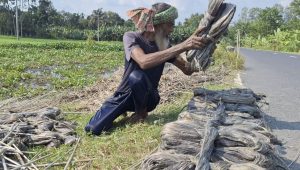



Discarded coconut husks, often considered nothing more than waste, have become an important source of income for hundreds of people in several villages in Nesarabad upazila of Pirojpur.
The husks are used to make brushes, doormats and various other household products.
Local artisans have kept the craft alive for nearly 70 years.
The products are sold to wholesalers before being distributed to different parts of the country.
Once discarded in courtyards or thrown into roadside bins, coconut husks are now being turned into brushes and doormats by local artisans.
Several families in Alkirhat and Sutiakathi villages of Nesarabad have been involved in making products from coconut husks for generations.

The discarded husks are collected from homes and different places and then soaked in water for nearly a month.
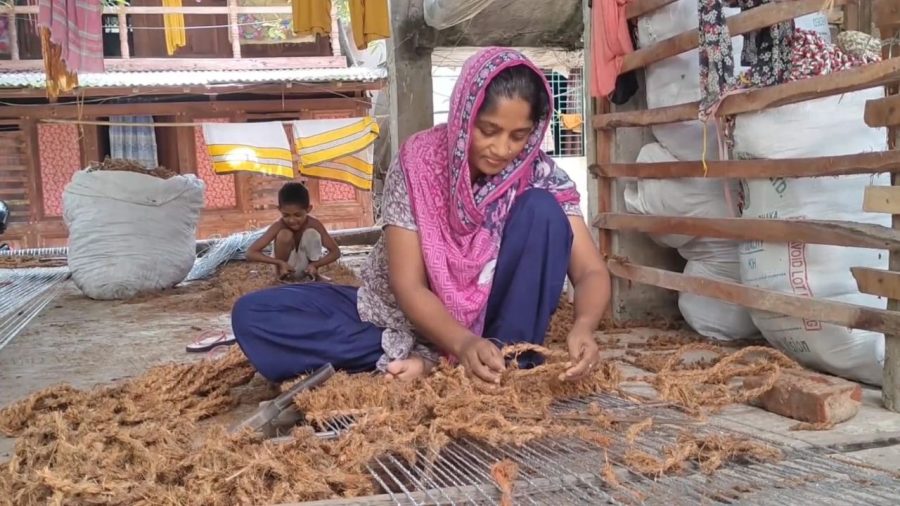
The soaked husks are processed to separate the fibers.
The fibers are then shaped by skilled artisans.
Doormats are made by threading small pieces of coconut husk onto thin strands of thread.



They are produced in different sizes according to demand.
Women in the villages make the doormats alongside their household chores, while men also contribute to the work.
The skills required for the craft have been passed down through generations within families.
In Alkirhat, the same coconut husks are also used to make different types of brushes for washing vehicles.
The fibers are cut to specific sizes, wrapped with thread and attached to handles with nails.
It takes nearly 10 steps to make a single brush.
The work is labour intensive, but it turns discarded coconut husks into useful products while reducing waste and creating local employment.
The brushes and doormats are sold in Dhaka and other districts for vehicle cleaning and household use.
It costs around Tk 40 to Tk 50 to make a brush, while it is sold in the market for Tk 100 to Tk 120.
The price of doormats starts at Tk 200 depending on their size, while larger ones are sold for Tk 600 to Tk 2,000.
However, artisans receive fixed wages, with a worker earning Tk 300 to Tk 500 for a full day’s work.
Jasmine Begum, a doormat maker from Alkirhat, said, “We do not receive fair payment for our work and can earn only Tk 150 to Tk 200 a day. There are also no easy-term loans for the industry, prompting people to gradually leave the profession.”
Milon Sheikh, a brush maker from Sutiakathi, said, “Each vehicle-washing brush passes through three to four hands, but we do not get a fair price. Demand is declining due to plastic products. Easy-term loans and government support are needed to sustain the industry.”
HM Faizur Rahman, Deputy Manager of the Bangladesh Small and Cottage Industries Corporation (BSCIC), said coconut husks are used to make vehicle-washing brushes and doormats.
He said BSCIC would provide support to those involved in the industry through advice and loans to help develop the sector.
The artisans said the coconut-husk-based industry could become a larger source of employment if market access is expanded and easy-term loans and modern marketing facilities are made available.