
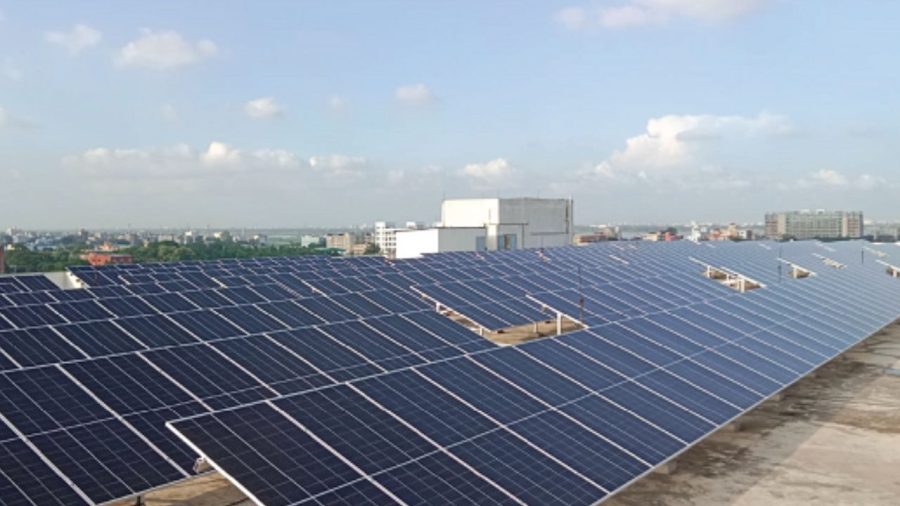

The recent gas crisis and growing interest in rooftop solar have raised an important question for Bangladesh’s ready-made garment (RMG) industry: can solar power help reduce factories’ dependence on gas?
The question has emerged as gas shortages disrupt production and manufacturers explore alternative energy options. But experts say rooftop solar power is not an immediate replacement for gas, but it can help reduce dependence on conventional energy sources.
While rooftop solar can meet a significant share of factories’ general electricity needs, larger renewable power solutions would be required for energy-intensive operations such as dyeing, washing and finishing.
The discussion has gained attention after some manufacturers started exploring solar-based solutions. Gajipur-based Four Z Apparels Limited has taken an initiative to install a 500-kilowatt solar power system from China after lower gas pressure reduced its production from 10,000 pieces to around 5,000 pieces in August.
Four Z Apparels Chairman Mohammad Rezaul Karim Zahid said the company feared around 20 per cent losses in business due to the gas crisis. Even after gas flow improved significantly from 14 September, the company plans to gradually convert gas-dependent generators and other equipment into electricity and solar-powered systems.
Centre for Policy Dialogue (CPD) Research Director Khondaker Golam Moazzem told TIMES of Bangladesh that garment factories in Bangladesh have the potential to generate around 1,768 megawatt-peak electricity through rooftop solar systems.
This could meet around 30 to 34 per cent of factories’ general electricity demand.

However, boilers, dyeing and washing operations currently depend mainly on gas. Converting these activities into electricity-based systems would require large amounts of energy, making rooftop solar alone insufficient for such operations.
Gas shortage disrupts garments
The gas shortage has disrupted production in the textile and garment sectors, particularly gas-dependent operations such as dyeing, washing and finishing.
Bangladesh Textile Mills Association (BTMA) data released in August showed that more than 900 of its over 1,800 member mills remained fully closed during periods of gas shortage.
BGMEA President Mahmud Hasan Khan told TIMES it would not be accurate to say garment factories completely shut down due to the gas shortage over the past two months.
He said lower gas availability disrupted production, increased costs and made timely delivery to buyers difficult, affecting Bangladesh’s image in the global market.




A survey of 134 member factories by Bangladesh Knitwear Manufacturers and Exporters Association (BKMEA) found that 87 per cent failed to ship products on time during 55 days of gas and power disruptions.
The survey showed that 60 per cent of factories had to provide discounts to buyers due to delays, while 55 per cent faced reduced export orders or cancellations.
Rooftop solar has limits
Bangladesh Textile University Textile Machinery Design and Maintenance Department Professor Sheikh Mohammad Mominul Alam told TIMES rooftop solar could support lighting and operations requiring less electricity.
However, he said heavy machinery with capacity of 40 to 45 kilowatts requires stable and uninterrupted electricity supply.
For such requirements, he said large-scale power generation facilities would be needed and referred to merchant power plants as an example.
Sustainable and Renewable Energy Development Authority (SREDA) Renewable Energy Development Department Director Mohammad Mujibur Rahman said reducing garment factories’ dependence on gas through solar power was technically possible.
He said electricity could be used to heat water and generate steam, which requires significant energy. If infrastructure is developed to generate sufficient solar energy, electric boilers could produce steam required for dyeing and washing.
However, existing gas-fired boilers cannot operate simply by connecting electricity. Factories would need electric boilers and suitable equipment, along with stronger electricity connections and internal infrastructure.
Merchant power offers bigger scope
Khondaker Golam Moazzem said merchant power plants could provide a larger renewable electricity source beyond the limited capacity of rooftop solar.
Under the system, 200 to 300 megawatt solar plants could be built in remote areas and supply contracted industrial users through the national grid. Reliable supply could support electric boilers, dyeing and washing operations, he said.
However, wheeling charges remain a major barrier. Moazzem said solar power becomes less affordable if combined charges reach around Tk3.25 per unit, while reducing the charge to Tk0.70–0.75 per unit could make industrial solar use more viable.
BGMEA President Mahmud Hasan Khan said the Ministry of Power and Energy was positive about merchant power purchase agreements and that at least eight to 10 meetings had been held on the issue. However, different charges imposed by Bangladesh Power Development Board (BPDB) and Rural Electrification Board (REB) have prevented implementation.
He said the wheeling charge, previously proposed at 34 poisha per unit, had increased to more than Tk2 per unit under different names, including open access charges. Effective merchant power agreements would allow industries to directly buy renewable electricity, reducing pressure on gas and subsidised power.
Experts said rooftop solar, electric boilers and merchant power plants would not immediately solve the gas shortage. However, reducing electricity dependence through solar, gradually converting equipment, ensuring reliable supply and lowering wheeling charges could help factories maintain production during shortages.
Sheikh Mohammad Mominul Alam told TIMES that solar power generation declines during cloudy and rainy weather. Therefore, factories using rooftop solar or merchant power would need grid connections or other reliable backup systems, requiring additional investment.
He said if around 4,000 garment factories used solar power only for lighting, it could save a significant amount of electricity from the national grid. Gas-dependent operations such as dyeing and washing could also shift to solar energy if appropriate technological and infrastructural arrangements were developed.
For long-term success, he stressed the importance of maintenance and spare parts availability, saying dependence on high-cost imports would increase overall expenses. He suggested initiatives to manufacture technical components locally.