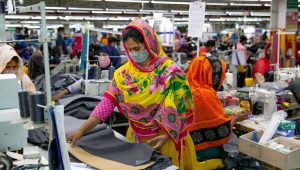
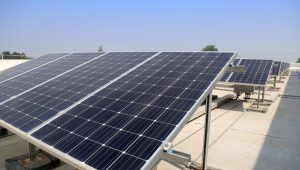
Bangladesh’s garment factories have the potential to generate 1,700MW to 1,768MW of rooftop solar power, requiring $188 million in investment, according to a study by the Centre for Policy Dialogue (CPD).
Presented at the fifth Bangladesh-China Renewable Energy Forum in Dhaka on Thursday, the study found that nearly 3,320 garment factories have around 9 million to 9.7 million square metres of rooftop space suitable for installing solar panels.
Titled “Industrial Rooftop Solar in RMG Sector and Investment Potentials for Chinese FDI,” the study analysed the potential of rooftop solar power in garment factories and opportunities for Chinese investment in the sector.
According to the study, the available rooftop space could create capacity to generate around 1,700MW to 1,768MW of solar power.
The study found that rooftop solar could meet around 40 per cent of electricity demand at large factories, 33 per cent at medium-sized factories and 38 per cent at small factories.

Researchers said around 500 factories are currently suitable for investment, while another 1,300 factories could become suitable for rooftop solar investment if they receive necessary financial support.
However, CPD warned that rooftop solar projects lose much of their investment viability if loan interest rates remain between 10 per cent and 12 per cent. It said a significant number of factories could become suitable for investment if green finance or low-interest loans are available.
The study said rooftop structures, financing, documentation, import and customs processes, foreign exchange risks and lack of coordination among different agencies are major barriers to adopting rooftop solar.



From investors’ perspective, many projects are abandoned midway due to inconsistencies related to project financing, the study said.
Speaking at the discussion, Ha-Meem Group Head of Power, Energy and Environmental Sustainability Tanul Chakraborty said the group’s 29.2MW rooftop solar system is already operational.
However, the rooftop solar system meets only 15 per cent of the group’s total electricity demand and around 6 per cent of its total energy demand, he said.
He said not only factory rooftops but also merchant power plants and battery storage systems should be considered for renewable energy expansion.
Director of the Centre for Energy Research at United International University Shahriar Ahmed Chowdhury proposed completely withdrawing import duties on renewable energy equipment.
“Reducing import duties to zero for three years could rapidly increase investment in this sector,” he said.
According to his estimate, 100MW of solar power can save around Tk150 crore worth of gas and around Tk300 crore worth of furnace oil annually.
Shahriar said using solar power and battery storage together could create an alternative to high-cost furnace oil-based electricity. He added that garment and textile factories could be brought under greater renewable energy coverage through merchant power plants alongside rooftop solar.
The seminar also stressed restoring confidence among Chinese investors and reducing administrative, technical, financial and legal barriers to investment.
At the end of the discussion, participants proposed creating a special ‘window’ until 2036 to speed up approval and implementation of renewable energy projects.