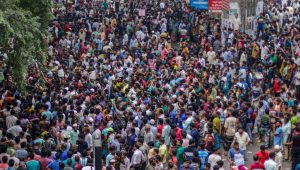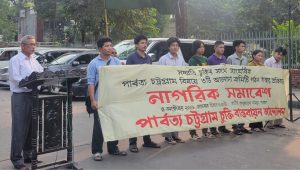




Violence in Bangladesh is increasingly appearing as a recurring social experience rather than isolated incidents. From mob attacks and religious tensions to domestic abuse, violence against women and children, and political clashes, a series of events across the country suggests deeper unrest simmering within society.
Several recent high-profile cases illustrate how violence now cuts across different layers of everyday life. A college student was raped inside a launch cabin travelling from Noakhali to Dhaka; a man was beaten to death on suspicion of theft in the Postogola area of the capital; an elderly man, allegedly a drug dealer, was killed beneath a building under construction in Lalbagh; a person died during a clash between two groups in Madaripur; and a Dhaka University student was assaulted at the BUET cafeteria after being labelled a Chhatra League activist.
In another disturbing case, a seven-year-old child was allegedly sexually assaulted and left for dead with her throat slit following a family dispute.
Last year in Mymensingh, Dipu Chandra Das was beaten to death and his body set on fire by a mob after accusations of making derogatory remarks about religion. Attacks on prominent media organisations, including The Daily Star and Prothom Alo, as well as mob violence and arson targeting cultural institutions such as Chhayanaut and Udichi, further highlighted the volatile environment. In a separate incident, Sharif Osman Hadi was shot, critically injured and later died in a hospital in Singapore.
A rising pattern in crime statistics
Official data also points to a sustained rise in criminal activity.
According to Bangladesh Police statistics, 172,005 criminal cases were filed nationwide in 2024. Among them, woman and child repression cases were the highest at 17,571, while murder cases stood at 3,432. Other recorded offences included 643 incidents of police assault and 125 riot-related incidents.
The number rose in 2025 to 181,737 cases. Woman and child repression cases increased to 21,939 and murders to 3,786. There were also 601 incidents of police assault and 66 riot-related cases.

The trend appears to be continuing into 2026. In just the first two months (January–February), 25,817 criminal cases were recorded, including 2,462 woman and child repression cases and 539 murders. There were also 84 police assault cases and two riot-related incidents.
Taken together, the figures indicate a steady rise in reported crime, highlighting a growing challenge for law enforcement and social stability.
Violence, therefore, is no longer confined to a single sphere. It stretches across family life, public spaces, political arenas and religious relations, raising a troubling question: why is society becoming increasingly violent?
Accumulated frustration and social pressures
Psychologists say the roots of the problem lie partly in accumulated social frustration shaped by long-term economic and institutional pressures.
Professor Md Kamal Uddin of the University of Dhaka’s Department of Psychology said anger, frustration and feelings of deprivation have built up over recent years and are increasingly expressed through violent behaviour.




He links this to structural pressures, particularly among young people whose education often fails to translate into employment. Experiences of exclusion within families and negative institutional environments deepen alienation, while weak accountability can normalise violence when offenders face few consequences. Social media, he added, accelerates the spread of misinformation and emotionally charged content, shaping attitudes more strongly than formal education. Pressures on law enforcement, including attacks on security personnel during recent political developments, may also reduce policing effectiveness.
Human rights data reinforce concerns
Human rights organisations present data suggesting violence is spreading across multiple sectors.
According to Ain o Salish Kendra (ASK), Bangladesh recorded 560 incidents of domestic violence and 230 rape cases last year, alongside 1,024 cases of violence against children.
Mob violence alone claimed 198 lives, while 401 incidents of political violence left 4,744 people injured and 102 dead. Attacks on religious minorities were reported in 46 incidents, and 381 cases of harassment against journalists were documented.
The new year has shown little improvement. In January 2026 alone, there were 35 incidents of child abuse and 14 deaths linked to mob violence. During the same month, 75 incidents of political violence left 616 people injured and 11 dead, while 14 attacks targeting religious minorities killed five people. Sixteen cases of harassment against journalists were also recorded.
Advocate Manzill Murshid, president of Human Rights and Peace for Bangladesh (HRPB), said prolonged political instability risks normalising violence in society.
According to him, recent political movements have increasingly taken violent forms, and those gaining influence through such actions are often socially portrayed as “heroes”. This has encouraged what he calls a “hero mentality”, where violence becomes a path to recognition and fuels mob behaviour.
Weakening socialisation and justice mechanisms
Criminologists also point to weakening socialisation and institutional limitations within the justice system.
Assistant Professor Rezaul Karim Shohag, chair of the Department of Criminology at the University of Dhaka, said delays and uncertainty in the justice system weaken deterrence. When public confidence declines, collective resistance to crime falls and repeat offending rises.
He also observes a shift in public behaviour. Communities that once intervened to protect victims now often remain passive or even support violent acts, while widely publicised incidents can trigger imitation.
A crisis of values and social relationships
From a gender and social perspective, Professor Tania Haque of the University of Dhaka’s Department of Women and Gender Studies views the rise in violence as part of a broader moral and relational crisis.
She argues that intense social competition and changing lifestyles have weakened value formation. Harmful behaviours spread quickly while empathy declines, and digital interactions increasingly replace deeper social relationships. This, she says, reduces people’s willingness to intervene against violence and allows intolerance to grow.
Addressing the problem, she emphasised, requires coordinated efforts from families, educational institutions and social platforms rather than relying solely on law enforcement.
Beyond law and order
Field-level observations from law enforcement echo similar concerns.
Masud Alam, deputy commissioner of the Ramna Division of the Dhaka Metropolitan Police, said prolonged political use of state institutions has weakened the structure of law enforcement bodies.
He believes a major political shock has also disrupted public respect for the rule of law. “The culture of breaking law that developed during movements is now being reflected at the field level,” he said, adding that people are expressing long-suppressed frustrations whenever they find the opportunity.
All in all, the rise in violence appears to reflect deeper psychological strain, weakened socialisation and eroding social bonds. When individuals feel disconnected from opportunity, community and justice, violence can gradually begin to appear normal.
Experts say reversing the trend will require rebuilding trust, strengthening social responsibility and restoring confidence in institutions alongside effective law enforcement.