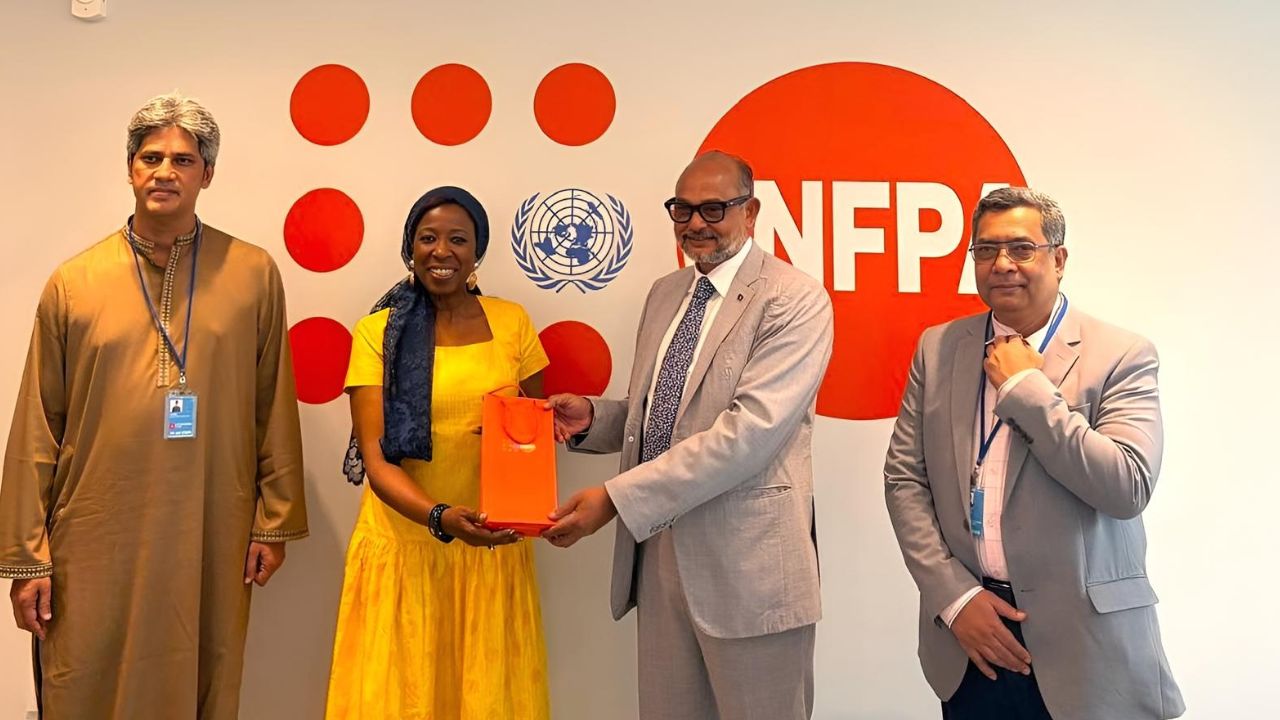

United Nations Population Fund (UNFPA) Executive Director Diene Keita has pledged to showcase Bangladesh’s development experiences on the international stage, praising the nation’s initiatives in building demographic resilience, women’s empowerment, universal healthcare, and inclusive social protection systems.
The commitment was made during a meeting at the UNFPA headquarters in New York with a high-level Bangladeshi delegation led by Economic and Planning Affairs Adviser Rashed Al Mahmud Titumir, and included State Minister for Planning Zonayed Abdur Rahim Saki, and Monjur Hossain, member of General Economics Division (GED).
During the discussions, Titumir highlighted the government’s priority programmes, noting that work is underway to establish a life-cycle-based universal social protection system centred on women.
He further emphasised the importance of Family Card programme, increased investment in education and health, youth skill development and employment, and ensuring healthy ageing.

Titumir also stressed the need for a reliable demographic data system and the establishment of robust primary healthcare.
Addressing the Rohingya crisis, he said Bangladesh continues to provide shelter to over 1.2 million Rohingya on humanitarian grounds, which has placed significant pressure on the country’s economy, environment, and security.




Titumir sought more active cooperation from UNFPA for the speedy repatriation of Rohingya to Myanmar, ensuring they can live in a safe and dignified environment with access to rights and sustainable livelihoods.
He also noted that Bangladesh’s large youth population presents a unique opportunity to reap a demographic dividend. Titumir underscored the importance of effectively utilizing the potential arising from increased longevity due to changes in the population’s age structure.
Saki noted that the government aims to build an integrated primary healthcare system to ensure easy access for all citizens, particularly mothers, children, and marginalised communities.
He called for closer cooperation to strengthen the national statistical system and to align UNFPA’s next country programme with the government’s Five-Year Strategic Framework.
He also urged UNFPA to highlight Bangladesh’s development experience as a model of global best practice.
In response, Keita reaffirmed UNFPA’s commitment to strengthening cooperation with Bangladesh in areas such as demographic resilience, reproductive health, youth development, healthy ageing, population data systems, and innovative financing.
She remarked that Bangladesh’s experience demonstrates how strong political leadership and national ownership can accelerate progress toward achieving the Sustainable Development Goals (SDGs).
Keita pledged UNFPA’s continued role in promoting Bangladesh’s development successes in the international arena.