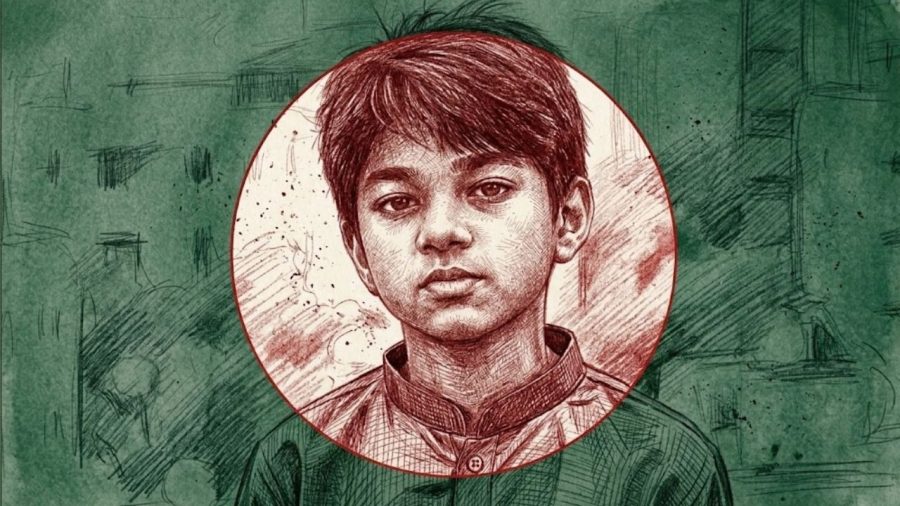

My son turned thirteen a few days ago. So when I saw the photo of thirteen-year-old Apratim on Saturday morning, I did not first see a news story. I saw a boy the same age as my own son, who might still walk back through the door at any moment.
At thirteen, a child is no longer very small, but not yet fully grown. Friends matter more, and independence begins to matter. As a father, my wish is simple. I want my son to grow, explore, build his own world, and come home safely. That was what I hoped for Apratim too.
At around 2am on Saturday, his mother, Nahida Nahid, wrote on Facebook: “I have not been able to find my son since 3pm.” She ended with a desperate plea: “I am begging you, please save my son.”
Thousands shared the post and prayed for him. We all wanted Apratim to come home.
But he never did.
The moment after I saw Apratim’s photo, his body was recovered from a secluded area of the Lalmai hills near Comilla University. He had serious injuries to his head, and the iPhone he had been carrying was missing.
Police are looking into robbery as a possible motive, and several people have been detained. CCTV footage believed to show some of the last images of Apratim alive has also been widely shared.

But why he was killed, who was involved, and what happened must be established through a proper investigation.
Photographs of his body also began circulating online. They are difficult to look at, yet people still look, perhaps to confirm the horror with their own eyes.
But if the sight of a bloodied child becomes just another image on our screens, something is deeply wrong with our collective sensitivity.
After hearing about Apratim’s death, I went to the MUN Alert page. I could not stay there for long. There were faces of missing children. But there were happier updates too: a child had been found, another had returned home. That is the ending we want.
According to data from Police Headquarters, 15,717 general diaries related to missing children were filed across Bangladesh between January and July 2026. Of them, 13,679 children were rescued or returned to their families.




Most were found, but 2,038, nearly 13 percent, remained missing. Behind each number is a family waiting.
A missing child does not always mean kidnapping or violent crime. Police data shows that many are between 10 and 17.
Teenagers may leave home after arguments, academic pressure, family conflict, online influence, or a desire for independence. Younger children may simply become separated from their families.
So the answer is not only more policing. Families need spaces where children can speak without fear. Schools need to teach digital safety. Parents need to listen and build trust.
This is where MUN Alert matters. Launched in January 2026, it was inspired by the case of five-year-old Muntaha Akter Zarin, whose body was found seven days after she went missing in 2024. Its purpose is simple: once a report is verified, information should spread quickly.
The 13219 hotline, a web portal, and social media platforms are part of the system.
But it needs to become part of a wider state response. Finding a child should not depend on whether a mother’s Facebook post goes viral or an algorithm puts it in the right feed. Emergency alerts should reach phones in the relevant area.
Photos should appear quickly at transport hubs. CCTV networks and real-time information sharing between police, DB, PBI, and CID should be part of the response.
Most importantly, the first report of a missing child must be treated with urgency. Nobody knows then whether the child is at a friend’s house, hiding after an argument, or in real danger.
The last known location, phone data, recent contacts, and possible risks should be checked immediately. When a child goes missing, every minute matters. That should become state policy.
We also need to examine our own behavior. While Apratim’s mother was searching for her son, she had to ask people not to call with unnecessary questions.
Calling a family out of curiosity, spreading unverified information, or sharing images of a dead child is not compassion.
We want the truth about Apratim’s death. If he was killed for an iPhone, that is horrifying. If there was another reason, that truth must also come out. Those responsible must face justice. But justice comes afterward.
Our greater responsibility is to ensure the next story does not end the same way.
We never wanted to know Apratim this way. We wanted one simple sentence under his smiling photograph: “He has been found. He is home.” That is the sentence we want beside every missing child.
We want our children to leave home and return safely, not as a “recovered body.”
The writer is a Filmmaker.