
For a nation carved from a river delta, water is not merely a resource; it is our identity, our economic pulse, and our most profound vulnerability. Water diplomacy, once a quiet, technical backwater of international relations, has surged to the forefront of our geopolitical reality. As we navigate the complexities of the 21st century, the traditional, rigid frameworks of water sharing are proving increasingly obsolete. For Bangladesh, the stakes have shifted. The question is no longer just about the volumetric sharing of the Ganges or the Teesta; it is about securing our national survival against the dual threats of climate change and a volatile regional landscape. It is time for Bangladesh to evolve from a passive downstream recipient into a proactive, strategic architect of a new, multi-dimensional water diplomacy.
The history of water diplomacy is littered with treaties that sought to tame nature and divide its bounty. From the Indus Waters Treaty of 1960 to our own Ganges Water Sharing Treaty of 1996, these agreements were born of a bygone era – a time of predictable hydrology and stable geopolitics. They were crafted bilaterally, focusing on single rivers and fixed quantities, effectively trying to divide a pie that is constantly shrinking and shifting. The 1996 Ganges Treaty was a landmark in its day, but as we look toward its renewal, we must acknowledge that it is no longer sufficient to address the contemporary crisis. The very concept of ‘sharing’ is being upended by the reality of a basin under siege.
The challenges we face today are deeply interconnected. Climate change is rendering historical data obsolete by intensifying the water cycle, bringing both more catastrophic flooding in the wet season and more acute, prolonged droughts in the dry season. The entire Ganges-Brahmaputra-Meghna (GBM) basin is under immense stress, where unpredictable flows make fixed, static sharing formulas a risky gamble for everyone involved.
Compounding this are the new ‘unknowns’. We are seeing the rise of non-traditional security threats – including the potential weaponisation of water. China’s significant infrastructure investments in the upper reaches and in neighbouring Nepal add another layer of complexity. While China’s role is significant, it must be engaged not as a wedge in bilateral relations, but as a partner in regional data sharing and infrastructure integration. The goal is to transform the GBM basin from a site of geopolitical friction into a shared economic zone.
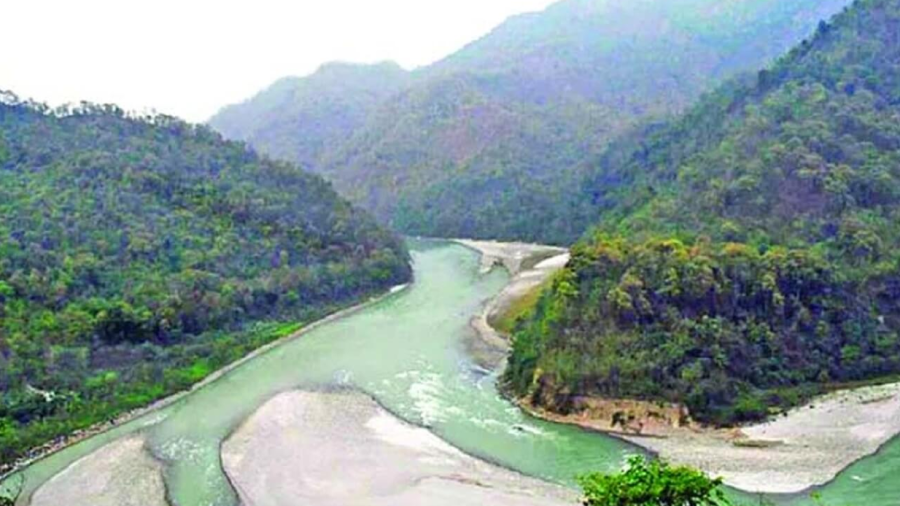
This is no longer just an environmental or technical issue; it is a fundamental pillar of our national security, economic stability, and social peace. Consider the Teesta: it supports roughly 14% of our arable land and the livelihoods of millions. Its erratic flow, driven by upstream diversion and climate change, is a primary engine of desertification in our northwest.
The human cost is even more stark in the south, where diminished freshwater flow drives salinity intrusion, poisoning the soil and destroying the livelihoods of smallholder farmers. This environmental degradation is a silent, relentless driver of internal migration, forcing thousands of climate refugees into the overcrowded slums of Dhaka every year. Furthermore, any serious diplomatic effort must incorporate a gender-equity lens. In our rural coastal regions, women are often the first to bear the brunt of water scarcity and salinity, frequently at the cost of their education and economic opportunity.

Our strategy must be as dynamic as the rivers themselves. We must move beyond a reactive posture to a proactive, basin-wide management framework – a vision that both India and Bangladesh have previously endorsed in principle.
The 2011 Framework Agreement on Cooperation for Development stands as a landmark, yet underutilised, foundation. It was never just a document about water; it was a strategic commitment to sub-regional cooperation. Crucially, Article 2 explicitly calls for “common basin management of common rivers.” It outlines a shared responsibility to preserve the ecosystem and address environmental challenges as a cross-border priority.
This agreement provides the political architecture to move beyond the cycle of bilateral grievances. The implementation gap is our primary challenge. We must build upon this foundation to move from political rhetoric to technical operationalisation. By framing our diplomatic efforts within the language of the 2011 Agreement – specifically its emphasis on the ‘common ecosystem’- we can hold our neighbours to their own commitments to collaborative stewardship.




A basin-wide approach is not a zero-sum game; it offers substantial benefits to all riparians. For India, cooperative management would enhance water and food security across the Ganges plain and its northeastern states. By jointly managing reservoirs in Bhutan and Nepal, India can optimise hydropower and mitigate the impacts of uncoordinated flood releases. For China, engaging in transparent data sharing on the Yarlung Tsangpo (Brahmaputra) can demonstrate a commitment to international norms and help integrate its regional investments into a more efficient, sustainable plan.
The new water diplomacy must also embrace a fundamental paradigm shift regarding the river itself. We must move toward recognising the river as a legal entity with inherent rights. This legal innovation is gaining global traction: in 2017, the Uttarakhand High Court declared the Ganges and Yamuna as ‘living human entities’; New Zealand’s 2017 settlement granted legal personhood to the Whanganui River; and in 2016, Colombia’s Constitutional Court recognised the Atrato River as a subject of rights. While some of these rulings have faced subsequent legal challenges, they represent a powerful, emerging global consensus that rivers are not merely property but living systems with a right to exist.
This concept of ‘river personhood’ should be paired with the technical requirement of ‘environmental flow’ – the quantity, timing, and quality of water required to sustain freshwater and estuarine ecosystems. It is insufficient to divide only the water available for human use; we must reserve a portion of the river’s flow for its own health. A ‘River Commission’ model, which includes not only government bureaucrats but also environmental scientists, representatives from local communities, and civil society, could manage these flows, ensuring that the river remains a living, breathing ecosystem rather than just a conduit for transport and irrigation.
To achieve this, Bangladesh must take the lead in shaping regional opinion:
Real-Time Data Transparency: The most immediate, non-negotiable diplomatic demand must be for open-access, real-time hydrological data. Bangladesh should propose a shared GIS-based dashboard – a common digital platform where all riparians can contribute and access data on river flows, rainfall, and reservoir levels.
Expert-Level Exchanges: Elevate the Joint Rivers Commission to a hub of scientific research. This requires investing in technical capacity, hosting joint hydrological studies, and creating a permanent secretariat.
Civil Society and Media Engagement: Invest in Track II and Track III diplomacy. Foster a network of academics, environmentalists, and journalists across the basin to advocate for the basin-wide approach.
International Platforms: Actively use forums like the UN, SAARC, and BIMSTEC to present the GBM basin as a pilot project for climate-resilient, transboundary water cooperation.
The path ahead is challenging, but with a newly empowered mandate, the time for hesitation has passed. We must abandon the mindset of a helpless downstream victim and embrace our role as a crucial, active stakeholder.
Our success will depend on our ability to pivot from a strategy of division to one of collaboration. By championing the 2011 Framework, advocating for the legal rights of our rivers, and crafting a narrative that highlights shared prosperity, we can secure our future. For a nation born from water, failure to adapt is not an option. The time for decisive, resilient water diplomacy is now.
(The writer previously served as an Expert Member of the Bangladesh-India Joint Rivers Commission and held diplomatic assignments in India and at the South Asia desk of the Ministry of Foreign Affairs.)
The views expressed in this article are solely those of the author
The writer is the former ambassador of Bangladesh to Norway, Finland, and Sweden