
Inequality still exists in the world economy, even as it grows. In some cases, countries have developed better technology, strengthened their financial resources, and gained better access to global markets. In contrast, many developing countries still face poverty, debt, inequality, food insecurity, energy vulnerability, and limited development opportunities. Against this backdrop, the BRICS countries’ initiative for inclusive global growth is well worth considering.
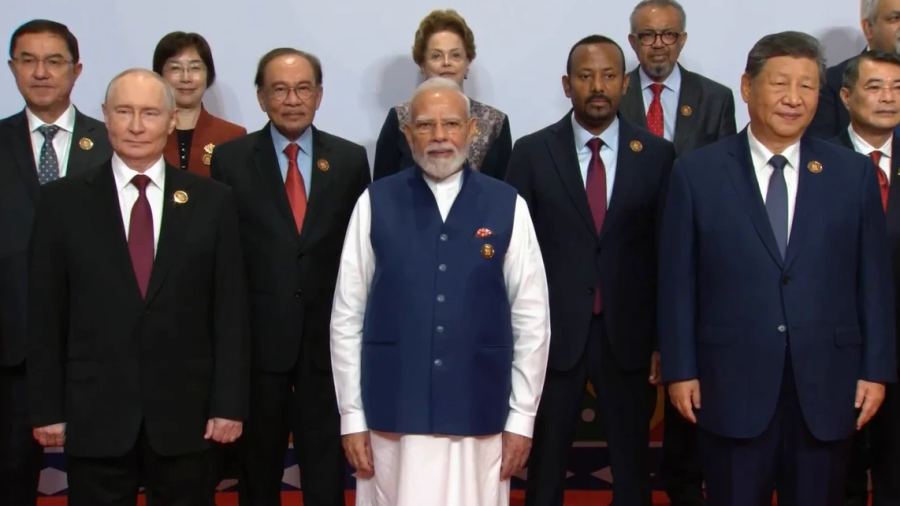
After a two-day summit in New Delhi, leaders of the new group of emerging economies called for a more inclusive and coordinated strategy for global development. They also called for peace and tranquillity in the Middle East, after a rare agreement on the growing crisis in the region. The leaders of the countries, Vladimir Putin of Russia, Xi Jinping of China, Masoud Pezeshkian of Iran, and Narendra Modi of India, were participating in the summit.
Prime Minister Narendra Modi called BRICS a bloc comprising about 50 percent of the world’s population, about 40 percent of the world’s GDP and more than 25 percent of the world’s trade. These figures show the organisation’s growing importance in the international economic and political landscape. The BRICS countries are emerging economies with different developmental needs and include major economies like China, India and Russia. Their cooperation can create opportunities for trade, investment, infrastructure development, financial coordination and South-South cooperation.
Over the last few decades, GDP growth, foreign investment, industrial production and trade expansion have been used as measures of global development. These signs are still relevant but are not all-encompassing. Inequality and economic growth can coexist. But even if a country is experiencing strong growth, large parts of the population may still lack good education, healthcare, decent jobs, social protection and basic public services.

Inclusive global growth thus goes beyond economic statistics. It should include greater global-level participation of developing countries in decision-making, fairer financial systems, sustainable development, food and energy security, and equitable opportunities. This broader perspective on development is reflected in BRICS leaders’ emphasis on inclusive growth. Their message is not only to produce more wealth for the global economy, but to distribute it more evenly.
Today, strategic competition, protectionism, sanctions, tensions in trade, technology, and geopolitical disintegration are hallmarks of the international system. Rising tensions between the major powers are impacting supply chains, the energy market, investments, and development planning. The call for cooperation by BRICS is important in such an environment. Prime Minister Modi asserted that ‘our strength lies in diversity and cooperation,’ a way to escape the politics of confrontation. BRICS can also help to reform the global financial architecture. New patterns of global economic power are often not reflected in institutions such as the International Monetary Fund (IMF) and the World Bank, which developing countries complain are missing. This means representation needs to increase, access to finance needs to be fairer, and development finance needs to be more available.




Russian President Vladimir Putin described BRICS as an organisation striving for a new multipolar world order that is fair and just. Chinese President Xi Jinping metaphorised a world without law as ‘a crossroad without traffic lights, where chaos and confusion are bound to be.’ Many of the concerns of the countries of the Global South are about the consistency and equity in the application of rules, and they resonate with the main theme of the international order in place, which is often called ‘rules-based’. A rules-based order would be based on rules that would apply to all states. There is no geopolitical manipulation of the principles of sovereignty, territorial integrity, non-interference, peaceful dispute resolution and economic justice.
BRICS members also reached a rare consensus on the Middle East situation at the summit. The group expressed grave concerns about the current situation in the Middle East and West Asia and called on all concerned to ‘exercise the utmost restraint.’ The agreement matters because BRICS countries have varying relationships with countries in the region where the conflict is playing out. They can appeal to each other and call for a union; it shows that diplomacy is still possible, despite major differences in opinion among world powers. The Middle East crisis has repercussions that ripple outside the region. Conflict can disrupt lives, affect energy supplies, drive price increases, disrupt international trade, and create new humanitarian crises. These effects are more prominent in developing countries.
Bangladesh has both opportunities and challenges within the BRICS framework. Bangladesh is a developing nation with growing economic relations with the rest of Asia and the Global South, and it is committed to inclusive growth and fair trade, infrastructure investment, energy security and access to affordable development finance. Bangladesh can benefit from BRICS in the following areas: trade diversification, investment cooperation, technology cooperation, development of a logistics corridor, renewable energy cooperation and educational cooperation. The state may also advance the cause of the least developed and vulnerable developing countries in wider arrangements for South-South cooperation.
While the call for shared prosperity in New Delhi is welcome, words are not enough to change the world economy. Next, BRICS needs to focus on implementation. Its members should lower trade tariffs among themselves, increase financial cooperation, facilitate local-currency transactions as much as possible, increase development lending and encourage technology sharing. They also need to develop dialogue with partner countries/economies, civil society and development institutions. Moreover, BRICS should build consensus within the bloc. They are not always aligned on security, trade, monetary policy and global governance. These differences are natural, but shouldn’t affect the grouping’s ability to pursue shared interests.
BRICS’ vision of inclusive global growth comes amid a world that is split in two by geopolitical tensions and economic disparities. Cooperation, peace and a more equitable international system are what appeal to its members. It is the dream of many developing countries. But shared prosperity should not be only about redistributing global power. It requires strong leadership, open institutions, sustainable policies, and sincere concern for the commoner. BRICS has the population, economic power and political influence to influence global discussion. But its most important role is to prove that cooperation between different countries can deliver real gains for human development.
There’s no need for another exclusive power bloc in the world. It needs a more inclusive system to create shared growth, sustainable development and peace and to listen to the voices of middle, small and developing states.
The views expressed in this article are solely those of the author
The writer is a Professor, Department of International Relations, University of Chittagong, Bangladesh. Director, Hong Kong Research Center for Asian Studies-Bangladesh Center (RCASBC).Email: [email protected]