

The share of defaulted loans in Bangladesh has earned global recognition, with 32.78% of total defaulted loans and by surpassing Chad having 31.5 percent. Rising NPLs are not just a banking issue, it has macroeconomic concerns affecting investment, liquidity, and overall economic stability. Despite regulatory efforts and policy reforms, the persistent high default loans reflect deeper structural weaknesses in governance, risk management, and institutional discipline.
The question is: how to overcome the crisis? If you investigate newspaper reports, academic research, TV talk shows and gossip have rhetoric conclusion that businesspeople take loans under political pressure and launder them to other countries.
We have hardly any discussion on a way out of this crisis. The experts are more focused on hatred toward borrowers and demands for punishment, rather than suggestions to resolve the national crisis. These experts and civil society members are silent about the role of bankers and corrupt political masters of such non-viable project loans. There is no discussion about the beneficial owners of the defaulted business projects.
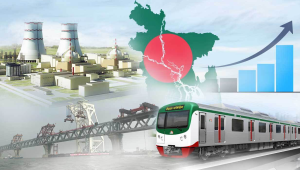
Bangladesh’s defaulted loans now account for roughly one-third of the total loans disbursed. The amount is now calculated to be Tk 606,555 crore, or about $49.31 billion. This defaulted amount is enough to make underground railway (subway) for all of Dhaka, 18 metro rail lines, or at least 12 Padma bridges. It is interesting to know that about 80 percent of its bad loans are on account of top 20 defaulters, including Beximco, S Alam and AnonTex. This large share of its defaulted loans is linked to the S Alam Group, with recovery remaining minimal.

Bangladesh’s performance in banking funds does not conform to that of any other country. Its NPL ratio has surprisingly exceeded its peers’ experience by far. A report presents the loan default rates of South Asian nations; Bangladesh’s percentage is 32.78, Sri Lanka’s figure is 9.4 percent, Pakistan’s 5.8 percent, Nepal’s 5.7 percent and India’s 1.8 percent. The corresponding number suggests that the defaulted loan is pandemic in Bangladesh.
In terms of volume, Islami Bank Bangladesh Ltd (IBBL) has the highest level of bad loans in the banking sector. Until June this year, its NPLs stood at around Tk 98,914 crore, or 52.15 percent of its disbursed loans. The country’s NPL situation shows that the problem is concentrated in a handful of Islamic and state-owned banks. IBBL was taken over by S Alam Group in 2017. The controversial conglomerate later extended around 80 percent of the bank’s total loans to its own companies and associated firms, violating banking rules and regulations. At the end of December last year, Islami Bank’s bad loans stood at Tk 92,115 crore, or 49 percent of its disbursed loans. In the six months to June, its bad loans increased by Tk 6,799 crore, according to BB data. The bank regularised Tk 5,885 crore this year through rescheduling, while it recovered Tk 749 crore from classified loans.
One of the primary drivers of NPL growth is inadequate credit risk assessment. Loans are often approved without proper feasibility analysis, over-reliance on collateral rather than cash-flow-based lending and lack of industry-specific risk evaluation. Loans are also granted under political or corporate pressure.



A study of BIDS finds that about half of the enterprises became sick due to lack of working capital. According to a study by Bangladesh Bank, macroeconomic and economic conditions significantly drive non-performing loans (NPLs). The situation where borrowers are unable to make scheduled payments for a prolonged period. A significant structural issue in Bangladesh’s banking sector is influence-based lending.
Recently, a central bank said that around 10 percentage points of the banking sector’s NPL ratio, which has now reached 30 percent, can be attributed to economic factors, while the remaining 20 percentage points are the result of willful default, irregularities and corruption. If we compare Bangladesh’s situation with its South Asian peers, it is a unique failure of loan operation and management syndrome that has moved from bad to worse under all regimes in turn. The symptoms of sickness surface from the initial stage of loan operation.
Recently, Bangladesh Bank (BB) has taken up a strategy of setting annual NPL reduction targets for all banks through introducing a one-time exit facility with strict eligibility criteria, distinguishing genuine business distress from willful default, strengthening banking supervision through risk-based inspections and asset quality reviews (AQRS), establishing a national asset management company (AMC) to resolve legacy bad loans, and enhancing the early warning system (EWS) and Credit Information Bureau (CIB). BB has introduced an 18-month strategic framework featuring a one-time special exit facility allowing eligible defaulters to clear classified ‘bad’ or ‘loss’ loans in a single installment with potential interest waivers.
About 35 years ago, donor agencies had proposed the formation of an Asset Management Company (AMC) to address the crisis of distressed assets of banks, but Bangladesh refused to take the suggestion since they are empowered by a very powerful law, namely ‘Artho Rin Adalat Act 1990.’ But after no other alternative, it has now ‘unwillingly’ and half ‘heartedly’ agreed to and initiated a law titled Distressed Asset Management Act, 2026. The move comes as the World Bank, the International Monetary Fund (IMF) and the Asian Development Bank (ADB) push for stronger capacity to manage stress in the banking sector. Its main objective is to create a regulator, namely the Distressed Asset Management Unit (DAMU) at Bangladesh Bank and a Distressed Recovery Programme (DARP).
The draft ‘Distressed Asset Management Act, 2026’ seeks to establish a specialised ecosystem of regulators, private asset managers and recovery firms that can buy, manage and recover the country’s massive stock of bad loans more aggressively and with fewer legal issues than under the current system. A well-prepared and conducted asset sale process is essential to maximise recovery values. The primary buyer is Distressed Asset Management Company (DAMC). After re-organising and re-structuring the asset, the general buyers from home and abroad shall buy the assets to run the companies.
A well-developed legal and institutional regime is key to maintaining an acceptable risk level, allowing distressed asset markets to develop. Enabling measures for dealing with insolvency, enforcement, and the ability to achieve out-of-court workouts (OCW) are essential.
Developing a distressed asset market requires the interaction of multiple factors and stakeholders, sometimes with opposing interests. It may also create an opportunity for corruption, favouritism, and nepotism in buying and selling NPLs. Bangladesh also has lack of manpower to implement the huge technical job to overcome crisis of NPL.
The views expressed in this article are solely those of the author
The writer is the CEO, Bangla Chemical & Legal Economist. E-mail: [email protected]