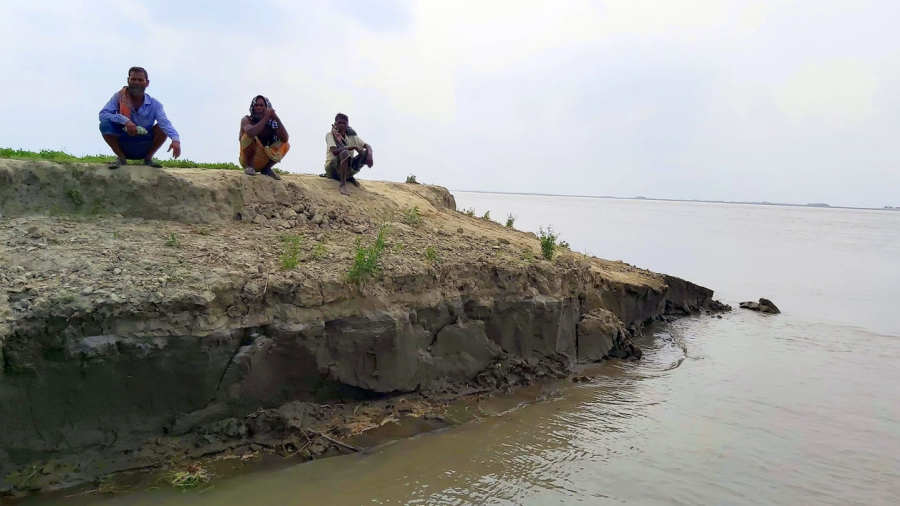

Unlike floods or sudden storms, riverbank erosion announces itself with no sirens, no warning bell; it arrives in the dead of night like a thief in the dark, carving away the earth with a quiet, ruthless violence. For the residents of at least fifteen villages across Sadar and Sadarpur upazilas in Faridpur, the passing hours of the night are no longer measured by sleep, but by a suffocating, unending dread. Under the relentless, predatory advance of the Padma and the Arial Kha, lives are being systematically dismantled. While the rest of the country slumbers under blankets of safety, these villagers sit upright in the dark, straining their ears against the rhythmic, heavy gurgle of the current and the terrifying, sudden thud of collapsing soil. A courtyard where children chased laughter the evening before vanishes into the grey, swirling vortex before the morning sun can break.
In Charmanair union’s Afsardanghi and surrounding locales, the erosion has assumed such a brutal dimension that within barely two months, five hundred metres of paved roadway have dissolved into the riverbed. Yet, against this existential devourment, there are no permanent administrative safeguards – only the pitiful, post-disaster ritual of dumping sandbags into raging waters long after the homesteads have slipped beneath the waves.
This tragedy unfolding along the banks in Faridpur is not an isolated local grievance; it is a microcosm of a profound, systemic climate crisis gripping Bangladesh. According to authoritative satellite data compiled by the Centre for Environmental and Geographic Information Services (CEGIS), over the past five decades, the nation’s principal river systems – the Jamuna, the Ganges, and their formidable confluence, the Padma – have devoured approximately 158,353 hectares of land, an expanse nearly five times the physical size of Dhaka city.
Distinguished morphologists such as Professor M. R. Islam and migration scholars like Dr. Bishawjit Mallick have consistently demonstrated through empirical research that riverbank erosion is far more than a natural hazard; it is a silent, creeping humanitarian disaster that strips prosperous, self-reliant citizens of their dignity and casts them overnight into landless refugees.
When a single square kilometre of fertile earth vanishes into the river, roughly a thousand human beings are stripped of their historical livelihoods. Stripped of their ancestral soil, impoverished farmers face a desolate binary: live in precarious squalor on vulnerable embankments or migrate toward the suffocating, unhygienic slums of Dhaka to disappear anonymously among the urban informal proletariat. This profound human dispossession strikes directly at the foundational compact of our Republic. Article 32 of the Constitution of Bangladesh explicitly guarantees every citizen the right to life and personal liberty. Yet, when the state stands idly by as preventable ecological forces consume the homes and futures of its people, this constitutional guarantee is reduced to a cruel mockery.

For decades, the bureaucratic response to river erosion has been mired in reactionary tokenism. Administrative wheels turn only after the riverbank has collapsed, triggering a scramble to drop geo-bags into the abyss. This ritual serves primarily as a monument to institutional inertia, financial waste, and systemic corruption. Because of this fragmented, short-sighted administrative posture, generations of educational institutions, sacred places of worship, and hallowed burial grounds are surrendered to the current.
Beneath the physical and economic devastation lies a deeper, largely unspoken psychological ruin that corrodes the cultural fabric of rural life. Traditional society in Bangladesh has evolved through an intimate dialogue with nature, where the permanence of homesteads and the continuity of ancestral roots anchored human sanity. When those roots are torn away year after year, the collective psyche fractures. People begin to internalise a harrowing rootlessness, accepting that their existence is written on shifting sands. Psychologists define this enduring trauma as climate grief – an acute, chronic melancholia where tomorrow is invariably perceived as a threat. Children grow up with packed suitcases tucked behind doors, intimately aware that their birthplace is merely a temporary transit camp.




Yet, looking beyond our borders reveals that rivers need not be treated solely as implacable enemies. Nations historically besieged by water have pioneered brilliant paradigms of coexistence. Consider the Netherlands, a country that spent centuries fighting aggressive dikes before revolutionising its hydrological philosophy through the radical ‘Room for the River’ programme. Instead of straitjacketing nature behind monolithic concrete walls that ultimately invite catastrophic failure, Dutch planners widened the river’s scope, giving it deliberate space to expand safely during seasonal surges and marrying ecological restoration with absolute security.
Similarly, community-based adaptive management has transformed settlement patterns across Vietnam’s Mekong Delta. Bangladesh does not lack intellectual capital, technical expertise, or visionary blueprints; what has chronically eluded us is sustained political will, institutional coherence, and the courage to execute long-term, systemic strategies.
This critical historical juncture finds an invaluable compass in the newly unveiled Five-Year Strategic Framework for Reform and Development (2026–2031), formulated by the General Economics Division of the Bangladesh Planning Commission. Both volumes of this landmark national instrument provide a comprehensive theoretical and operational roadmap to heal our fractured riverine frontiers.
Volume One establishes a tripartite architecture of Recovery, Restoration, and Reconstruction across core pillars, placing heavy emphasis on institutional rebuilding, decentralised climate resilience, and equitable regional development. At the same time, Volume Two binds every relevant ministry and agency to time-bound, measurable commitments through a rigorous Strategic Action Matrix. For the first time, we possess an administrative document that weaves water resources management, sustainable land-use planning, and inclusive social protection into a unified national pledge.
To translate this strategic vision into reality, our policymakers and administrative machinery must execute a series of bold, structural transformations without delay. First, the Ministry of Water Resources and the Bangladesh Water Development Board must abandon the archaic, corruption-ridden ritual of reactive geo-bag dumping and instead shift toward macro-level, science-backed revetments informed by real-time satellite telemetry from institutions like CEGIS. Second, the state must institute a comprehensive, legally grounded National Riverbank Displacement and Resettlement Policy, ensuring that displaced families receive not mere token relief, but guaranteed land-for-land compensation, targeted vocational training, and accessible micro-credit to rebuild their livelihoods with dignity.
Third, in alignment with the universal life-cycle social protection mandates enshrined in the Five-Year Framework, automatic safety-net entitlements must be extended to all households residing within officially designated high-risk erosion zones. Fourth, local government institutions must have the financial autonomy and technical capacity to spearhead decentralised early-warning and community evacuation protocols.
A nation forged through immense sacrifice and blood cannot reconcile itself to a reality where its citizens are reduced to stateless refugees on the banks of their own life-giving waters. We must dismantle bureaucratic inertia, excise institutional apathy, and meet this crisis with absolute integrity, transparency, and radical empathy. The great rivers of Bengal must be reclaimed from symbols of midnight terror and transformed once more into enduring arteries of sustainable prosperity.
If we summon the political courage to honour this promise, the day will dawn when no family in Faridpur, Kurigram, Sirajganj, or Chandpur lies awake in the dark, wondering if their home will survive until dawn. That remains our supreme constitutional covenant, our highest moral duty, and the ultimate test of our democracy.
The views expressed in this article are solely those of the author
The writer is a development worker