
Following landmark maritime boundary settlements with India and Myanmar, Bangladesh secured sovereign rights over 118,813 square kilometres of maritime territory in the Bay of Bengal. This vast blue frontier is roughly equivalent to the nation’s entire landmass. In a country grappling with extreme population density and diminishing land-based resources, this aquatic expanse represents the next macroeconomic canvas. Yet, years after these historic legal victories, the transition from a traditional, extractive ocean economy to a sustainable, inclusive Blue Economy remains largely confined to policy briefs and seminars.
Contributing to the economy by 3.0-3.3% annually, the ocean economy has the latent potential to deliver an additional 3-5% to GDP over the next decade. However, this would require Bangladesh to evolve from its current status quo as a fragmented local economy to a global capital market-ready system.
Bangladesh’s ocean economy is a low-tech, non-scalable system. The current pillars of the ocean economy are all perfectly adequate as rural employment generators but wholly inadequate as growth engines. The roadblocking institutional and market impediments to realising a truly modern Blue Economy are manifold. Regulatory authority over the ocean is scattered across more than a dozen ministries, including the Ministry of Fisheries and Livestock, the Ministry of Shipping, and the Ministry of Environment, Forest and Climate Change. This bureaucratic silo system operates without a single, unified lead coordinating agency. Decisions are constantly duplicated or delayed, and the nation still lacks an established, comprehensive National Ocean Policy. Without a singular, authoritative body to manage maritime affairs, international investors face a confusing maze of red tape, significantly elevating the risk premium for foreign direct investment (FDI).
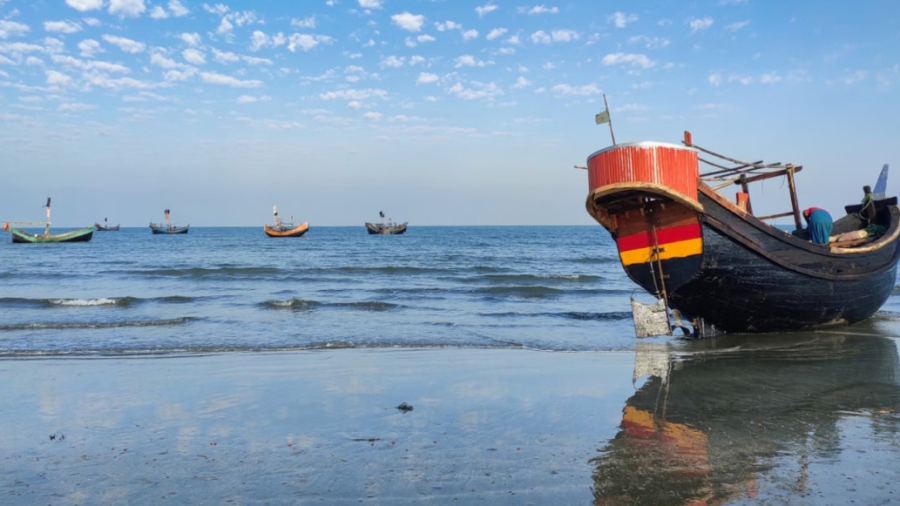
While fisheries support nearly 18 million livelihoods, these operations are almost entirely restricted to shallow coastal zones using fragile wooden trawlers. Bangladesh continues to significantly underuse its exclusive economic zone (EEZ) and deep-sea waters, where high-value pelagic fish like tuna remain completely untouched by local fleets. At the same time, this narrow coastal concentration has triggered localised overfishing. Coupled with unregulated industrial dumping, severe plastic pollution, and the total absence of a Marine Spatial Planning (MSP) framework, Bangladesh’s fragile coastal ecosystems- including the UNESCO-protected Sundarbans mangrove forest are facing unprecedented strain.

With Bangladesh’s national Sustainable Development Goal (SDG) financing gap estimated at a staggering USD 928 billion, relying solely on traditional public funding, domestic tax revenues, and foreign development aid is mathematically impossible. To finance large-scale, sustainable ocean infrastructure, the country must actively tap into global capital markets through innovative financial instruments, specifically Sovereign Blue Bonds.
Sovereign Blue Bonds function identically to standard government bonds but come with a strict legal caveat: 100% of the proceeds must be earmarked for sustainable marine and coastal projects. For Bangladesh, a maiden USD 500 million blue bond issuance could be launched on international exchanges, backed by credit guarantees from multilateral lenders like the World Bank or the Asian Development Bank (ADB). By securing a Partial Credit Guarantee (PCG), Bangladesh can effectively shield investors from country-specific risk premiums, lowering its coupon rate from a typical emerging market rate of ~9% down to a manageable 6.5%.




This capital raised can be channeled into capital-intensive, high-yield projects such as deep-sea sustainable aquaculture, commercial mariculture, marine biotechnology labs, and the modernisation of green port technologies to reduce carbon emissions across the nation’s shipping lanes. A robust blended finance framework must be deployed to strategically mix concessional public funding with private commercial investment. In high-risk, unproven sectors like offshore wind energy, tidal wave power, or deep-sea commercial fishing, public funds can absorb the first-loss risk, making them highly attractive to institutional impact investors from global financial hubs.
For the blue frontier to be genuinely successful, it must be radically inclusive. True inclusivity means that the scaling up of multi-billion-dollar industrial operations must not happen at the expense of marginal coastal communities. If large commercial conglomerates monopolise maritime zoning, millions of artisanal fishers risk being displaced into deeper poverty. To prevent this, the government must execute a highly structured policy blueprint.
Bangladesh must enact laws to dismantle the regulatory capture and institutional fragmentation plaguing its ocean economy. The most logical solution is to create a National Ocean Governance Commission (NOGC) that falls directly under the Prime Minister’s Office. By law, this commission must allocate specific areas for industrial shipping, offshore energy production, commercial aquaculture, and conservation while reserving traditional fishing grounds for small-scale fishers. With its growing number of deep-water berths, developing a Maritime Export Processing Zone around the Moheshkhali-Matarbari corridor will provide fiscal incentives to foreign direct investors.
Finally, Bangladesh must democratise access to Blue Tech for its small-scale fishers, physically manifested in the form of technological upgradation for the roughly 1.3 million traditional fishers currently working in the coastal waters. Through PPP, the government can equip these fishers with modern GPS-enabled satellite fish-finding devices, weather forecasting equipment, and solar-powered cold storage facilities.
By designing a transparent, legally predictable, and highly accountable investment framework backed by sovereign blue bonds and ironclad environmental protections, Bangladesh can transform its untamed blue frontier into a resilient, equitable, and sustainable powerhouse. The global tide of sustainable capital is high, the international investment community is actively seeking viable blue assets, and the time for Bangladesh to turn its economic gaze decisively toward the sea is now.
The views expressed in this article are solely those of the author
The writer is a columnist and political analyst