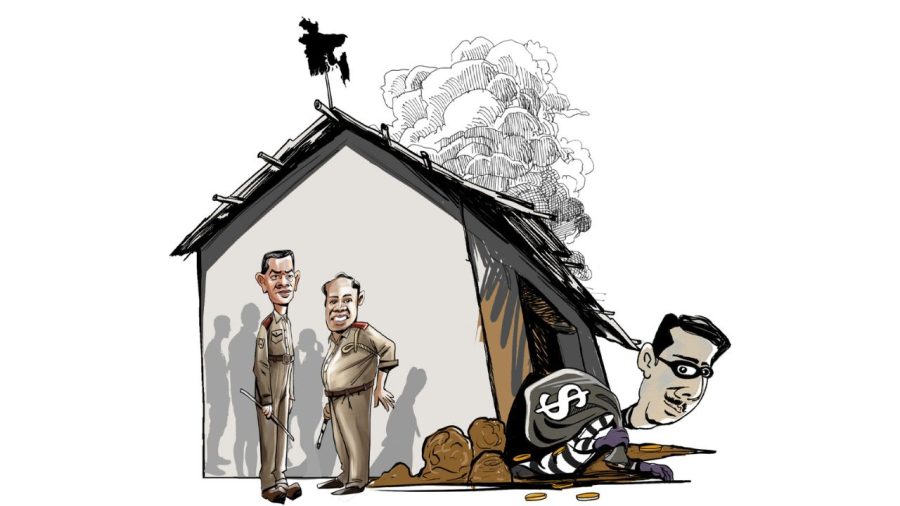

The UK government froze a suspicious $25 million and moved to help Dhaka recover it earlier this year; however, Bangladesh Financial Intelligence Unit (BFIU) “deliberately” let the fund slip away.
BFIU officials acted in a way that allowed the money to move unhindered from the UK to another country and enabled the owner to escape legal consequences.
Confidential intelligence reports, internal documents and emails from the UK National Crime Agency (NCA), UK Financial Intelligence Unit (UKFIU) and BFIU, along with National Board of Revenue (NBR) records and assessments by anti-money laundering experts, have uncovered the findings.
The frozen funds belonged to Mohammed Showkat Ali Chowdhury, then chairman of Eastern Bank and a ship-breaking businessman. The money was held in an account at the London branch of UBS AG bank. After temporarily freezing the funds, NCA sent an intelligence report to BFIU on 10 February.
Because BFIU failed to take the necessary steps, the funds were released in the UK and transferred in early March to the United Arab Emirates, widely regarded as a tax haven. Bangladesh thereby lost its first real opportunity to recover money from abroad since BFIU was established in 2012.
TIMES asked three former senior BFIU officials, who declined to be named, and a lawyer to independently review the documents obtained during the investigation. Their assessments were broadly consistent.
They said Bangladesh’s responses to the UK emails indicated that BFIU was not pursuing the appropriate course of action. Rather than acting in the country’s interest, its officials delayed the process, giving Showkat an opportunity to move the money. BFIU became active only after the transfer had taken place. It then took steps that could make it easier for Showkat to avoid accountability.
“What a terrific story. I never thought something like that can ever happen. It is truly unbelievable,” a former BFIU deputy head said after reviewing the documents.
Barrister MM Mohshiur Rahman, an expert on money-laundering laws, told TIMES, “BFIU deliberately took every step in a way that benefited Showkat Ali.”
“The UK agencies repeatedly made clear what needed to be done to keep the money frozen. But for as long as the funds remained under restraint, BFIU consciously avoided taking those steps,” the lawyer said.
BFIU Head Iqtiaruddin Md Mamun, however, denied that his agency was responsible for the loss of the money.
“Legal action could not be taken because the UK did not allow us to share this intelligence with anyone. We repeatedly sought permission, but the UK did not grant it,” he told TIMES.
But the former BFIU deputy chief who reviewed the documents rejected Mamun’s explanation.
Drawing on his own experience, he said, “When foreign agencies send intelligence reports, they normally prohibit those reports from being shared with other agencies. But countries still act on the basis of that intelligence using different methods.”
“It is not that BFIU officials do not know this method,” the former intelligence official said.

Barrister MM Mohshiur Rahman said, “If Showkat’s accounts had been frozen again and steps had been taken through the courts to attach his assets, Bangladesh’s position would have been stronger, and it would have created the basis for sending a formal MLA request for legal assistance.”
Calling for an impartial and independent investigation, Transparency International Bangladesh Executive Director Iftekharuzzaman told TIMES, “It must be established why BFIU, acting against the public interest, allowed this money to slip away.”
“This could not have happened without the knowledge of the organisation’s highest authority, which therefore cannot evade responsibility. The central question now is whether the incident was the result of deliberate action and collusion,” he said.
The Showkat Ali case has put at risk the prospect of recovering hundreds of billions of dollars siphoned out of Bangladesh. According to the government’s White Paper, about $234 billion was siphoned out of the country over the past 15 years – seven times Bangladesh’s total foreign-exchange reserves. Responsibility for recovering this money rests with BFIU-led Stolen Asset Recovery Task Force.
Whose decisions cost Bangladesh the money
Evidence obtained by TIMES shows that decisions concerning Showkat were being taken by BFIU Head Mamun and Kamrul Hasan Azad, additional director of the agency’s Operations Analysis Wing. Under their direction, Fuara Khatun, deputy director of the Policy Wing, handled the email correspondence with the UK.
By the time the first email alerting Bangladesh to the funds arrived, Showkat Ali was already well known to BFIU.
A year earlier, on 28 January 2025, BFIU examined transactions involving Showkat and his family following a suspicious transaction report from Meghna Bank. It froze his bank accounts on 1 July but lifted the freeze on 29 August.
Azad led the investigation, which was completed in September 2025. TIMES found no evidence that the report was forwarded to CID or ACC as required.
The report also did not mention Showkat’s St Kitts and Nevis passport obtained through investment or his luxury properties in Singapore, despite documents containing those details reaching Azad during the probe.
The developments have raised questions over Mamun and Azad’s roles in the case.
It could not be established whether either of them received any benefit from Showkat in connection with the $25 million case. However, a TIMES investigation has uncovered a pattern of potential financial dealings.




Evidence shows that information about the bank accounts BFIU was freezing, and when those freezes were imposed, was reaching Shoayeb Md Muntasir Morshed, a nephew of BFIU chief.
He would then contact the individuals concerned and offer a financial “package” in exchange for getting the freezes lifted.
To gather evidence, two businessmen contacted Shoayeb at this reporter’s request and recorded their conversations. TIMES verified the recordings.
In the recordings, Shoayeb can be heard invoking the name of BFIU Head Mamun and demanding an advance payment of Tk2 crore to Tk2.5 crore to have frozen bank accounts released, along with one-quarter of the money held in the accounts after the funds were unfrozen.
He also said that, once the advance was paid, he would arrange a private meeting with the BFIU chief.
This part of the investigation could not proceed further because he refused to arrange the meeting without a large upfront payment.
When Mamun was approached for comment through WhatsApp, he asked for evidence supporting the allegation. When told that the audio recording could not be sent to him because of the need to protect sources, he declined to comment.
Within about a minute of the questions being sent to the BFIU chief, his nephew Shoayeb called this reporter.
He initially denied the allegation. But after being told about the recording, he asked that the matter be “handled softly”.
Financial misconduct involving senior BFIU officials is not unprecedented.
The current chief, Iqtiaruddin Md Mamun, took office after his predecessor, AFM Shahinul Islam, was dismissed for financial and moral misconduct. Shahinul’s predecessor, Masud Biswas, has been in prison since January 2025 over allegations of financial crimes.
What happened to the $25 million
The first formal intelligence alert about Showkat Ali’s frozen funds arrived on 10 February this year.
NCA had prepared the report the previous day. It informed Dhaka about the money held in Showkat’s name at a London bank and asked whether he was the subject of any ongoing investigation in Bangladesh and whether Dhaka wanted further assistance from London.
Eight days later, on 18 February, BFIU told the UK that Showkat was a “person of interest” in Bangladesh and requested that the money remain frozen.
In response, NCA asked why BFIU had not extended the freeze on Showkat’s bank accounts in Bangladesh and why no assets had been seized domestically.
“Under the existing law, BFIU could have kept those bank accounts frozen for another five months. If a longer freeze was necessary, there was also a route to approach the court through CID or ACC,” Barrister Mohshiur Rahman said.
But Bangladesh’s financial intelligence agency did not take that route.
Then, at 9:26am on 25 February, NCA sent an urgent message to Dhaka.
“The deadline is looming,” it wrote.
NCA warned that, based on the information Bangladesh had provided, it would be difficult to justify keeping the money frozen for longer.
NCA had already told BFIU what Bangladesh needed to do to keep the funds restrained.
It wanted to know which agency was investigating Showkat, what offences he was suspected of, how far the investigation had progressed and what connection existed between those alleged offences and the $25 million.
It also asked whether Bangladesh would be able to submit an effective Mutual Legal Assistance (MLA) request within two months.
But the reply sent at 1:13pm on 25 February was when Bangladesh lost the opportunity to recover the money.
In its response to the UK, BFIU said the freeze on Showkat’s bank accounts in Bangladesh had not been extended.
It also said that although NBR, CID and ACC were separately looking into him, no law-enforcement agency had seized any of his assets.
Two days later, on 27 February, the UK informed Bangladesh that the International Anti-Corruption Co-ordination Centre, which was responsible for the matter, would take no further action.
Bangladesh was, however, told to return if it was later able to establish allegations that could support further action.
Banking and intelligence records show that shortly after that email, the freeze on Showkat Ali’s London bank account was lifted.
BFIU springs into action after the money is lost
Documents show that only after Showkat’s money was transferred to Dubai did BFIU begin following the path outlined by the UK.
On 10 March, the agency told the UK that Showkat was under investigation for alleged trade-based money laundering through offshore shell companies.
BFIU again sought an extension of the restraint but received no response. On 15 March, NBR imposed a tax demand and penalty of Tk307 crore on Showkat, equivalent to $25 million at the then exchange rate.
On 17 March, BFIU presented the penalty and a foreign-exchange control investigation as grounds for Bangladesh’s claim over the funds, seeking UK cooperation to freeze and return the money.
But those efforts ultimately came to nothing.
Secret documents reach the NBR
Although strict restrictions on the intelligence were cited as the reason for not presenting the information to CID, ACC or a court, the documents nevertheless reached NBR.
BFIU Head Mamun gave contradictory explanations about how that happened.
On 13 July, he told TIMES that he had personally gone to NBR and handed over the file.
Following his statement, TIMES obtained copies of emails exchanged among NCA, UKFIU and BFIU from NBR.
But on 3 August, the BFIU chief changed his account.
He denied having sent those documents to NBR.
Questions therefore remain over why the material was shared with NBR but not with CID or ACC.
After examining the NBR documents, Barrister Mohshiur Rahman said, “The process through which NBR imposed the penalty on Showkat has worked in his favour. The procedural steps that should have been followed before imposing the tax demand and penalty were not followed here. That will give Showkat an advantage on appeal.”
Asked why such a golden opportunity to recover the money for Bangladesh had been lost, BFIU Head Mamun told TIMES, “We have not lost this money. An equivalent amount has been secured because NBR imposed a penalty.”
Mohshiur Rahman, however, said, “There is very little prospect of the state establishing a claim over this money unless Showkat Ali himself voluntarily brings it back to Bangladesh.”