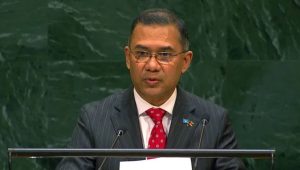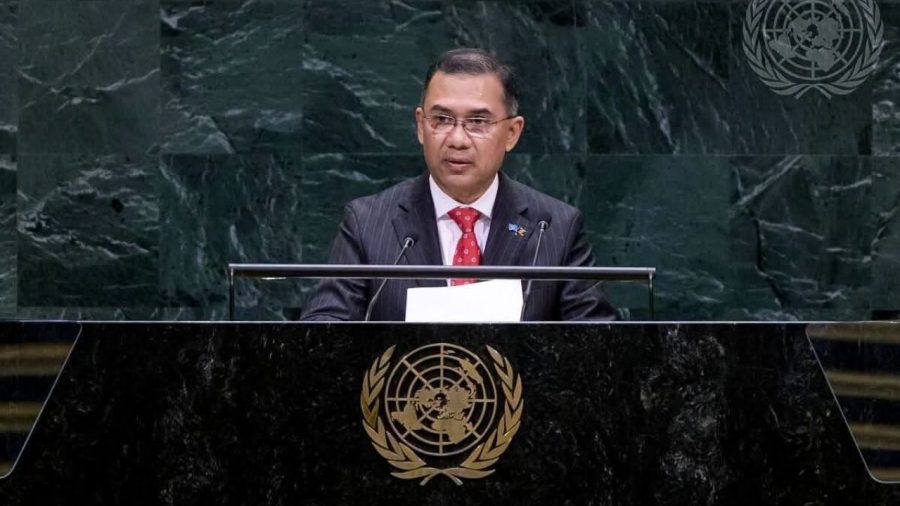

Prime Minister Tarique Rahman delivered his maiden address to the 81st United Nations General Assembly on Thursday, outlining his government’s reform agenda while setting out Bangladesh’s positions on a range of regional and global issues.
Speaking in Bangla during the General Debate, Rahman presented a mix of familiar foreign-policy positions and issues that Bangladesh has not traditionally highlighted at the UN General Assembly.
He became the third member of his family to address the UNGA, recalling his parents’ appearances before the world body – his father, former president Ziaur Rahman, who addressed the assembly in 1980, and his mother, former prime minister Khaleda Zia.
A central theme of Rahman’s speech was his government’s domestic reform agenda. He outlined a “3-R” strategy – Recovery, Restoration and Reconstruction – which he said was aimed at repairing and reforming the state.
He described Bangladesh as having emerged from what he called “more than a decade and a half of fascist rule and exploitation” following the student-led mass uprising of July-August 2024, and said the country was now returning to a democratic path.
Rahman also highlighted his government’s efforts to move beyond corruption, extrajudicial abductions and money laundering and build a transparent, welfare-oriented democratic society.

The absence of 1971
One notable feature of the speech was the absence of an explicit reference to 1971, which has traditionally been a prominent element of Bangladesh’s statements at international forums.
At the beginning of his address, Rahman paid his “deepest respects to all the martyred freedom fighters of Bangladesh.” He also recalled those who sacrificed their lives in the struggle for democracy, justice and people’s rights since independence.
He separately paid tribute to those killed and injured during the July-August 2024 mass uprising.
While the reference to the Liberation War remained through the mention of freedom fighters, Rahman did not explicitly use the term “1971” or refer to Pakistan as the occupying force, as Bangladeshi leaders have frequently done in international speeches.


Water diplomacy gets international spotlight
Another notable element was Rahman’s reference to transboundary water management.
He said the government had begun implementing the Teesta Master Plan and the Padma Barrage project to increase freshwater flow into the Sundarbans and conserve water through large reservoirs.
He also reaffirmed Bangladesh’s commitment to cooperation on transboundary water management by signing the 1992 Water Convention.
Water-sharing disputes are particularly sensitive for Bangladesh, which shares 54 transboundary rivers with neighbouring countries, including 54 with India according to Bangladesh’s official count. Dhaka and New Delhi have traditionally dealt with such issues through bilateral mechanisms, while India has maintained that water issues should be addressed bilaterally.


Against this backdrop, the decision to highlight transboundary water cooperation in a UNGA speech gives the issue a broader international dimension.
Palestine: continuity in policy
On Palestine, Rahman largely maintained Bangladesh’s long-standing position.
Dhaka has consistently supported Palestinian self-determination since establishing diplomatic relations with Palestine in 1972 and has regularly condemned civilian suffering in Gaza and the occupied Palestinian territories.
In his UNGA address, Rahman expressed deep concern over the suffering of the “freedom-seeking Palestinian people” and reaffirmed Bangladesh’s support for the establishment of an independent Palestinian state.
Diplomacy over conflict
Rahman also used the speech to articulate the foreign-policy slogan “Bangladesh First — Bangladesh for All.”
He said bilateral and multilateral disputes should be resolved through reason, debate and peaceful diplomacy rather than weapons of destruction.
While “Bangladesh First” has become a prominent phrase in the government’s political messaging, “Bangladesh for All” is a newer formulation. The government is expected to provide greater clarity on how the phrase translates into its domestic and foreign-policy approach.
Rohingya crisis and global issues
On the Rohingya crisis, Rahman called for sustained international engagement and a concerted global effort to ensure the safe, dignified and sustainable return of Rohingya refugees to Myanmar.
However, the prime minister had outlined a five-point proposal for resolving the crisis at a sideline event a day earlier. Including those specific proposals in his General Debate speech could have given them greater international visibility and placed them on the formal record of the UNGA. The General Debate speech forms part of the UN’s official documentation and remains available for future reference, whereas statements made at sideline events are not part of the UNGA’s formal proceedings or official record.
He also addressed climate change and technology, calling for greater climate finance for vulnerable countries and equitable access to emerging technologies, including artificial intelligence.
Taken together, Rahman’s maiden UNGA address combined the government’s domestic reform narrative with Bangladesh’s established positions on Palestine, the Rohingya crisis and climate justice, while giving greater prominence to transboundary water management and introducing “Bangladesh for All” as a new element of its broader political messaging.