


Prime Minister Tarique Rahman has presented a comprehensive roadmap to rebuild Bangladesh’s state institutions following the end of fascist rule, introducing his government’s “3R” strategy – Recovery, Restoration, and Reconstruction.
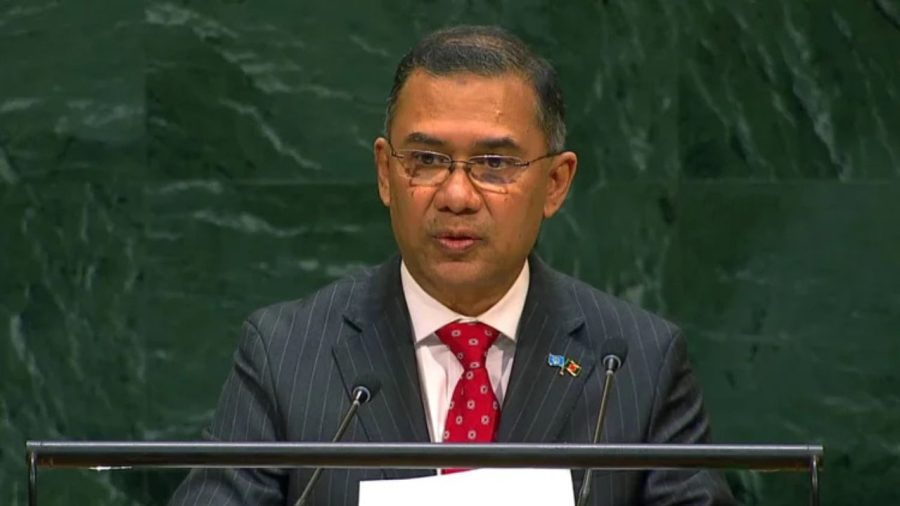
He made the presentation during his inaugural address to the 81st session of the United Nations General Assembly (UNGA).
Delivering his 17-minute address in Bangla at around 4:15am Bangladesh time on Friday, the prime minister highlighted the nation’s democratic transition following BNP’s victory in the 12 February national election.
‘3R’ strategy for democratic renewal
Addressing the world body from the platform where his father, former president Ziaur Rahman, and his mother, former prime minister Begum Khaleda Zia, previously spoke, Tarique paid tribute to the martyrs of the July uprising.
He pointed out that Bangladesh is recovering from fifteen years of enforced disappearances, political murders, systemic corruption, and money laundering.

To repair state institutions, the government is executing the “3R” framework to transition the country back to democratic governance, grounded in the belief that the people are the ultimate source of political power.
Aligning national reform with global SDGs
Tarique explained that the government is actively implementing its 31-point national reform programme announced ahead of the national election. This reform plan directly aligns with 37 per cent of the UN’s Sustainable Development Goals (SDGs) and indirectly supports a further 27 per cent.
The prime minister emphasised that this alignment aims to eliminate developmental disparities between urban and rural areas, ensuring inclusive accountability, economic democracy, and sustainable growth across all communities.




Rebuilding economic resilience and youth capacities
To convert Bangladesh’s demographic dividend into skilled human resources, the government has launched wide-ranging initiatives to establish the country as a global manufacturing hub. Tarique announced an allocation of $50 million in the current fiscal year to support young entrepreneurs, researchers, and innovators through startup initiatives.
He also urged international partners to assist in making Bangladesh’s transition from the Least Developed Country (LDC) category sustainable through secured financing, market access, and technology transfer.
Institutionalising social equity
Highlighting that women constitute over half of the national population, Tarique detailed measures for their economic empowerment, including free education up to the graduate level and expanded cash financing for female SME entrepreneurs.
The government has introduced Family Cards issued specifically to female household heads as a symbol of empowerment, alongside plans to integrate social safety initiatives into a Universal Card system.
In education, the government allocated its highest-ever budget, targeting 5 per cent of GDP within five years, while providing free uniforms, bags, and lunches for primary students.
Environmental restoration and transboundary water governance
On climate action, Tarique demanded climate justice at COP31, pointing out that Bangladesh suffers severe climate impacts despite minimal carbon emissions.
The government has initiated a national campaign to plant 250 million trees over five years, alongside clean energy projects, the re-excavation of 20,000 kilometres of canals, the Padma Barrage project, and freshwater restoration in the Sundarbans.
Moreover, Bangladesh has signed the 1992 Water Convention to enhance transboundary water management.
Safeguarding human rights, rohingya repatriation, and global governance
On foreign policy, Tarique urged a global shift from military spending towards diplomacy, reaffirming support for an independent Palestinian state and UN peacekeeping.
Addressing the burden of hosting over 1.2 million forcibly displaced Rohingyas for nine years, he reiterated that the crisis originated in Myanmar and must be resolved through their safe repatriation.
Finally, he called on the UN to establish a policy framework to bridge the global digital divide and prevent an emerging “artificial intelligence divide.”