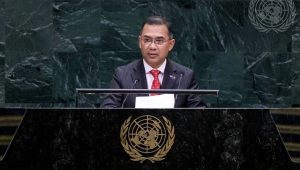
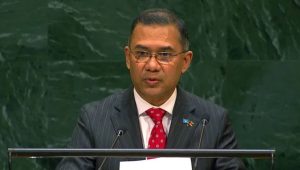
Bangladesh will strongly propose the inclusion of a “guarantee clause” in a new Ganges water-sharing treaty with India to secure its fair share, as the existing 30-year agreement approaches expiration on 12 December, said Water Resources Minister Md Shahiduddin Chowdhury Anee.
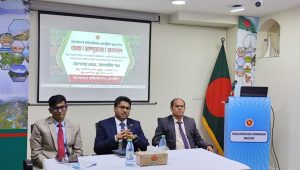
Speaking at a programme titled “High level event on Bangladesh rivers: Pollution control, conservation and management of the rivers surrounding capital Dhaka” in the capital on Thursday, Anee said Bangladesh seeks a completely new agreement rather than an extension of the existing treaty.
He emphasised that maximum priority will be accorded to national interests during negotiations for the new treaty. Highlighting the economic significance of rivers, Anee noted that river systems are being progressively damaged by industrialisation and the adverse impacts of climate change.
Recalling the history of Ganges water-sharing agreements, he stated that the first treaty was signed in 1977, followed by several interim arrangements that included guarantee clauses outlining specific water allocation mechanisms for Bangladesh.

However, the current 30-year agreement signed in 1996 contained no guarantee clause, although Bangladesh continued to abide by it in the spirit of bilateral friendship and continuity.
With the present treaty set to expire on 12 December, Anee expressed optimism that a new treaty would be concluded based on friendly relations while safeguarding public sentiments, national interests, and Bangladesh’s legitimate rights.
He mentioned that the Joint Rivers Commission (JRC) has already initiated work on the matter.




Explaining the necessity of a guarantee clause, Anee pointed out that as a lower riparian nation, Bangladesh faces severe damage to agriculture, fisheries, and its overall economy if adequate water flow is not received from upstream during the dry season.
Conversely, sudden releases of excess water during the monsoon intensify flooding, river erosion, and public suffering.
A guarantee clause would explicitly specify the quantum of water flow in cusecs at designated periods, thereby ensuring Bangladesh’s rightful share.
Responding to a query regarding the Teesta Barrage Project, Md Shahiduddin Chowdhury Annie said the government has initiated multiple local and foreign feasibility studies alongside securing necessary technical assistance.
The government is working to finish the studies swiftly and begin visible implementation work.
He added that the initiative has been undertaken in line with the election manifesto and the pledge of Prime Minister Tarique Rahman.
Regarding project financing, Anee informed that the government has initially decided to implement the Teesta Barrage Project using its own funding under Government of Bangladesh (GoB) resources.
International tenders or Government-to-Government (G2G) arrangements may be considered in future if required, though the immediate objective remains ensuring a complete feasibility study and necessary technical support.