




After a long break, five public universities got student unions upon political changeover in 2024. But before the new cycle could take shape, the next round of elections has already fallen into uncertainty.
The terms of Dhaka University Central Students’ Union (Ducsu) and Jahangirnagar University Central Students’ Union (Jucsu) have expired, while Rajshahi University Central Students’ Union (Rucsu) and Chittagong University Central Students’ Union (Cucsu) are nearing the end of their terms.
Yet, no election commission or committee has been formed at any of these universities, and none has indicated when polls may be held.
The uncertainty reflects a wider decline in student representation. Of the 53 public universities, 46 have no legal provision for student unions.
Although university student union elections resumed after years of deadlock, no initiative has emerged to revive college elections, which have gradually disappeared since the 1990s.
Observers say the absence of elected student representatives limits students’ role in university decision-making.
“If student unions do not exist, students’ democratic rights are violated. Their responsibility is to ensure that administrations or governments cannot impose decisions on students by force,” Professor Mohammad Aynul Islam of Dhaka University’s political science told TIMES.
No signs of fresh polls
After a 29-year gap, Ducsu elections were held in 2019 during the Awami League government. But after the one-year term ended, the next election remained stalled for six years.
The latest Ducsu committee’s term expired on 14 September.
Under the Ducsu constitution, elected representatives can continue for 90 days after the expiry of their term or until a new election is held, whichever comes first. After that, the union will automatically be dissolved unless a new election schedule is announced earlier.
Although the Dhaka University administration has said preparations for a new election have started, it has not announced any timeline.
DU Pro-Vice-Chancellor Mohammed Almujaddade Alfasane told TIMES that the university’s top four officials had met the current Ducsu committee and sought reports from hall provosts on the overall situation.

“The administration will also hold discussions with active student organisations,” he said.
However, he added that “when the schedule may be announced is still uncertain”.
Ducsu member Md Shahinur Rahman said they had repeatedly asked the vice-chancellor about the election timeline but were told that the decision was beyond his authority.
He said demands to include Ducsu elections in the academic calendar had also made no progress.
JU held its first student union election in 33 years on 11 September 2025. The committee’s term expired on 18 September, but preparations for another election have not started.
University Chhatra Dal Convener Zahir Uddin Mohammad Babar said financial issues, lengthy procedures and possible government considerations might be affecting the process.
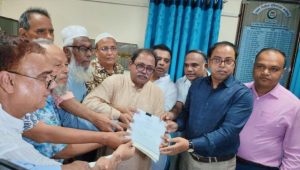
Jatiya Chhatra Shakti JU unit President Ziauddin Ayaan, who recently submitted a memorandum demanding elections, said financial constraints could not be a reason to delay polls.
RU also held its student union election after 35 years, but the current committee’s term has only a few weeks remaining.



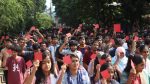
No steps have been taken to form an election commission, update the voter list, announce a schedule, distribute nomination papers or conduct voting.
Before last year’s election, the winning Shibir-backed “Combined Students Alliance” had pledged to include Rucsu elections in the academic calendar to ensure regular polls.
Rucsu Vice-President Mostakur Rahman Zahid alleged that the administration was waiting for a “green signal” from the political government.
“Although the administration is focusing on other issues, no initiative regarding Rucsu can be seen,” he said.
Rucsu General Secretary Salahuddin Ammar said keeping the union active was necessary to maintain normal campus activities.
Vice-Chancellor Md Faridul Islam said elections depended on several factors.
“An election cannot be held simply because the time has arrived; the overall environment and situation also need to be favourable,” he said.
Cucsu’s term will expire in the last week of October. No formal discussion has yet taken place between the administration and the union over a new election.
Vice-Chancellor Mohammad Al-Forkan said the election would be held at an appropriate time considering the circumstances.
Cucsu General Secretary Saeed Bin Habib said elections should be held within three months of the term expiry.
At Jagannath University, the first central students’ union committee still has time remaining, with its term ending on 6 January 2027.
Most universities lack provisions
Three universities where student unions exist under their laws – Bangladesh Agricultural University, Bangladesh University of Engineering and Technology (Buet) and Shahjalal University of Science and Technology – did not hold elections during the interim government’s tenure.
At Shahjalal University, an initiative was taken to hold elections, but the High Court suspended the process for four weeks on 19 January, a day before the scheduled vote. The election was not held afterwards.
Students at BAU staged protests demanding elections, while Buet students showed limited interest.
Shahjalal University Pro-Vice-Chancellor Md Shajedul Karim said students wanted the union restored.
“The administration has no reason to object. A decision will be taken soon,” he said.
Buet students expressed mixed views. Some opposed student politics and feared elections could bring back party-based activities on campus.
Others argued student unions could function without political affiliations, similar to existing welfare organisations.
The biggest legal gap exists in 46 public universities where laws contain no provision for student unions.
The vice-chancellor at a technology university, speaking on condition of anonymity, said universities could not suddenly arrange elections without legal provisions.
“Although provisions can be added through syndicate meetings or special procedures, universities do not want to take the initiative on their own because there is no ‘green signal’ from the government,” he said.
Former University Grants Commission chairman SMA Faiz disagreed, saying government approval was not required.
“Universities can formulate statutes through syndicate meetings and arrange elections. There is no obstacle to this,” he said.
Students at several universities, including Comilla University, Islamic University, Sher-e-Bangla Agricultural University, Gopalganj Science and Technology University, Begum Rokeya University, Barishal University and Sylhet Agricultural University, have at different times demanded student unions.
College polls disappear
Student union elections in the 1980s were not limited to universities. Major public and private colleges also held elections with significant participation.
Today, college student union elections are barely part of public discussion.
AN Rasheda, former vice-president of the Eden Mohila College students’ union, said all educational institutions once had student unions.
“Political parties in power consider student unions an obstacle to establishing dominance of their student organisations. That is why regular elections are not held,” she said.
She said elections could have been arranged simultaneously across universities and major colleges if there was genuine intent.
Mohammad Ali Zinnah, pro-vice-chancellor of National University, said the institution’s structure was different from other universities as academic activities are conducted through affiliated colleges.
“Our goal is to ensure a student-friendly environment, create opportunities for academic and co-curricular activities and prepare students for future employment,” he said.
Correspondents from DU, JU, RU, CU and JnU contributed to this report.