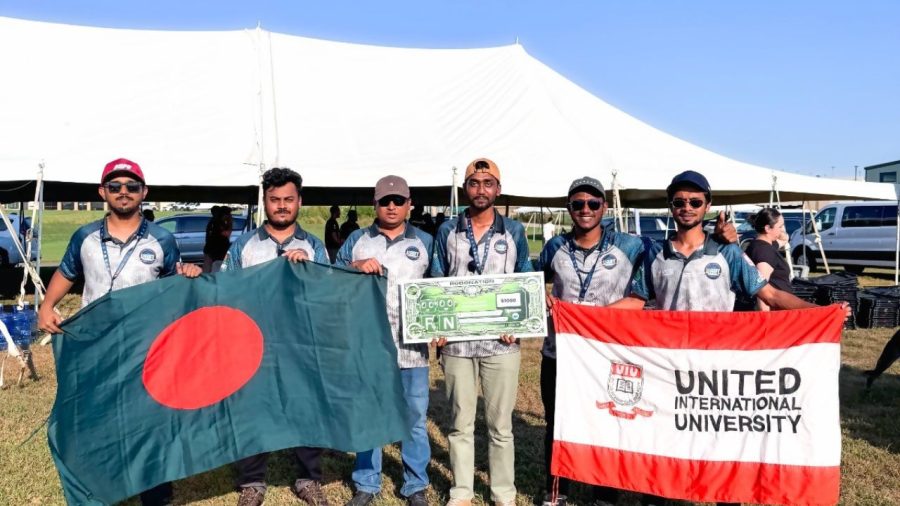

United International University’s (UIU) Aerial Robotics Team secured fourth place globally at the Student Unmanned Aerial Systems 2026 Competition in Tulsa, Oklahoma, marking its first participation in the international event.
The four-day final, held from 14 to 17 September at Skyway Range, brought together teams from universities and higher education institutions worldwide. UIU’s team, known as UART, completed its mission despite high winds and temperature-related difficulties, using real-time strategic adjustments and technical adaptations, UIU said in a press release on Saturday.
UIU said the fourth-place finish made UART the first Bangladeshi team in the history of the SUAS Competition to secure a podium position.
The competition, organised annually since 2003, is recognised as one of the leading international student contests in unmanned aerial systems, according to the release.

This year, 81 teams from different countries participated in the preliminary round, with 67 qualifying for the final flying competition. Of those, 64 received flight-readiness approval and 58 ultimately conducted flights.
Weather conditions posed a major challenge during the competition. High winds and temperature-related difficulties resulted in crashes involving 21 teams, the release said.


UIU said UART demonstrated its technologies, engineering expertise and operational capabilities while adapting its strategy and technical systems during the competition to complete the mission and finish fourth globally.
Teams from Cornell University, Monash University, The Ohio State University, the University of Maryland and Warsaw University of Technology were among those taking part.
UIU said competing alongside those international teams and finishing fourth represented an important achievement for Bangladesh’s higher education, research and technological capabilities.


UART received full marks in the Safety Inspection and Rapid Response categories. The university also said its team was the only participant to complete the mission fully autonomously.
The result followed a long-term collaborative effort involving research, system design, engineering development, construction, testing, experimentation and continuous refinement, according to the release.
The autonomous unmanned aerial vehicle developed by UART incorporates autonomous navigation, aerial mapping, object detection, payload delivery, obstacle detection and avoidance and multiple safety mechanisms.
UIU said the integration of those technologies enabled the team to complete its mission under challenging environmental conditions.
The university said the achievement demonstrated what could be accomplished through a combination of institutional support, faculty guidance, student talent and long-term leadership. It also said the result could encourage