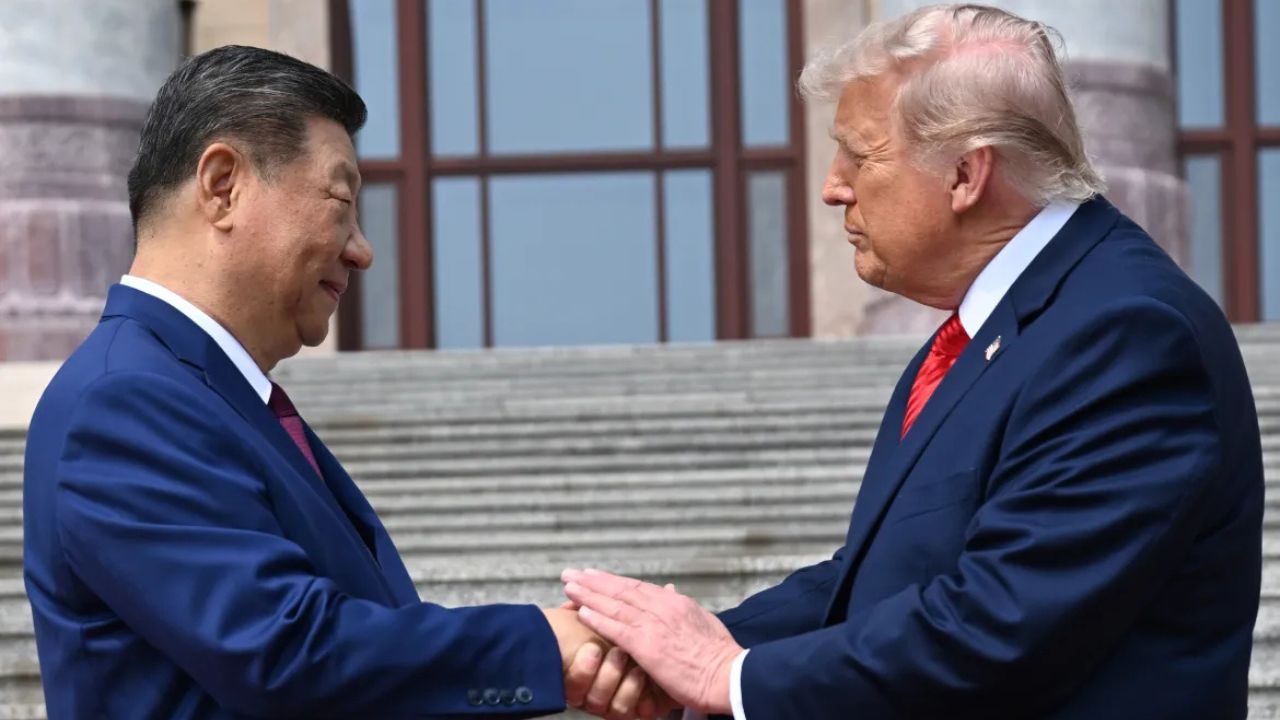
US President Donald Trump left China on Friday without securing major breakthroughs on trade or meaningful assistance from Beijing in efforts to end the Iran conflict, despite two days of high-profile meetings with Chinese President Xi Jinping.
Trump’s visit — the first by a US president to China since 2017 — was aimed at producing tangible outcomes that could strengthen his domestic standing ahead of the US midterm elections.
While the summit featured elaborate ceremonies, military displays and carefully choreographed events, substantive disagreements remained unresolved behind closed doors.
Chinese officials reportedly warned that any mishandling of the Taiwan issue could escalate tensions between the world’s two largest economies and strategic rivals.
Trump said he and Xi discussed the Iran conflict and shared concerns over disruptions in global energy supplies, particularly the closure of the Strait of Hormuz.
However, Beijing gave no indication that it would use its influence with Tehran to pressure Iran into reopening the vital shipping route.
Speaking aboard Air Force One on his return from Beijing, Trump said he was considering whether to ease US sanctions on Chinese companies purchasing Iranian oil. China remains the largest buyer of Iranian crude.
“I’m not asking for any favours because, when you ask for favours, you have to do favours in return,” Trump told reporters when asked whether Xi had committed to pressuring Iran.

“We’ve wiped out their armed forces, essentially. We may have to do a little cleanup work,” he added.
Xi did not publicly comment on discussions related to Iran.
However, China’s foreign ministry issued a strongly worded statement expressing frustration over the conflict.
“This conflict, which should never have happened, has no reason to continue,” the ministry said, adding that China supported diplomatic efforts to restore peace and stability.
Limited progress on Iran and trade
A brief White House summary of Thursday’s talks highlighted what US officials described as a shared interest in reopening the Strait of Hormuz and expanding China’s purchases of American energy supplies to reduce its dependence on the Middle East.




Still, analysts said Beijing appeared reluctant to place significant pressure on Tehran, which China views as an important strategic partner and counterbalance to US influence.
US Treasury Secretary Scott Bessent had urged China to use its leverage with Iran to support diplomatic negotiations, but there was little evidence that Beijing was prepared to shift its position.
The summit also produced fewer economic gains than many investors had anticipated.

Trump announced that China would purchase 200 Boeing aircraft, although the figure fell well below earlier expectations of roughly 500 planes reportedly under discussion.
Boeing shares fell 4 per cent following the announcement.
Trump later suggested the order could increase to 750 aircraft “if they do a good job with the 200.”
US officials said both sides agreed to expand sales of American agricultural products and continue discussions on future trade mechanisms.
Washington and Beijing are also expected to identify around $30 billion worth of non-sensitive goods for increased trade.
However, few details were released, and there was no breakthrough on exports of advanced Nvidia H200 AI chips to China, despite the participation of Nvidia Chief Executive Jensen Huang during the visit.

The talks also failed to resolve disputes over China’s export controls on rare earth minerals, which Beijing imposed in response to Trump’s tariff measures introduced in April 2025.
The restrictions have disrupted supply chains for US semiconductor and aerospace industries.
Although both countries agreed last October to temporarily ease tariff tensions in exchange for continued rare earth exports, uncertainty remains over whether the truce will be extended beyond this year.
When asked whether the tariff agreement had been prolonged, Trump said he and Xi “did not discuss tariffs”.
Taiwan remains a major flashpoint
Taiwan emerged as one of the most sensitive issues during the summit.
Trump said he discussed US arms sales to Taiwan with Xi and indicated that a decision on future sales would be made soon.
He stressed that he had made no commitments to Beijing regarding Washington’s policy toward the island.
“We talked a lot about Taiwan,” Trump said. “But I don’t believe there is conflict over the issue.”
He also revealed that Xi directly asked whether the United States would defend Taiwan in the event of a Chinese attack, but Trump declined to provide a clear answer.

“There’s only one person that knows that, and it is me,” Trump said. “I said, I don’t talk about that.”
China claims Taiwan as part of its territory and strongly opposes US arms sales to the self-governed island, viewing such support as interference in its internal affairs.
The United States, while lacking formal diplomatic relations with Taiwan, remains Taipei’s most important international partner and primary arms supplier.