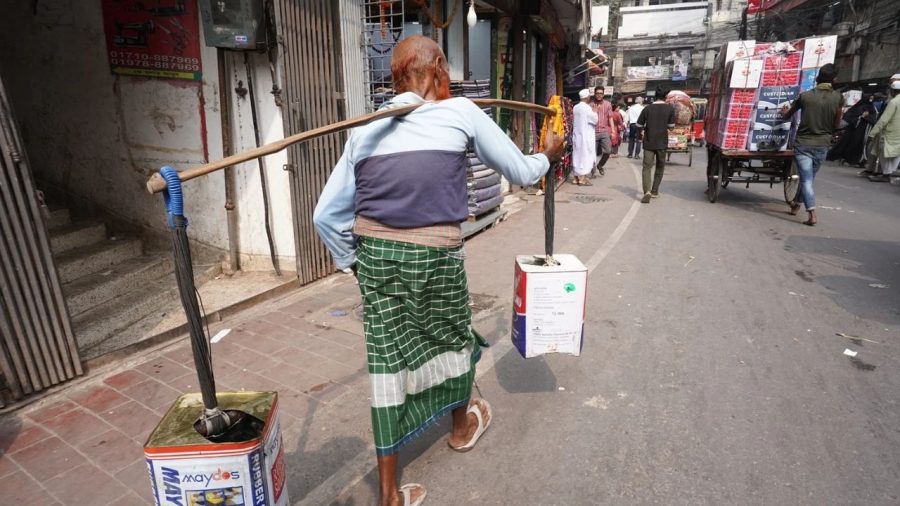



In the winding, congested alleys of Old Dhaka, where history breathes through centuries-old brickwork and bustling bazaars, an invisible thread connecting the city to its pre-modern past is quietly snapping.
Long before underground PVC pipelines, deep tube wells, and Dhaka WASA transformed the urban landscape, survival in this historic quarter depended entirely on the human back, the Bhistis and Mashkis specifically.
Today, while the iconic leather mashaq has vanished into the archives of time, the lineage of traditional water carriers survives in a modified, deeply resilient form.

The history of water distribution in Dhaka dates back centuries. Originally known as Bhistis – derived from the Persian word bihisht – these workers earned their poetic moniker because the relief they brought to a scorching city felt heavenly.
Armed with the mashaq, a heavy-duty pouch crafted from whole goat or ox hide capable of holding up to 30 litres, they were the absolute lifeblood of neighbourhoods lacking municipal infrastructure.

Over generations, the trade underwent a profound material evolution. As Mohammad Sirajul Islam, a veteran with 27 years on the job, explains: “This is Old Dhaka’s heritage. This has been running from many years ago. They used to use leather bags before.”

As leather sacks grew obsolete and unmanageable, workers transitioned temporarily to clay and brass pitchers. However, high rates of theft and loss eventually pushed the trade toward its current, pragmatic vessel: the humble tin container.
While the vessels changed, the physical demands of the job remained largely unchanged.




Mohammad Ratan, who has spent six to seven years in the trade, operates on an irregular, demand-driven schedule servicing local tea shops, hotels, and residential households, supplying clean water primarily for drinking, food preparation, handwashing, and occasional bathing.
Rates remain remarkably modest and tethered to the local economy. Workers typically charge around Tk10 for two cans. A standard workday involves completing 20 to 30 gruelling trips across crowded neighbourhoods, depending entirely on daily demand from local establishments.
Behind the service lifeline provided to Old Dhaka’s commercial hubs lies a severe human and physical toll. Carrying heavy loads of water on shoulders across uneven, unpaved paths or narrow alleys exacts a heavy cost over time.
Ratan candidly describes the physical reality of the work: “Then the body aches. At night when I sleep, waking up in the morning, I feel it, it hurts so much.”

Compounding the physical strain are systemic socio-economic vulnerabilities. Siraj, who anchors a localised supply ring of about nine individuals servicing roughly 100 shops on a rotating shift system, reflects on the personal sacrifices of a lifetime spent in the trade. Having lost his father at a young age, he dedicated his life to supporting his family and educating his brother.

Yet structural barriers – particularly the prohibitive cost of securing formal employment in modern society – leave working-class families trapped in cycles of generational labour.
“If I could get him a job, that would be good, but I can’t give money. To give a job requires a lot of money, which I don’t have,” he says.

The systematic introduction of water treatment – dating back to the establishment of the Chandnighat Water Works in 1874 by Nawab Khwaja Abdul Ghani – and the subsequent expansion of municipal authorities like Dhaka WASA spelled the structural decline of manual water carrying.
Today, automated pump stations, underground pipelines, and commercial jar-water delivery networks dominate the urban grid. Yet small pockets of Old Dhaka still rely on the tenacity of workers like Siraj and Ratan.
They stand as living monuments of an era when water literally “walked” into people’s homes, reminding a fast-modernising megacity of the quiet human endurance upon which its historical foundations were built.