


Imagine sitting in a dark cinema hall, surrounded by friends, families and strangers. Suddenly, an intimate scene begins. Someone laughs, someone looks uncomfortable, and another looks away. Now imagine watching that same scene alone on your phone. The film has not changed, but the experience has. French film theorist Jean-Louis Baudry explored how a cinema’s setting and technology shape our viewing experience. His idea, known as apparatus theory, raises a simple question: does where we watch a film influence what we feel comfortable watching?
India is the birthplace of the Kama Sutra, one of the world’s best-known writings about human desire. Yet mainstream Indian cinema has often struggled to speak openly about women’s sexuality. Bangladesh was hardly different. Think of the characters played by Shabana or Babita in so many of our popular films. As wives and mothers, they sacrificed their happiness for their families. Their suffering and patience made them ideal women in society’s eyes. But what did these women want for themselves? What about their loneliness, physical needs or desire to be loved? Such questions rarely became the central subject of their films. Family responsibilities mattered more than personal desires.
Some filmmakers challenged these boundaries. Deepa Mehta’s Fire (1996) follows two sisters-in-law, played by Shabana Azmi and Nandita Das, who find affection in each other after unhappy marriages. Although officially cleared, its Indian theatrical release in 1998 faced violent protests and disrupted screenings. Mira Nair’s Kama Sutra: A Tale of Love also faced serious censorship difficulties. These experiences showed that the problem was not simply what filmmakers wanted to tell, but what society and the authorities were willing to let audiences watch.
Bangladesh experienced another contradiction. During the 1990s and early 2000s, some single-screen cinemas secretly inserted sexually explicit scenes, popularly called cut-pieces, into ordinary films. In Malayalam cinema, actress Shakeela became hugely popular through erotic films. Clearly, audiences were interested in sexuality, yet such content was largely dismissed as B-grade entertainment. People consumed it, but society rarely discussed it seriously. Sexuality existed on screen, mostly outside what was considered respectable filmmaking.

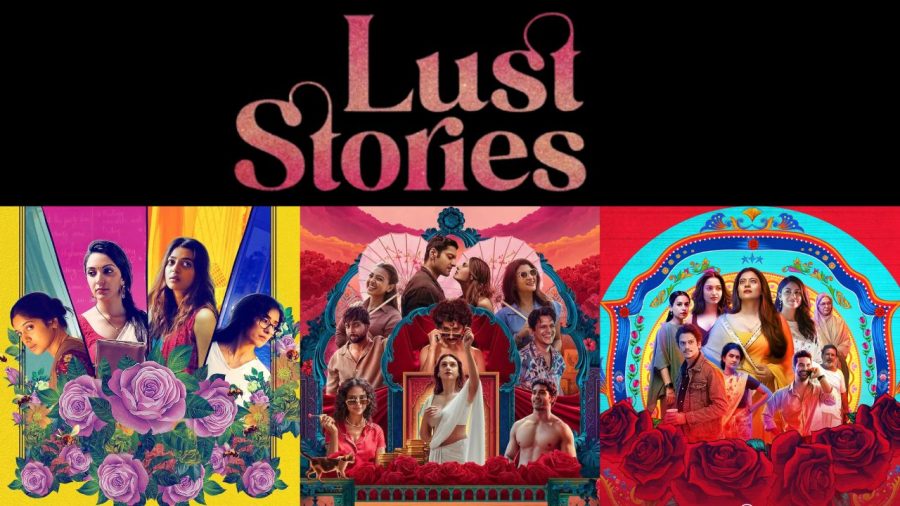
Netflix and other OTT platforms gradually changed this situation. People could now watch films privately on phones, laptops or televisions. This did not remove censorship or social judgement, but it gave audiences more freedom in how they watched. It also opened new opportunities for filmmakers. Netflix’s Lust Stories arrived in 2018, followed by Lust Stories 2 in 2023 and Lust Stories 3 in September 2026. Together, they brought women’s desires, troubled marriages and sexual dissatisfaction into mainstream discussion.
What makes these films interesting is not simply their intimate scenes, but how they portray women. Film theorist Laura Mulvey introduced the idea of the male gaze, where cinema often shows women through men’s eyes, focusing on their bodies rather than their feelings. Lust Stories frequently takes a different approach. Its women experience attraction, frustration, jealousy and dissatisfaction. They make their own choices, sometimes against society’s expectations. Their desires become part of the story rather than something to be ignored.




The first anthology brought together Anurag Kashyap, Zoya Akhtar, Dibakar Banerjee and Karan Johar. Akhtar follows Sudha, a housemaid whose relationship with her employer reveals the distance between their social positions. Her silence speaks louder than dialogue. Johar uses humour, including a memorable vibrator scene, to question why a wife’s sexual satisfaction receives so little attention. Both stories ask something mainstream cinema had often avoided: why should a woman’s happiness always depend on satisfying someone else?
Lust Stories 2 explored these questions further. R. Balki used humour to discuss sexual compatibility before marriage. Konkona Sen Sharma took a different approach. A wealthy woman discovers her housemaid having sex in her bedroom and secretly starts watching her. Initially, it appears to be about voyeurism, or the pleasure of secretly watching others. Gradually, it becomes a story about loneliness, class and power. The employer has money and authority, yet envies something her housemaid enjoys. Desire becomes a way of examining inequality.
The third instalment brings Vikramaditya Motwane, Kiran Rao, Shakun Batra and Vishal Bhardwaj together. Motwane explores marital boredom through couples experimenting with partner swapping. Rao connects desire with ambition and financial independence. Batra examines a separating couple struggling with their physical attachment. Bhardwaj takes us to 1980s Hyderabad, where a woman’s unfulfilled desires find expression through writing. Not every film works equally well, but together they show that lust is not always about sex. Sometimes it comes from loneliness or simply wanting to be understood.
As a filmmaker, I find another aspect equally interesting. How can cinema make us feel desire without showing physical intimacy? Film studies offers an idea called affect theory. Imagine a couple sitting silently at dinner. Their expressions suggest something is wrong, but we cannot immediately tell whether they are angry, unhappy or still attracted to each other. We feel the tension before understanding it. That immediate sensation helps explain affect. A glance, an unfinished conversation or the distance between two people can communicate feelings without words. Some of the strongest moments in Lust Stories work precisely this way.
Such scenes also require sensitivity behind the camera. Filming intimacy involves planning, consent, careful camera placement and respect for actors’ boundaries. The growing use of intimacy coordinators reflects this responsibility. Creative freedom should never come at the cost of an actor’s comfort or safety.
OTT platforms are not entirely free from regulation. India introduced streaming rules in 2021, including age classifications and complaint procedures. Bangladesh replaced its Film Censor Board with a Film Certification Board in 2024, under legislation passed the previous year. But changing an institution’s name does not necessarily change its understanding of artistic freedom. The question is whether adult audiences can make their own viewing choices and filmmakers can explore mature subjects without automatically being accused of promoting immorality.
Looking at all three Lust Stories films, I do not think their importance lies simply in how openly they portray sex. Earlier filmmakers explored these subjects despite considerable resistance. What Netflix has helped create is a space where these conversations can continue. The franchise has weaknesses, but it has brought women’s desires, sexual compatibility, loneliness and personal freedom into mainstream storytelling. Perhaps the biggest change is not that filmmakers can show more today. It is that audiences have more opportunities to watch, think and talk about feelings that South Asian cinema once preferred to leave unspoken.
The Writer is a Filmmaker