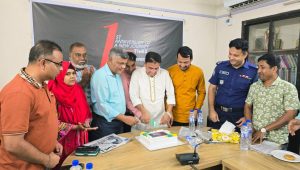

In 2004, on a public holiday, Tarique Rahman went to the Channel-i office to give an interview to journalist Matiur Rahman Chowdhury, who is currently the editor of Bangladeshi tabloid newspaper Manab Zamin.
Programme host Matiur Rahman Chowdhury asked questions to Tarique Rahman, elder son of Khaleda Zia, who was the serving Prime Minister of Bangladesh that time and Tarique had just joined politics, and was an iconic young face of BNP politics at the time.
Khaleda Zia, a mother and prime minister, maintained sharp lines between her personal and non-interfering professional life with her children.
On that interview, the host asked: “Your mother [Khaleda Zia] is the prime minister of Bangladesh. Did you ever try to impose or argue for any idea as a son of hers to implement or over-implementations?”
Tarique Rahman: “She doesn’t allow us to do that.”
In a recent interview, Nasir Ali Mamun, a veteran photojournalist and one of the most significant archive owners of Bangladeshi history, shares his experiences of interviewing Khaleda Zia for a news magazine cover story with Dhaka Stream, a Dhaka-based digital news media.
Nasir Ali Mamun: “Khaleda Zia left the place……., Tarique came to me and said, ‘I have a photography hobby, but my camera is disturbing, can you help me fix it? Here is my number.’ A sweet request, ‘don’t tell it to my mother.’
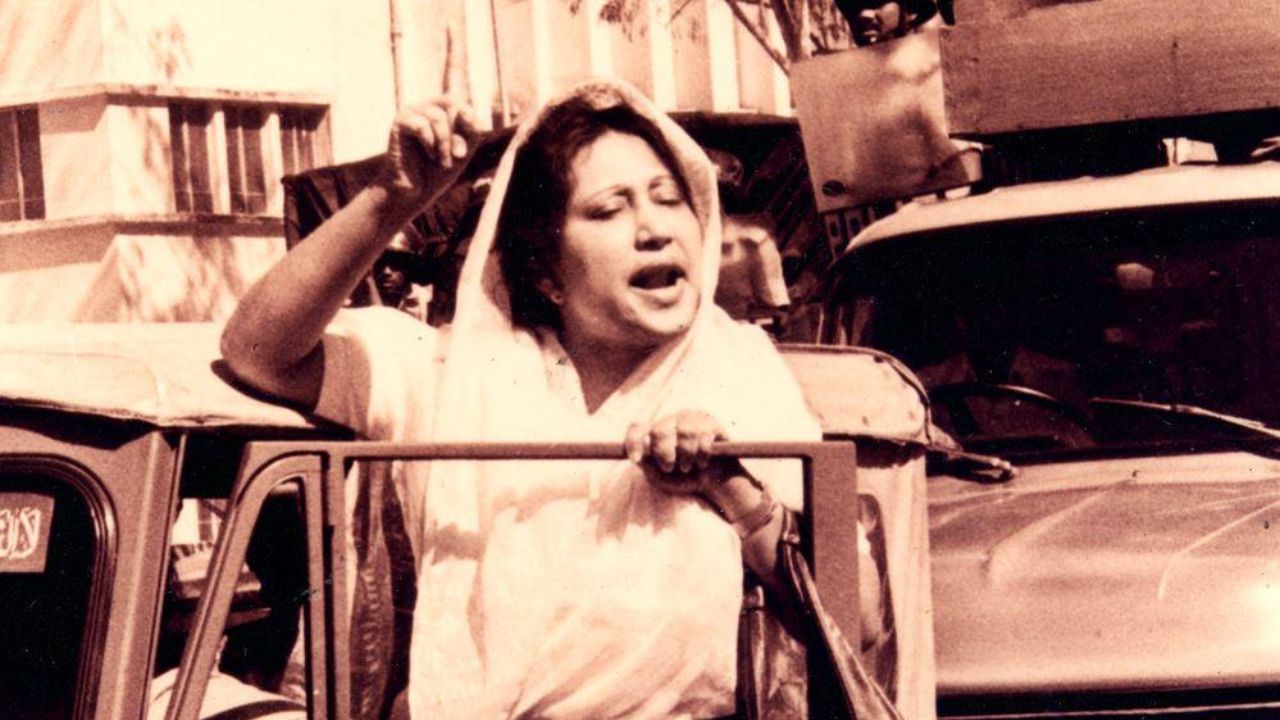
Khaleda Zia [80], former Prime Minister of Bangladesh, died in Dhaka, after a long battle with her health conditions, on Tuesday and was laid to eternal rest today. The nation is mourning her death. The Bangladesh government announced a three-day mourning period and a general holiday from work following her death.

She has travelled to the world many times, delivered many speeches, met many journalists, but some reports, quotes, and interviews are to pick for the re-read.
She gave an interview to Alex Pherry for TIME in 2006, in which she expressed her views on the political rivalry with Sheikh Hasina.
“It’s not mutual [hostility]. I want to be friends. I’d be thrilled to meet her [Sheikh Hasina]. Many time I have invited her, but she did not turn up.”
She was bold and very planned to empower women through education. She told TIME in the same interview.
“If we want to progress as a country, if we want to remove poverty, if we have to spread awareness of family planning and bring down population growth, we have to educate them [girls], give them equal rights. Women have to prove that they are no less than men. I am trying to end [the] dowry [system]. That will only happen when women start working as professionals.”



Forbes recognised her twice as an influential woman leader worldwide.
When she was elected as the first female prime minister of Bangladesh, a predominantly Islamic nation, during her 1993 visit to New York to address world leaders at the UN. During that visit she gave an interview to the New York Times’ Barbara Crossette, highlighting women’s roles in work and education.
She boldly spoke about the uncommon societal norms between Bangladesh and the Middle East with the New York Times.
Her exact quote was ‘We allow and encourage women to participate in all fields of national life… women are taking part in cultural activities and politics; they are working in the offices and in government departments, and as doctors and teachers.’
For the internationalist, Khaleda Zia is a friend of traditionalists, but she made a remarkable contribution to women’s education with an uncompromising commitment.
In 1991, Ms. Zia gave an interview to Steve Coll for the Washington Post; she didn’t criticize other ultra-nationalists or contemporary situations. She was bold and very pragmatic,
“I really don’t feel neglected. There is nothing special about being a woman in power.”
Khaleda Zia addressed world leaders at the 48th UN General Assembly in 1993. She emphasized girls’ and children’s education, and the world was impressed by her initiative ‘food for education’ program, also the Ganga’s water disputes with Bangladesh.
In 1995, at the historic 50th year anniversary of the UN, she clarified the mission, spoke about achieving goals to uphold human rights, and addressed Farakka and water rights.
She highlighted in her speech.
“While we are assembled here to celebrate the founding of this august body, over 40 million people in my country are facing poverty and destruction owing to deprivation of our rightful share of the waters of the Ganges River by India through unilateral withdrawal at Farakka… The Farakka Barrage has become an issue of life and death for us.”
“I had mentioned this acute problem before this world body in 1993. Unfortunately, in spite of our best efforts, the problem still remains unresolved. I would like to call upon all of you gathered here today to help resolve this problem.”
The Economist, a British newspaper, analytically criticises her tenure but often describes her as “uncompromising,” “Refusal to compromise.”
My takeaways from her policy steps:
In 1991, she restored parliamentary democracy through the 12th amendment. She set the supremacy of the people’s mandate-elected members in parliament over the presidential government system.
In 2002, her government adopted a strategic foreign policy to build friendly diplomatic relations with Southeast Asian countries, including Myanmar, Thailand, China, and Japan. Especially in focus on ASEAN nations.
The 13th Amendment, passed in 1996, established the bills of the Caretaker government [Non-partisan government system] to handover the power transitions for future Bangladesh.
Khaleda Zia, a visionary leader for democracy, was a caring mother to her children. Uncompromising leader forever.
Tanbirul Miraj Ripon is a journalist who has been covering Bangladesh, Myanmar, and the Bay of Bengal for international media for more than half a decade.