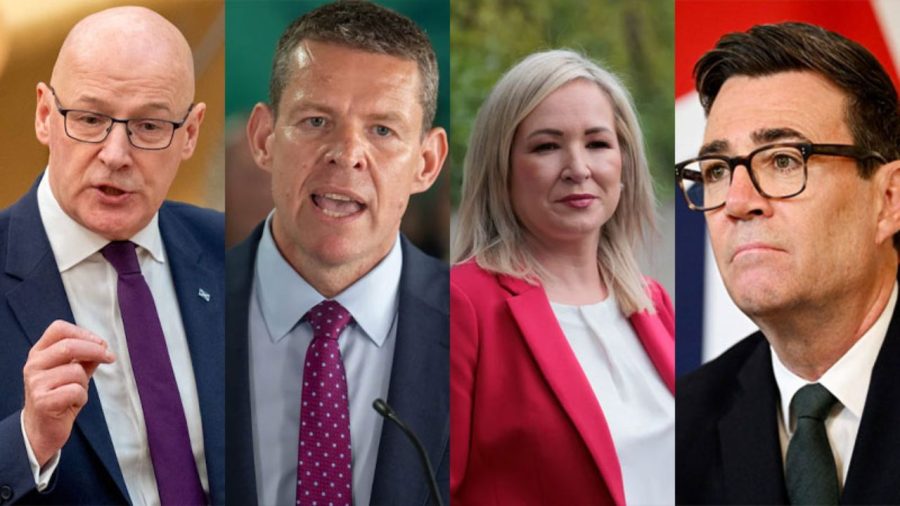

The leaders of Scotland, Wales and Northern Ireland are meeting on Monday to sign an agreement aimed at accelerating efforts to break up the United Kingdom. At an unprecedented summit in Cardiff, the three first ministers will sign a joint declaration calling for the right to hold independence referendums.
The meeting at the five-star St David’s Hotel overlooking Cardiff Bay brings together leaders of pro-independence governments in all three devolved nations for the first time following recent electoral shifts, reports The Telegraph.
Scottish First Minister and Scottish National Party (SNP) leader John Swinney, Welsh First Minister and Plaid Cymru leader Rhun ap Iowerth, and Northern Ireland First Minister Michelle O’Neill of Sinn Fein will attend the summit.
They will be joined by Mary Lou McDonald, president of Sinn Fein and leader of the opposition in Ireland, to discuss cooperation on a renewed independence campaign.
Four areas of cooperation
Following the discussions, the four leaders will hold a press conference and sign a memorandum of understanding committing their parties to political cooperation in four key areas: the economy, energy, Europe and international cooperation, and self-determination.
The three parties maintain that their respective nations should be part of the European Union (EU), with Scotland and Wales joining as new member states and Northern Ireland becoming part of the Republic of Ireland.
The memorandum also commits the parties to strengthening ties with European neighbours while preparing for independence. They argue that the current economic model of the United Kingdom does not serve the people of Scotland, Wales and Northern Ireland.

Political shifts across devolved nations
The summit comes after significant political changes across the devolved administrations.
In Wales, Labour suffered a major setback in May’s elections, allowing Plaid Cymru to emerge as the largest party in the Cardiff Senedd and paving the way for Rhun ap Iowerth to become First Minister.
Plaid Cymru plans to use the summit to press UK Prime Minister Andy Burnham for greater fiscal powers, including control over taxation, spending, policing and railway funding.
The party also wants the Barnett Formula replaced with a more generous financial settlement and is demanding revenues from the Crown Estate, including income from the seabed used for offshore wind farms, which currently goes to the Treasury.



A Plaid Cymru source said there was a “strong case for practical political cooperation” on energy, the economy, relations with Europe and wider constitutional issues surrounding self-determination. The source added that working together as equal partners would improve people’s lives.
In Scotland, the SNP has maintained its position as the dominant political force despite losing six Holyrood seats as Reform and the Greens made gains.
In Northern Ireland, Sinn Fein won the 2022 Stormont elections, although a walkout by the Democratic Unionist Party (DUP) prevented Michelle O’Neill from taking office as First Minister until 2024.
Sinn Fein is widely expected to retain power in next year’s election.
A Sinn Fein source said the summit would focus on the right of each nation to determine its future democratically. The source said the Good Friday Agreement provides the mechanism for such a choice and added that “the work of building the new Ireland must begin now”.
Growing pressure on Westminster
The Cardiff summit puts further pressure on Prime Minister Andy Burnham, who has made the devolution of power in England a central part of his agenda.
On Sunday, John Swinney said the momentum for constitutional change was “undeniable” and argued that the current status quo was “not sustainable”.
Swinney said Burnham must confront the possibility of becoming “the final prime minister of the United Kingdom”.
The summit also follows an intervention by US President Donald Trump during a visit to Dublin on Saturday. Trump said he would “love” to see a united Ireland, describing Northern Ireland joining the Republic as “a great thing” and asking, “How can it be bad?”
Tensions over the Union increased further after Burnham told MPs during Prime Minister’s Questions on Wednesday that another Scottish independence referendum could take place if there was a “clear consensus” or public support for one.
The Prime Minister told the House of Commons that the circumstances for triggering a Scottish vote were “exactly the same” as those applying to Northern Ireland, where the Good Friday Agreement provides for a referendum if it appears likely that a majority would vote to leave the UK.
A source close to Swinney strongly criticised Burnham, accusing him of failing to understand his brief and confusing the UK Government’s positions on Scotland and Northern Ireland.
Westminster rejects referendum demand
Despite the joint campaign by the devolved leaders, Prime Minister Andy Burnham wrote to Swinney on Thursday insisting that another Scottish independence referendum remains “off limits” before the next general election.
Burnham said there was “no consensus for an independence referendum in Scotland” and no evidence that a majority in Northern Ireland currently wanted to leave the UK.
Referring to Labour’s 2024 election manifesto commitment opposing independence or further referendums, the Prime Minister said pursuing another vote would distract from efforts to boost economic growth and tackle the cost-of-living crisis.
He reiterated the position he had previously set out to Swinney during a recent meeting in Glasgow.