


“Main character energy” has been one of the internet’s most durable exports of the past several years – the idea, popularised across TikTok and Instagram captions, that you are the protagonist of your own story, and everyone else is a supporting act. It is a philosophy built for the feed: Curated, individual, aimed at an audience of one starring role.
In Dhaka, though, some of the more striking scenes involving Gen Z over the past two years have looked like the opposite of that idea entirely: Teenagers directing traffic at unlit intersections, students sweeping glass off city streets, strangers organising themselves by walkie-talkie and word of mouth to do a job no one asked them, individually, to do.
The clearest example arrived in August 2024, in the chaotic days after Sheikh Hasina resigned and fled the country amid a student-led uprising. With police stations attacked and officers largely absent from the streets, Dhaka’s infamous traffic – usually kept barely functional by a dedicated police force – was left entirely to chance.
Instead, students filled the gap. At intersections across the capital, from Mirpur to Moghbazar to Bijoy Sarani, young volunteers, many still in their teens, took over traffic management with no formal authority beyond a willingness to stand in the middle of the road and make it work. Others cleaned streets, guarded temples and churches, and protected police stations from further attacks: Over 200 volunteers reportedly stepped in to protect minority places of worship alone.

The public reaction captured something about how differently this register of youth action lands compared to a curated social feed. “At first, I was concerned about what would happen to the traffic system,” one Moghbazar resident, Md Shahin, told a local outlet at the time. “But look at these kids, look how they handle it.” There was no single face to that moment, no individual protagonist, just a distributed, largely anonymous mass of young people choosing to be useful, together, at a moment the city badly needed it.
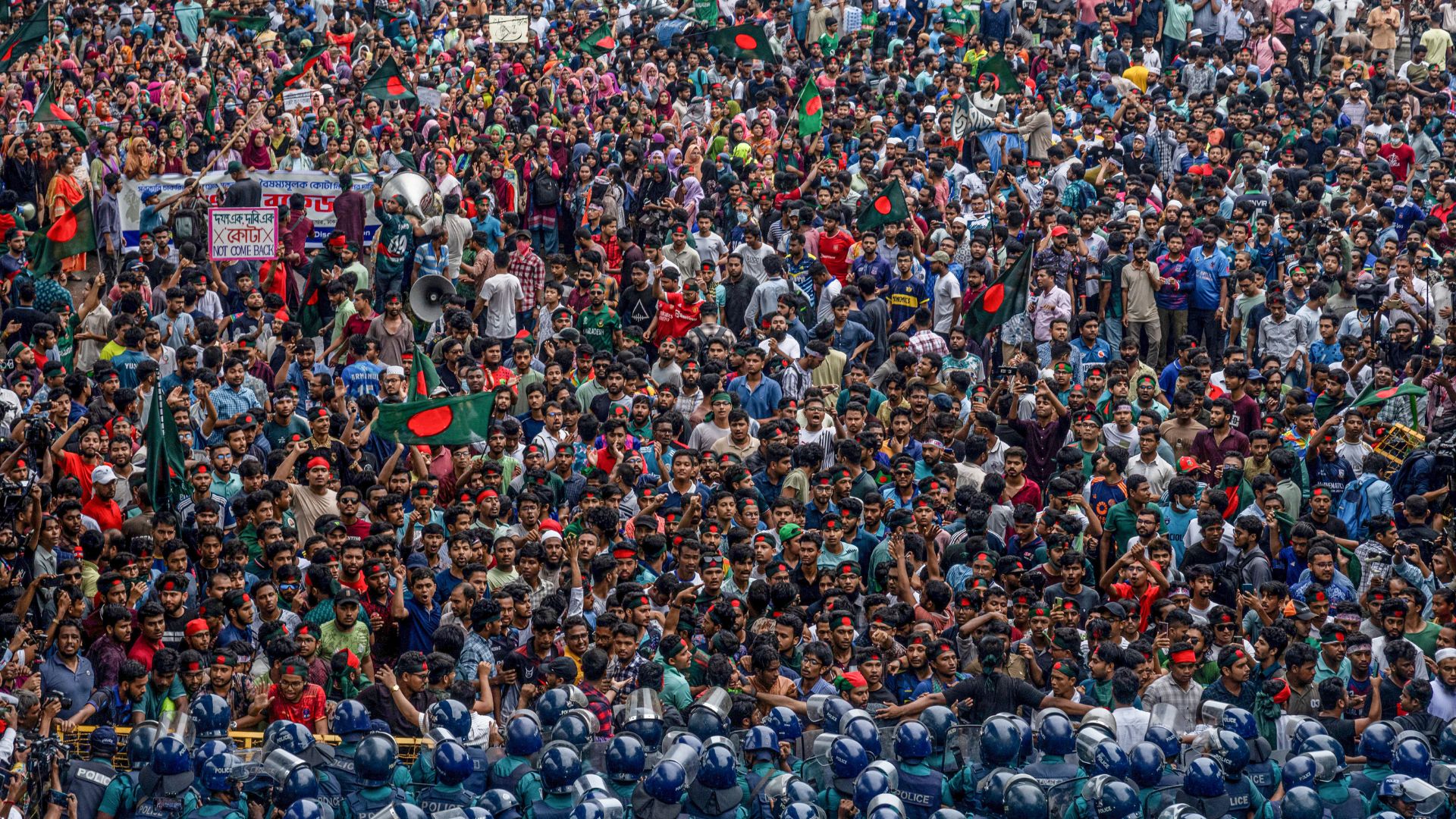
That instinct didn’t appear from nowhere. The traffic volunteering followed weeks of student-led protests against a discriminatory civil service quota system, mobilisations that grew into a broader, youth-driven movement against 15 years of one-party rule, a movement now widely cited internationally as among the first successful Gen Z-led uprisings in the world, predating similar youth movements that followed in Nepal, Indonesia, and elsewhere.




Whatever one’s view of the political outcome, the organisational fact of it is striking on its own terms: A decentralised, largely digitally coordinated generation proved capable of sustained collective action at national scale, and then, when the state’s basic functions briefly gave out, simply kept organising, just pointed at potholes and intersections instead of parliament.
Away from moments of crisis, the same collective impulse shows up in steadier, less dramatic forms. Organisations like the Bangladesh Youth Leadership Center have spent years running youth-led environmental and civic initiatives – from waste-management projects to circular-economy ventures turning agricultural waste into usable products – built entirely around teams rather than individual credit.
The Bangladesh Youth Environmental Initiative runs youth-designed environmental stewardship programmes aimed at climate resilience, while a national Youth Climate Grant now funds grassroots, volunteer-driven projects across the country in climate-smart agriculture, waste management, and disaster risk reduction. None of these initiatives produce a single face for an Instagram grid; they produce a waste-sorting system, a cleaner canal, a community better prepared for the next flood.
Psychologists studying the effects of individualistic, comparison-heavy social media culture have long noted its association with loneliness, anxiety, and a persistent sense of falling short of a curated ideal – the exhausting work of being the main character in a story with an audience that never fully applauds.
Collective action offers something structurally different: Role that doesn’t depend on being the most interesting person in the frame, and a form of purpose that comes from being useful to something larger rather than legible to an algorithm. It is not a coincidence that so many young Bangladeshis who spent their early teenage years absorbing main-character culture online turned out, when the moment called for it, to be remarkably good at disappearing into a crowd doing something that mattered.
None of this means Bangladesh’s Gen Z has rejected the main-character aesthetic – the same young volunteers directing traffic in 2024 were, by every indication, still posting, still curating, still fluent in the internet’s individualist grammar the rest of the week. The more interesting finding may simply be that the two instincts coexist without much friction: A generation raised to narrate its own life as a solo story, that turns out, when it counts, to know exactly how to put that story down and pick up a role in something collective instead.
If Bangladesh’s Gen Z has a defining trait, it may not be its fluency in main-character culture at all, but its apparent ease in stepping out of that role – repeatedly, and without much fuss – the moment the city, or the country, actually needed an ensemble.