


As soon as you get onto the Lalon Shah Bridge, your heart and soul seem to lift. On one side stands the gleaming red Hardinge Bridge, a remarkable relic of the British era; on the other, the Rooppur Nuclear Power Plant rises on the horizon, representing a very different chapter of the region’s story.
When we reached the bridge, it was a winter afternoon. Standing there, the icy breeze rising from the Padma sent shivers through us, even under the gentle warmth of the winter sun. Golden sunlight reflected on the river’s waters, making them appear almost silver, while the red iron bridge stretched majestically across the vastness. For a moment, it felt as if the mighty Padma had been crowned with a royal jewel.
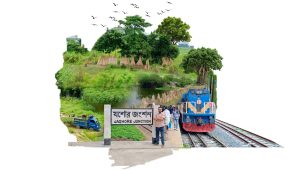
Hardinge Bridge, also known as Paksey Bridge, connects Paksey in Pabna with Bheramara in Kushtia by rail. It is difficult to believe that the historic bridge crossed its centenary in 2015. Named after Lord Hardinge, the Viceroy of India, the steel railway bridge remains one of the most striking landmarks along the Padma.
The idea of building a bridge over the Padma at this point had been discussed for more than two decades. The Eastern Bengal Railway first proposed the project in 1889. After years of investigation, planning and debate over its location, the project was finally approved in 1908. Construction began in 1910 and was completed in 1912.
British engineer Sir Robert Gailes led the construction as chief engineer. The first trial train crossed the bridge on January 1, 1915, followed by a second trial on February 25. On March 4, 1915, Lord Hardinge officially inaugurated the bridge. Around 24,000 workers were involved in its construction.
The bridge stretches for about 1.8 kilometres and has 15 main steel truss spans, each about 345 feet between bearings, along with six 75-foot approach spans, three at each end. Supported by massive piers, the bridge was built to withstand the heavy loads of railway traffic and remains an impressive example of early twentieth-century engineering.

But Kushtia is more than a bridge. Today, train services make the journey from Dhaka to Kushtia considerably easier. Several intercity trains connect the two destinations, with journey times and fares varying according to the service and class. Travellers should check the latest Bangladesh Railway schedule and fare before setting out.
From Kushtia town, Bheramara and Hardinge Bridge are accessible by local transport. The journey itself is part of the experience, as the landscape gradually changes and the Padma comes into view.
Under the bridge, boats offer another way to experience the river. A ride along the Padma towards the Rooppur Nuclear Power Plant area can turn an ordinary winter afternoon into something memorable. The river, the open sky, the passing boats and the immense bridge overhead create a scene that is difficult to capture from the road.




After Hardinge Bridge, the journey through Kushtia naturally leads towards another important part of its identity: literature.
About 15 kilometres from Kushtia town, in Shilaidaha Union of Kumarkhali Upazila, stands Rabindranath Tagore’s Kuthibari. Surrounded by gardens, a pond and open spaces, the estate carries the memory of one of Bengal’s greatest literary figures.
From 1889 to 1901, Rabindranath Tagore visited Shilaidaha intermittently while managing his family’s estate. The house, with its rooms and preserved belongings, offers more than a glimpse into the life of the poet. It also evokes the landscape that influenced his writing. Walking through the compound, it is not difficult to imagine why the rivers, villages and rural life of Bengal found such a strong place in his work.
Kushtia’s literary heritage does not end with Tagore. Near Lahinipara Mor, beside the toll plaza of the Syed Masud Rumi Bridge, stands the house of novelist Mir Mosharraf Hossain, another important literary landmark of the district.
The region also carries a rich architectural heritage. In Jhaudia village, about 21 kilometres southwest of Kushtia town, stands the historic Jhaudia Shahi Mosque. The brick-built mosque is distinguished by its three domes and three arched entrances. Its relatively quiet surroundings make the visit appealing for those interested in the older architectural traditions of Bengal.
Yet perhaps no place represents the cultural soul of Kushtia more strongly than the Lalon Akhra.
Located in Kumarkhali Upazila, the shrine was built around the tomb of Lalon Fakir, the mystic whose songs and philosophy continue to influence generations across Bengal. The atmosphere around the shrine carries a different kind of energy. It is not simply a historical site; it remains a living cultural space.
Two major fairs are held at the Lalon Akhra each year, one during Dol Purnima and another on the first day of the Bengali month of Kartik. During these occasions, visitors and devotees gather, turning the area into a vibrant celebration of music, spirituality and folk culture.
And then there are the rivers. As evening begins to descend, sitting beside the Gorai River with a cup of tea offers a quieter way to experience Kushtia. The changing light, the slow movement of the water and the fading sounds of the day create a peaceful ending to a day of exploration.
The sandy shores of the Padma offer another kind of beauty. In Kumarkhali, meanwhile, the old buildings and narrow streets invite visitors to wander without a fixed destination. Across Kushtia town, traces of another era survive in its older structures, reminding visitors that the district’s history is not confined to museums or monuments. It is woven into the town itself.
Tagore Lodge is another place worth visiting, particularly for those interested in the literary and architectural history of the city. Alongside it are scattered old buildings that quietly preserve the character of a bygone Kushtia.
A journey through Kushtia, therefore, is not simply a trip to a collection of tourist spots. It is a journey through layers of Bengal’s history: from the engineering ambition of the Hardinge Bridge to Tagore’s literary world, from Mir Mosharraf Hossain’s legacy to Lalon’s philosophy, from historic mosques to the timeless movement of the Padma and Gorai.
Perhaps that is what makes Kushtia special. Here, history does not feel distant. It stands above the river, lives in old houses, echoes through songs, rests in quiet courtyards and flows endlessly with the water.