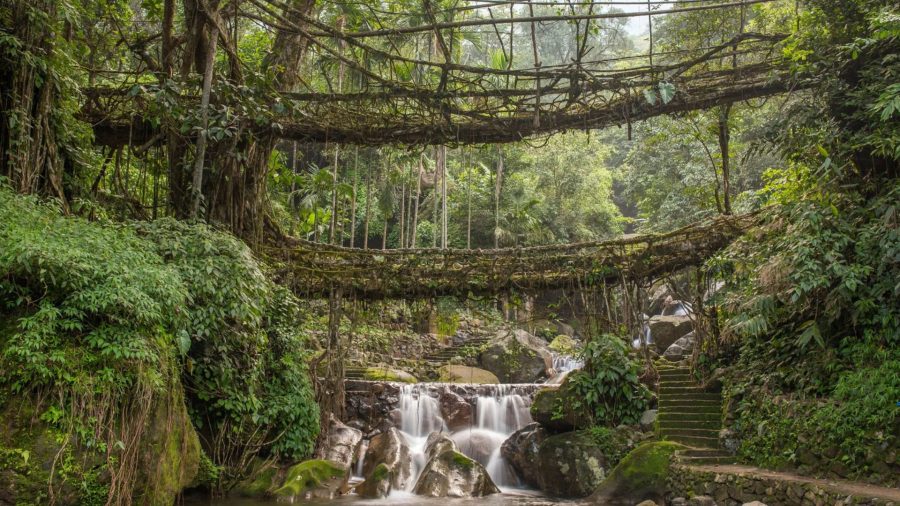

Most bridges are built. The ones in the Khasi and Jaintia hills of Meghalaya are grown: planted, coaxed, and tended across generations until a living tree has quietly become a structure strong enough to carry a person over a monsoon-swollen river. If slow travel has a physical monument, it may be this: a bridge whose builders will, in most cases, never live to see it finished.
The technique is known in Khasi as jingkieng jri, and it begins with a single Ficus elastica – the rubber fig – planted on the bank of a stream or the edge of a ravine. As the young tree sends out its aerial roots, villagers guide them horizontally rather than letting them drop toward the ground, threading the pliable young roots through hollowed betel nut trunks or bamboo scaffolding laid across the gap like a temporary skeleton.
Over years, sometimes 15, sometimes 30, the roots reach the far bank, take hold, and begin a process botanists call inosculation, essentially self-grafting, as the roots fuse and thicken into a single mechanically stable structure. Unlike timber, which rots, or steel, which rusts, a living root bridge does the opposite of ageing: the older it gets, the stronger it becomes, some surviving for centuries with nothing but regular maintenance: clearing moss, weaving in new roots, packing fallen leaves into the gaps to decompose into nourishing humus for the structure itself.

The engineering makes more sense once you understand the climate that demanded it. Cherrapunji, known locally as Sohra, sits at the southern edge of the East Khasi Hills and ranks among the wettest places on Earth, recording over 11,000 millimetres of rainfall most years. Conventional wooden bridges rot within a single monsoon season here; steel and concrete are difficult to transport and maintain across this vertical, isolated terrain.
A living bridge, by contrast, is actively nourished by the very rainfall that would destroy anything else. British officer Henry Yule became one of the first Westerners to document the phenomenon, writing about it with evident astonishment in the Journal of the Asiatic Society of Bengal in 1844, and the bridges he described are, in many cases, still standing, still growing, and still carrying villagers across the same rivers today.

The most famous of these structures is the Double Decker Root Bridge in Nongriat village, a remote Khasi settlement tucked at the bottom of a dramatic gorge, reachable only on foot. Visitors typically drive from Cherrapunji to Tyrna village, the nearest road access point, before descending roughly 3.5 kilometres on foot, a trek that is itself part of the experience, involving thousands of stone steps down into the valley. Individual bridges elsewhere in the East Khasi Hills range from as short as 15 feet to nearly 250 feet in span, scattered across villages that most tourist itineraries never reach at all.
For Bangladeshi travellers, the remarkable part of this story is how close it actually is. From Sylhet, the Tamabil border crossing sits roughly 55 kilometres away, a familiar day-trip route for anyone who has already visited Jaflong, just five kilometres short of the border itself.
Crossing into Meghalaya at the corresponding Dawki checkpoint requires a valid Indian visa, however. Once across, Shillong lies roughly 70 kilometres from Dawki, with Cherrapunji a further 54 kilometres beyond that, putting the entire living root bridge region within a single long day’s drive of the Bangladeshi border, or a more comfortable two- or three-day trip allowing time for the trek into Nongriat itself.
What makes this feature worth the border crossing isn’t only the spectacle of a tree behaving like infrastructure. It’s the underlying philosophy: an entire community organising itself around a structure that will outlive the people who build it, maintained not because anyone profits from finishing it, but because it will matter to grandchildren not yet born. In a travel culture increasingly organised around speed – the shortest layover, the fastest itinerary, the most efficient use of a long weekend – the living root bridges of the Khasi and Jaintia hills offer something almost radical: proof that some of the most resilient things humans have ever built were never rushed and were never really finished at all.