It is still almost an hour before dawn breaks. The night’s darkness has not fully lifted. The narrow alleys of Old Dhaka are still largely silent. Suddenly, the Fajr azan drifts from one mosque, then another, then several more. At the sound of the azan, some wake up to perform ablution, some prepare for prayer. Others, waking from sleep, begin preparing to start the day’s work.
It is during this time that another kind of “busyness” begins in some alleys of Old Dhaka.
Before daylight breaks, working people get down to work. Some are lifting shop shutters, some are arranging goods, some are preparing for the day’s business. And inside some shops, a fire is being lit. With coal and wood fire, the clay tandoor slowly begins to heat up.
After a while, a familiar smell begins to mix with the air: the smell of burnt coal, wood smoke, and dough mixed with ghee. It is difficult to separate the morning of Old Dhaka from this smell.
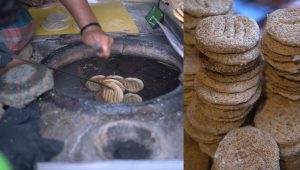
In the reddish glow of the clay tandoor, one after another, golden, crispy bakarkhani is born. A thin layer of raw dough is pressed onto the hot wall of the tandoor. After being in the heat of the fire for a while, it puffs up, hardens, and is made: this very old food of Old Dhaka.
Like many other foods of the city, the story of bakarkhani is not just a story of taste. It is intertwined with the lives, labour, family memories, and centuries-old food culture of the people of Old Dhaka.
From the morning breakfast of working people to the dining tables of aristocratic families, bakarkhani has found a place in the lives of people of various classes and professions. For many years, the mornings of Old Dhaka’s people have begun with this crispy bread and tea.
People from various parts of the country are also familiar with the taste of bakarkhani. Many who visit Old Dhaka take bakarkhani home with them. For some, it is a breakfast; for some, a memory of Old Dhaka; and for others, it is part of family tradition.

Holding on to a 150-Year tradition
In Gendaria of Old Dhaka, Kajal Mia and his family have been involved in making bakarkhani for nearly 150 years. They still hold on to the method that has come down through generation after generation.
In his shop, bakarkhani is made in the old way in a clay tandoor, with coal and wood fire. For Kajal Mia, bakarkhani is not just a business. His family’s long-standing identity is also intertwined with this food.
He says, “Bakarkhani has become known to people not only in Old Dhaka but also abroad. But bakarkhani is now being made in a different method than the one we traditionally use. As a result, the real aroma and taste are being largely lost. My family and I are determined to hold on to this old method.”
From his words, it is clear that for him, the fight to preserve the taste of bakarkhani is not just the fight of a businessman. It is also an effort to keep alive a long-standing family occupation. However, he admits that making bakarkhani in the old method is not an easy task.




Preparation begins at night
Bakarkhani is not made in a few minutes after arriving at the shop. Behind it lies long preparation. In Kajal Mia’s words, this work must begin at night.
He says, “Making bakarkhani in this old method is quite difficult. But the result is excellent food quality. We wake up in the middle of the night and knead the dough with ghee. At dawn, we open the shop and start making bakarkhani.”
Then begins the work of preparing the tandoor. Coal and wood are burned to heat the tandoor. The fire gradually intensifies. When the inner wall of the clay tandoor becomes sufficiently hot, the real work begins.
Kajal Mia says, “We prepare the tandoor by burning coal and wood. When the tandoor is sufficiently hot, we press each piece of raw bakarkhani onto the inner part of the tandoor. After a while, when they are done, we take them out with the help of an iron rod and set them aside.”
A little too much fire can burn the bakarkhani. Again, if the heat is low, it will not become properly crispy. As a result, managing the tandoor’s fire is also an important skill of this profession.
This is why bakarkhani made in the old method carries not just ingredients but also the artisan’s experience.
Arif Rahman regularly comes to eat bakarkhani at Kajal Mia’s shop. For him, the bakarkhani of this shop is not just a morning breakfast; it is also part of family memory.
He says, “My father, my grandfather and I have all eaten bakarkhani from this shop. There is a difference between its taste and the taste of bakarkhani prepared in the new method.”
In his view, the taste of tandoor-made bakarkhani is different. Arif Rahman says, “When bakarkhani is made in this method, the taste and quality of the bakarkhani remain intact.”
Perhaps in this customer’s words, one can understand how the taste of food mixes with personal memory. The shop where the grandfather ate bakarkhani, the taste the father knew, that same taste becomes familiar to the next generation as well.
Another bakarkhani trader of Old Dhaka, Wahid Mia, has been involved in this business for nearly 60 years. For a long time, he made bakarkhani in a clay tandoor.
But for the past year, he has been using a gas-powered oven instead of a tandoor. The change is not for taste, but out of the reality of the work.
Asked why he moved away from the old method, Wahid Mia says, “I still feel comfortable making bakarkhani in a tandoor. But those who currently work in my shop, and those who worked in the past, suffer. Burnt soot, the smell of smoke; it creates a lot of hassle. It is quite laborious.”
It is from this hardship that he moved to a gas oven. According to Wahid Mia, working at a tandoor is not only time-consuming but also physically difficult. One has to stand in front of the fire for long periods. One has to endure smoke. The smell of burnt soot clings to the body and clothes.
Wahid Mia also believes that tandoor-made bakarkhani and gas-oven-made bakarkhani are not the same. On the question of tradition disappearing, he says, “Of course, there is a difference. There is a difference in taste, aroma, and the way it is eaten.”
But then he adds, “In keeping pace with time and the era, we are letting the old method disappear.” His logic is also simple. “If you make it in an oven, you can make it quickly, and there is less labour. However, it takes about 15 litres of gas every day, which is a bit expensive.”
In other words, the modern method is not entirely advantageous either. Here, in exchange for less labour, another kind of cost increases. Yet, due to faster production and reduced labour pressure, many traders are leaning toward this method.
The mechanical blue flame may make bakarkhani faster. It will reduce labour. It will make business easier. But within that blue flame, there will be no memory of the tandoor’s red fire.
Perhaps one day, in some alley of Old Dhaka, a clay tandoor will burn for the last time. An old artisan will, for the last time, understand the heat of the fire and press raw bakarkhani onto the wall. After a while, he will lift it out with an iron rod and place it on the shop’s shelf. Then, perhaps the tandoor will burn no more.