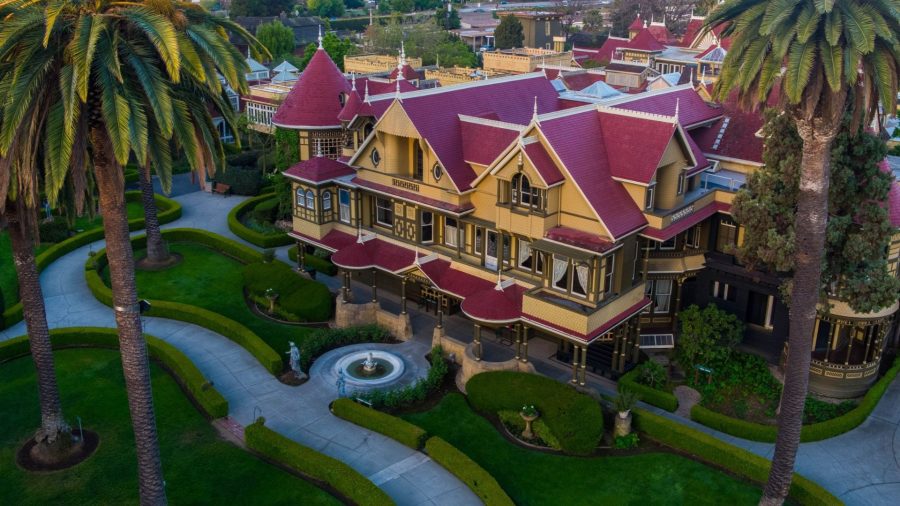



Behind a fortress of manicured hedges stands a sprawling Victorian mansion unlike almost any other. Inside the 24,000-square-foot labyrinth, doors open onto empty drops, staircases lead abruptly into ceilings, and windows are arranged in eerie groups of thirteen. Built by a reclusive and extraordinarily wealthy widow in the aftermath of profound personal loss, the Winchester Mystery House has fascinated visitors for more than a century.
Located at 525 South Winchester Boulevard in San Jose, California, the mansion is closely associated with the Winchester Repeating Arms Company, the famed firearms manufacturer founded by her husband’s family. Sarah Lockwood Winchester, widow of company treasurer William Wirt Winchester, oversaw the house’s design, with construction continuing for nearly four decades.
Sarah Winchester moved to California in 1885, reportedly on the advice of her doctors. She had endured a series of devastating losses, including the deaths of her infant daughter and husband. A year later, having inherited a substantial fortune, she began transforming a modest farmhouse into an enormous residence that would eventually become one of California’s most unusual landmarks.
The mansion eventually grew to 160 rooms, with around 10,000 windows, 2,000 doors and 47 staircases. Its most famous features are its architectural oddities: doors that open onto multi-storey drops, corridors that lead nowhere, hidden passages and staircases that terminate at ceilings.

Yet the house was not simply a collection of eccentricities. It also incorporated remarkably advanced technology for its time, including indoor plumbing, elevators, insulated walls, forced-air heating and an elaborate push-button communication system.
The reasons behind its bewildering design remain the subject of fascination. Historians have often interpreted Sarah Winchester’s constant construction as a possible way of coping with grief and keeping herself occupied. A much more dramatic explanation comes from a popular legend that a spiritual medium warned her that the Winchester family was being haunted by the victims of Winchester rifles.




According to the story, Sarah was told that she would remain safe only if she continued building the house. The strange doors, staircases and rooms were supposedly intended to confuse or appease the spirits. There is, however, no conclusive historical evidence that a séance or such a curse dictated the mansion’s design.
Sarah Winchester died in 1922. The property opened to the public the following year and gradually evolved into a major tourist attraction.
Today, visitors can explore portions of the sprawling mansion through guided tours that cover 110 of its 160 rooms, along with its winding passages, staircases and hallways. Specialised experiences take visitors into areas including the stone cellars, Victorian gardens and restricted sections of the house.

The mansion has also embraced its darker reputation. Nighttime flashlight tours, paranormal investigations and seasonal Halloween events invite visitors to explore the property through the lens of its ghost stories and alleged hauntings.
More than a century after Sarah Winchester’s death, the house remains suspended between history and legend. Its bewildering, almost Escher-like architecture offers a glimpse into an extraordinary chapter of one woman’s life, while its advanced engineering reveals a side of the mansion that is often overshadowed by its ghost stories.
Perhaps that is what makes the Winchester Mystery House so enduring. It is not simply a house built on mystery. It is a place where grief, invention, folklore and architecture have become impossible to separate.