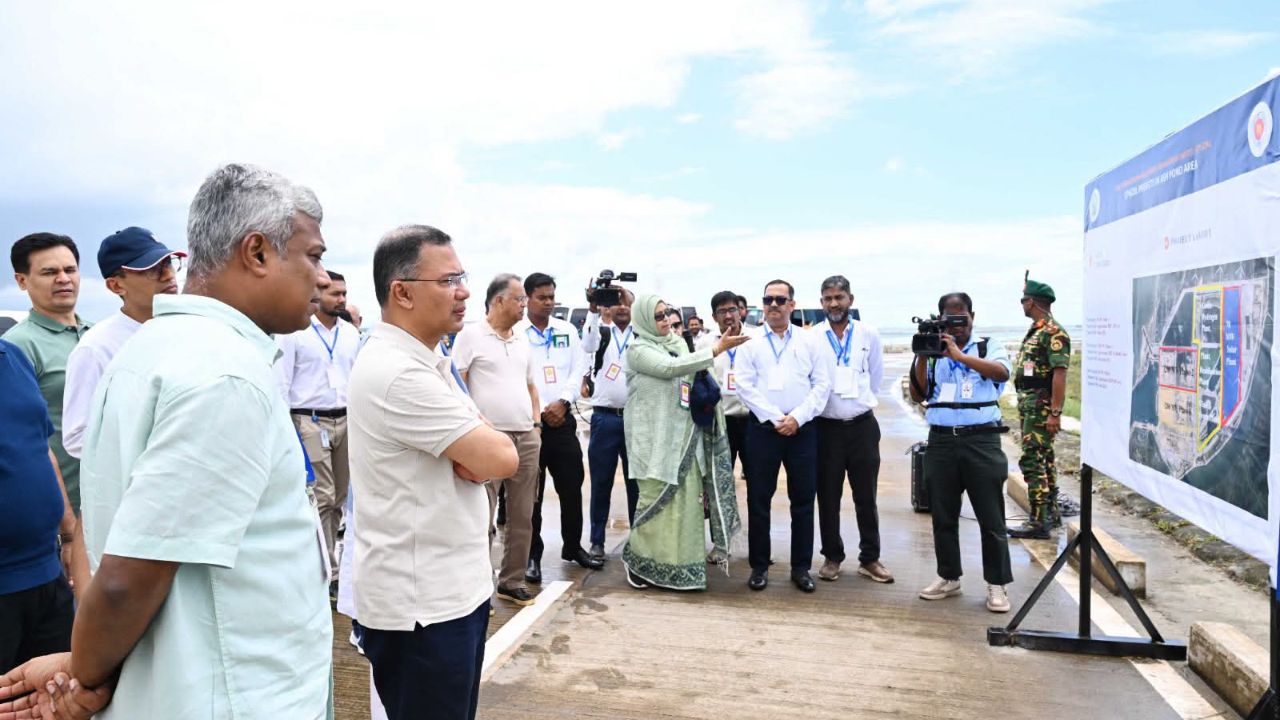



Prime Minister Tarique Rahman on Sunday outlined a major development vision for Chattogram, focusing on industrialisation of the coastal belt from Matarbari to Mirsarai, investment, marine resources, energy infrastructure and large-scale job creation.
During his tour of Chattogram, Tarique visited Maheshkhali and Matarbari before addressing a public rally at Baharchhara in Banshkhali.
He later visited Fatikchhari and Hathazari, where he announced a range of initiatives covering industry, energy, healthcare, social protection, agriculture and coastal infrastructure.
At the Banshkhali rally, Prime Minister Tarique Rahman said the government plans to develop the Matarbari-Mirsarai coastal belt into a major industrial corridor, creating jobs, attracting investment and boosting the region’s economy.
“I have seen the coastal area from Matarbari to Mirsarai by helicopter. This vast sea is not merely a body of water; it is a resource belonging to the people of Bangladesh,” he said.
The government plans to utilise marine resources and establish industries along the coast, he said, adding that the initiative would create employment opportunities, particularly for unemployed young people in Chattogram.
Tarique said a large industrial zone had been allocated in Chattogram for Chinese investors, where several hundred factories were planned.
Production from these industries would be exported to generate foreign currency, which could then be used to improve education and healthcare, he said.

Energy security key to industrialisation
The prime minister also highlighted the need to strengthen the country’s energy sector to support industrial growth.
Speaking in Fatikchhari after meeting leaders of Hefazat-e-Islam Bangladesh, Tarique said Bangladesh was facing an oil and gas crisis and criticised the previous government for failing to adequately develop domestic energy resources.
“Our institutions were kept idle while foreigners were given the work. We need a huge amount of oil and gas,” he said.
At the Banshkhali rally, he said the government had already started reforms in the power and energy sector.
A 10-year plan and proposals for the sector would soon be placed before parliament, Tarique said.
The plan would aim to ensure uninterrupted electricity for schools, colleges, hospitals, industries and residential areas, as well as adequate gas supplies for transport and other sectors.




He also linked investment to political and economic stability, saying investors would lose interest if there was disorder in the country.
The government would ensure that investors could import industrial raw materials without disruption and transport finished products through ports smoothly, he said.
Coastal embankments planned
Tarique also promised long-term investment in coastal embankments in Banshkhali and other vulnerable areas.
He said coastal embankments were an important part of the government’s master plan, although construction of a large and permanent embankment would take time.
“Everything will be done; we just need some patience,” he told local residents.
Support for salt farmers
The prime minister announced that salt farmers in Banshkhali would be brought under social safety-net and agricultural support programmes.
They would receive benefits under the Family Card and a special Farmers’ Card, alongside farmers engaged in rice, jute and vegetable cultivation, he said.
Tarique said a fair price for salt had already been determined after discussions with farmers and would be formally announced within days.
Family Cards, healthcare support
Tarique said nationwide distribution of Family Cards would begin on 16 August after completion of the pilot phase.
Around 41 lakh families are expected to receive the cards in the 2026-27 fiscal year, including 10,000 to 12,000 families in Banshkhali.
The government also plans to upgrade all 503 upazila hospitals to 101-bed facilities within five years, he said.
The initiative is intended to improve healthcare access for people in rural and remote areas.
Political stability
During his meeting with Hefazat leaders in Fatikchhari, Tarique called for cooperation in maintaining political stability and preventing disorder.
He said the group had worked with his party during the previous election and helped protect the country from what he described as a major danger.
“The problems have not ended yet,” he said, warning of what he described as various conspiracies by political opponents.
“We have to work together so that they cannot create any kind of disorder,” he said, adding, “You may not be part of the government, but you are partners of the government.”
He also called for religious harmony and urged people to practise their respective religions peacefully.
Hefazat Secretary General Maulana Sajidur Rahman presented several demands at the meeting, including justice for alleged killings at Shapla Chattar and during anti-Modi protests, legislation providing the highest punishment for insulting Islam, and recognition of Dawra-e-Hadith as equivalent to a master’s degree, with opportunities for Qawmi madrasa graduates to enter government service.
‘No one can stop Chattogram’s development’
Tarique said Bangladesh could no longer afford to remain behind more than five decades after independence. He called for increased agricultural production and industrialisation to create jobs and improve living standards.
Referring to Finance Minister Amir Khosru Mahmud Chowdhury and Home Minister Salahuddin Ahmed, both from Chattogram, he said their leadership of the two important ministries would help accelerate development in the region.
“With distinguished sons of Chattogram leading these two powerful ministries, no one can stop the development of Chattogram,” he said.
The prime minister’s announcements during his Chattogram tour centred on industrialisation of the coastal belt, greater use of marine resources, energy security, coastal protection, support for farmers and investment in healthcare and social protection.