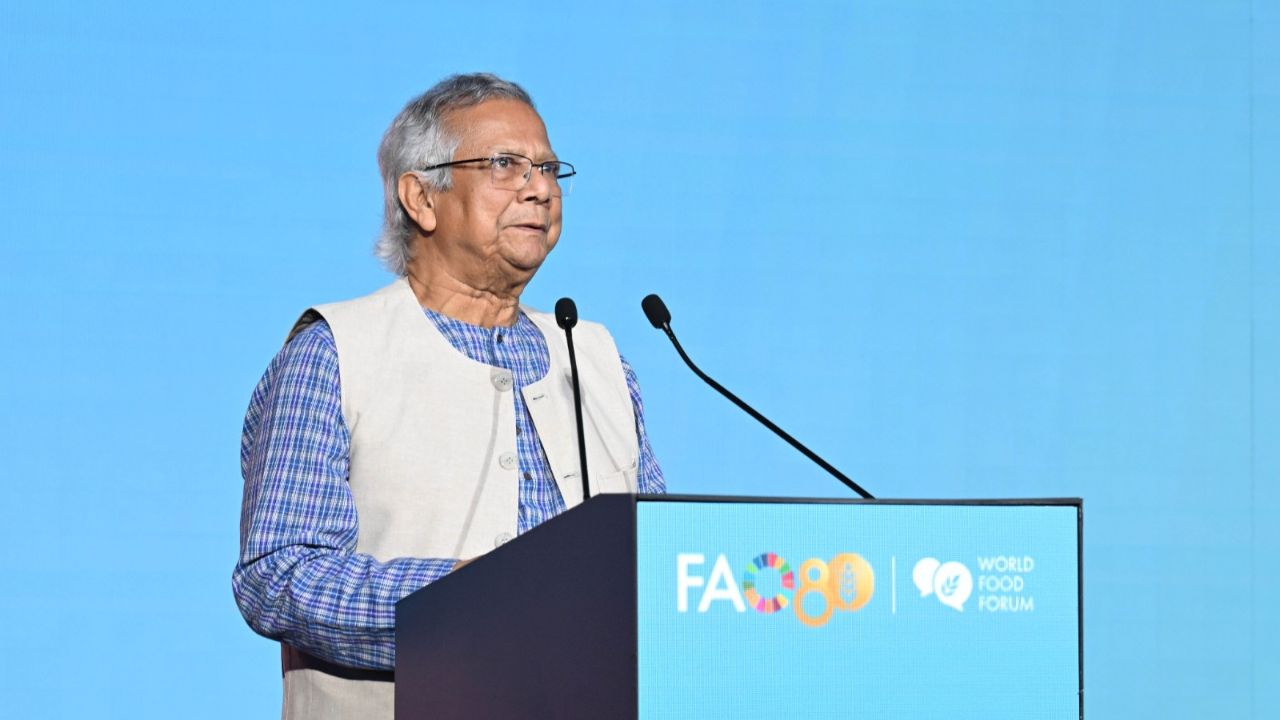

Chief Adviser Muhammad Yunus on Monday called on world leaders to end hunger and armed conflicts, presenting a six-point plan to overhaul the global food system at a time when the world is spending $2.7 trillion annually on military activities.
“While the world struggles to mobilise a few billion dollars to end hunger, we have no hesitation spending $2.7 trillion on weapons. Is this what we call progress?” he said in his keynote address.
Yunus urged the international community to break the hunger–war cycle by halting conflicts, opening dialogue, and ensuring access to food in war-torn areas.
He also emphasised the need for countries to honor financing commitments for the Sustainable Development Goals (SDGs), step up climate action, and help vulnerable communities strengthen their resilience.

He proposed establishing regional food banks to cushion against crises and stabilise supply chains, empowering young entrepreneurs through finance and infrastructure support, lifting export bans that undermine food security, and ensuring the Global South has access to agricultural technology and innovation.
The speech came during the opening of the 2025 World Food Forum (WFF), hosted from October 10 to 17 at the headquarters of Food and Agriculture Organization of the United Nations (FAO). This year’s theme, “Hand in Hand for Better Food and a Better Future,” centers on three key pillars – youth engagement, science and innovation, and investment.




Prof Yunus stressed that FAO’s 80th anniversary is more than a commemoration – it’s a rallying cry for urgent action. “Food is about dignity, justice, and the kind of world we want to build,” he said, adding that Bangladesh is proud to be a founding member of the Global Alliance Against Hunger and Poverty and is committed to providing technical, financial, and moral support under the Group of Twenty (G20) framework.
Highlighting the transformative power of youth, he said that young Bangladeshis played a decisive role in restoring democratic values through a peaceful movement last year. “Their demand was simple – return power to the people and build a fair, inclusive, and trustworthy society,” he said.
Yunus, a member of the Nobel Peace Laureates Alliance for Food Security and Peace, noted that hunger persists not due to scarcity but because of a flawed economic system. “In 2024, 673 million people went hungry even though we produce enough food for everyone. It’s not a production crisis – it’s an economic and moral failure,” he said.
He urged a fundamental rethink of the profit-driven economic model and called for scaling up social businesses that aim to solve problems rather than maximize personal gain. “Our ultimate vision is a Three-Zero World – Zero Wealth Concentration, Zero Unemployment through entrepreneurship, and Zero Net Carbon Emissions. This is not an idealistic dream – a it is a survival imperative,” he said.
Citing the example of Grameen Bank, he noted how microfinance has empowered women in Bangladesh. He proposed creating social business funds to support young farmers, women, agri-entrepreneurs, and innovators, backed by legal and financial frameworks that enable – not obstruct – entrepreneurship.
“Our youth are not like previous generations. They are connected, creative, and equipped with technologies that were unimaginable two decades ago,” he said. “We must stop telling them to wait for jobs. Instead, let’s help them create jobs.”
By investing in young innovators, Prof Yunus said, the world can achieve more than food security – it can reshape the future. “If we empower the youth, we will not only feed the world – we will change it,” he concluded.