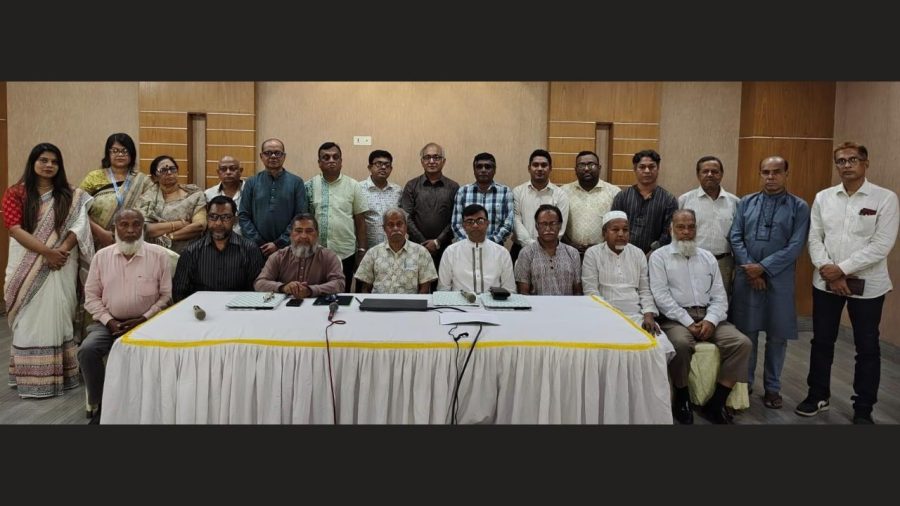

News media stakeholders have called for strengthening internal accountability mechanisms within newsrooms by ensuring the acknowledgement and correction of errors, effective management of audience grievances, and greater transparency in editorial decision-making to build audience trust. An effective self-regulation system can play an important role in improving professional standards, editorial independence, and public trust in the news media.
Organised by the Media Resources Development Initiative (MRDI), the event was part of an initiative implemented through the Canada Fund for Local Initiatives (CFLI), funded by the High Commission of Canada in Bangladesh, read a press release. The dialogue was held in Barishal as part of a series of consultations on improving professional and ethical standards in the news media and exploring possible frameworks for media self-regulation in Bangladesh.
Participants at a divisional consultation emphasised that audience trust depends not only on the timely publication of news, but also on how news outlets address complaints from readers and viewers, rectify mistakes, and follow established policies when making editorial decisions.
They stressed that news organisations must establish and effectively implement their own editorial policies, professional standards, and accountability mechanisms as part of an effective self-regulation system.

The consultation brought together media owners, publishers, editors, editorial decision-makers, leaders of journalist organisations, university teachers, and civil society representatives to exchange views on media accountability, editorial policies, complaints mechanisms, professional conduct, and public trust in the news media.
Internal grievance redressal mechanisms were identified as an essential component of media self-regulation.




Participants stated that accountability becomes more visible when news outlets have structured processes to receive and review complaints, along with arrangements for publishing corrections or explanations when necessary.
Speakers further noted that the accountability of news media owners must be discussed alongside editorial independence, as self-regulation cannot be ensured through journalists’ codes of conduct alone if professionals lack the opportunity to make decisions free from pressure by advertisers, political actors, or other influential groups.
The working conditions and economic security of journalists were also highlighted as closely interconnected with professional ethics. Participants asserted that timely payment of salaries, formal appointment letters, legally mandated benefits, and a safe working environment should be considered part of the accountability framework for news media organisations.
In addition, participants called for national discussions and policy initiatives on media self-regulation to give greater consideration to the experiences and realities of community news outlets and journalists outside Dhaka.
Pointing out that district-level outlets play an important role in providing information and highlighting local public interest issues, speakers emphasised the necessity of developing an inclusive and practical self-regulation framework that takes into account the diverse realities of news media across Bangladesh.
The consultation was addressed by Aminul Islam Khasru, President, Barishal Press Club; Kazi Miraj Mahmud, Editor, Dainik Ajker Poribartan, Barishal; Anisur Rahman Swapan, President, Reporters Unity, Barishal; Saifur Rahman Miron, President, Journalists Union, Barishal; Azad Alauddin, Editor, Bangladesh Bani and President, District Journalists Union, Barishal; Md. Hafizur Rahman, General Secretary, District Journalists Union, Barishal; Tunu Karmakar, President, TIB’s Committee of Concerned Citizens (CCC), Barishal; Henry Swapan, Joint Editor, Dainik Motobad; Gopal Sarkar, Editor, Weekly Jago Nari, Barishal; Md. Farhad Uddin, Head, Department of Mass Communication and Journalism, University of Barishal; Dr. Israt Jahan, Dean, Faculty of Social Sciences, University of Barishal; Jannatun Naim Oishi, Deputy Executive Director, AVAS, Barishal; Golam Kibria, Editor, Dainik Ganodabi, Patuakhali; Fasiul Islam Bacchu, Editor, Dainik Pirojpur Kantho, Pirojpur; Muhammad Shawkat Hossain, Editor, Dainik Ajker Bhola, Bhola; Ziaul Hasan Palash, Editor, Dainik Durjatra, Jhalokathi; Nasir Uddin Liton, Secretary, Bhola Press Club; K. M. Enayet Hossain, Executive Director, Society Development Agency, Patuakhali; Ziaul Ahsan, Executive Director, Pirojpur Gan Unnayan Samiti, Pirojpur; and Satyaban Sen Gupta, President, Sachetan Nagorik Committee (Sanak) of Transparency International Bangladesh, Jhalakathi.