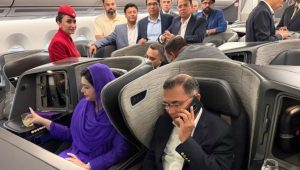
Speaker Hafiz Uddin Ahmed is returning home earlier than scheduled amid discussions over President Mohammed Shahabuddin’s possible resignation, with officials saying the resignation process will move forward once he arrives.
The president’s resignation letter is expected to be submitted to the speaker, who will then assume the role of acting president until a new president is elected, according to officials.
Parliament Secretariat officials said the speaker travelled to Thailand on 19 July for medical treatment and was scheduled to return on 26 July. However, due to the evolving situation, he is now returning two days earlier.
President’s Press Secretary Md Sarwar Alam said the president has not yet signed the resignation letter.
“The person to whom the resignation must be submitted is also abroad, so there is currently no way to tender it,” another official said, adding that various claims are circulating, there is no scope to take them into cognizance.

Under Article 50(3) of the Constitution, the president may resign by sending a signed letter addressed to the speaker. If the presidential post becomes vacant, Article 54 states that the speaker will perform presidential duties until a new president is elected.
The Constitution does not require the speaker to be present in person in the country when the president resigns. However, as the speaker has to assume presidential responsibilities immediately after a vacancy arises, the government wants to ensure a smooth transition.
According to Article 123(2), a new president must be elected within 90 days if the office falls vacant due to death, resignation or removal. Article 48(1) stipulates that the president is elected by votes of members of parliament.
Shahabuddin, 75, became president on 24 April 2023, during the Awami League government for a five-year term, which was scheduled to end in April 2028.



However, just 16 months into his tenure, he faced an unprecedented political crisis after the Awami League government was toppled in the student-led mass uprising. Prime Minister Sheikh Hasina resigned and left for India.
Despite the political upheaval, Shahabuddin remained at Bangabhaban. He approved the dissolution of parliament, administered the oath of office to the interim government led by Muhammad Yunus, and signed ordinances giving legal effect to decisions taken by the interim administration.
Several organisations backing the uprising launched a movement last October demanding his resignation.
The BNP, however, opposed the move, warning that it could create a constitutional crisis. The interim government ultimately decided against removing him.
In December 2025, Shahabuddin told Reuters that he intended to step down after the February parliamentary election. He said a new government would be expected to make arrangements for his departure.
He later said he felt “humiliated” after being sidelined during the interim government’s tenure, including the removal of his photographs from Bangladesh missions abroad and the scaling down of the Bangabhaban press wing.
Although the BNP formed the government with a landslide majority after the 12 February election, Shahabuddin did not resign immediately. On 17 February, Prime Minister Tarique Rahman and members of his cabinet took their oaths before him.
The president travelled to London in May for medical check-ups and treatment. He was accompanied by family members, doctors, nursing staff and Bangabhaban officials.
Shahabuddin underwent cardiac bypass surgery in Singapore in October 2023. During his UK visit, he underwent follow-up examinations as advised by doctors.
On 12 May, he underwent an angiogram at Royal Papworth Hospital in Cambridge, where doctors detected a serious blockage in one of his heart arteries. He subsequently underwent angioplasty and had a stent inserted before being placed under close medical observation.
Home Minister Salahuddin Ahmed told reporters on Thursday that the president had the constitutional right to resign if he wished, but said the government had taken no “initiative” regarding the matter.
The president is the supreme commander of Bangladesh’s armed forces, but the office is largely ceremonial, with executive powers vested in the prime minister and the cabinet.