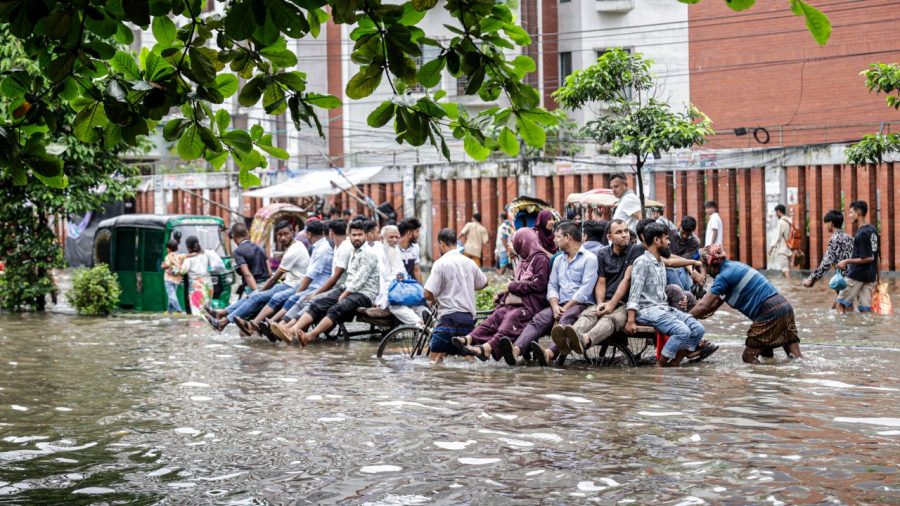

For Dhaka residents, heavy rain often means one thing: another day of wading through flooded streets.
But behind the familiar scenes of waterlogged roads and stranded commuters lies a deeper failure in the capital’s drainage system – including dozens of non-functional sluice gates meant to carry rainwater away.
Along the Buriganga River, Dhaka South City Corporation has 55 sluice gates. Only 24 are fully operational, 15 are partially functional, and 16 have stopped working altogether.
The worst situation is in the Babubazar-Kamrangirchar stretch, where most sluice gates are out of order, slowing the natural drainage of water from surrounding areas.
In several places, drain water now reaches the river through openings in the protection wall instead of functioning drainage channels. During heavy rain, this slows the outflow and leaves low-lying parts of Old Dhaka underwater for hours.
“Sluice gates cannot remain open all the time. During high tide, opening them would allow Buriganga water to flow back into the city,” Dhaka South Environmental, Climate and Disaster Management Circle Supervising Engineer (Civil) Rajib Khadem told TIMES.
“Most of the gates are now out of order. We also do not have the required manpower and maintenance structure to operate them.”

The consequences are felt across the capital every monsoon.
After early morning rain on Sunday, residents heading to work and school found many roads submerged. A scheduled autumn festival at AG Church School was cancelled after parents were informed that students could not reach the campus due to waterlogged roads.
Several Dhaka University examinations were also cancelled because of waterlogging.
By afternoon, water remained stagnant in areas including New Market, Dhanmondi, Zigatola, Malibagh, Rajarbagh, Shantinagar, Shukrabad, Azimpur, Mirpur, Moghbazar, Green Road, Bangshal, and Arambagh.



Roads in Jatrabari, Shanir Akhra, Motijheel, Kamalapur, and Gulistan were also affected, disrupting traffic and forcing pedestrians to walk through dirty water.
According to Dhaka South and Dhaka North City Corporation data, at least 129 locations across the capital experience regular waterlogging – 79 under Dhaka South and 50 under Dhaka North.
Among these, 15 areas in Dhaka North and 33 in Dhaka South have been identified as waterlogging hotspots.
For many residents, the problem has become a yearly cycle of promises and frustration.
“I have been seeing this suffering since birth. So many projects have been implemented, but the situation remains unchanged whenever the monsoon arrives,” said Rahul Saha after his motorcycle broke down on Jail Road due to waterlogging.
A system under strain
A World Bank study found that Old Dhaka’s drainage system mainly depends on gravity, with rainwater expected to flow into the Buriganga through sluice gates.
But during the monsoon, when the river level rises above the city’s water level, the gates must be closed. The system then depends on pumping facilities, which are already struggling.
Before 2021, Dhaka Wasa was responsible for drainage management. The agency prepared a drainage master plan in 2015, but it was never fully implemented after drainage and canal management responsibilities shifted to the city corporations.
For nearly five years, the two city corporations carried out separate projects without a new master plan. Despite significant spending, waterlogging has continued to worsen in many areas.
Engineer Khadem said the city corporations received drainage responsibilities from Dhaka Wasa without receiving the manpower and infrastructure needed to operate sluice gates.
Dhaka South has now sent proposals to the ministry for additional manpower, budget support and repairs, while the Institute of Water Modelling (IWM) is conducting a technical assessment of the gates.
The challenges extend beyond sluice gates.
Dhaka South data shows that one of the three major pumps at eight key drainage outlets has remained out of order for a long time. The remaining two are also not operating at full capacity.
Of the five cleaning machines operated by the two city corporations, one is unusable. Meanwhile, many sections of the 26 canals under the city corporations have lost their capacity to carry water.
Dhaka South said it has assigned IWM to conduct a detailed study of waterlogging causes in Zones 1 to 5.
Based on the findings, the city corporation plans to modernise drainage systems, repair damaged sluice gates, increase pumping capacity, shorten water discharge routes and add new water suction pumps.
For Dhaka residents, however, the question remains whether these plans will bring relief before the next heavy rain arrives.