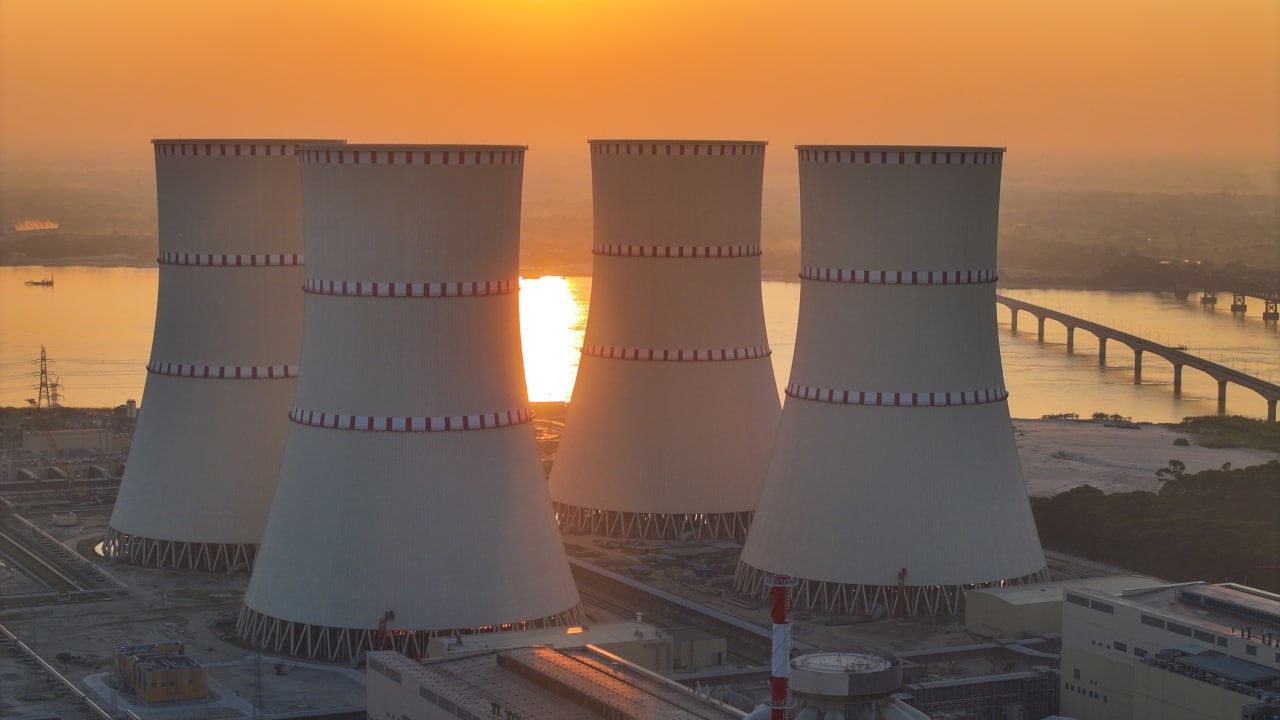

Bangladesh’s first nuclear power plant faces an uncertain start as Russian experts investigate why a safety pressure valve at the Rooppur Nuclear Power Plant is not functioning, leaving the timeline for its first 300 megawatts of electricity supply unclear.
The unresolved technical issue has delayed the final stage of bringing the country’s largest development project into operation, despite fuel loading and other major preparations already being completed.
A senior official of Bangladesh Atomic Energy Regulatory Authority told TIMES that an official of Russia’s Rosatom, the plant’s builder, informed him that the expert team would submit its findings by mid-October.
“He did not say whether it would be good or bad. Please pray that the outcome is positive,” the official said.
However, the official did not disclose what caused the valve problem or how long it would take to resolve.
Russian Ambassador to Bangladesh Alexander Khozin recently said efforts were underway to supply 300 megawatts of electricity from Rooppur to the national grid by October. But Science and Technology Secretary Anwar Hossain said the timeline was not certain.

“The team of experts from Russia is still conducting tests. After completing the tests, they will identify the cause and submit a report. We will take the next steps afterwards,” he told TIMES.
The safety pressure valve is a critical component of the plant’s operation, but authorities have not disclosed whether the malfunction is linked to the reactor safety system or the final commissioning process.
The government had earlier announced that Rooppur would begin supplying 300 megawatts of electricity in August. Preparations, including fuel loading, had already been completed before the technical issue emerged at the end of July.
Science and Technology Minister Faqir Mahbub Alam later confirmed that the safety pressure valve was not functioning and said no specific timeline could be given for electricity generation until the problem was resolved.




After experts working in Bangladesh failed to fix the issue, a five-member specialist team arrived from Russia on 11 September. The team began inspections the following day, and the assessment has continued for more than a week.
Meanwhile, during a courtesy meeting with Federation of Bangladesh Chambers of Commerce and Industry leaders in Dhaka last week, Ambassador Khozin said work was progressing towards supplying 300 megawatts from Rooppur by next month.
However, Anwar told TIMES that the matter had been reported inaccurately and that there was no certainty the plant would begin production next month.
The conflicting statements have added to uncertainty over when Bangladesh will finally receive electricity from its first nuclear power plant.
Last Monday, Minister Mahbub met Alexey Likhachev, director general of Russia’s state nuclear corporation Rosatom, in Vienna, Austria.
The meeting discussed ensuring the earliest possible supply of electricity from Rooppur to the national grid. However, the Rosatom chief did not provide any specific timeline.
The delay comes as Bangladesh continues to face power shortages due to a gas supply crisis. Load-shedding has affected households, agriculture, businesses, industrial production and healthcare services.
The absence of expected Rooppur electricity has added pressure on the national power system at a time when industries and consumers are already struggling with energy constraints.
Questions remain over why the technical problem emerged after major preparations, including fuel loading, had been completed and when the authorities will be able to provide a firm timeline for resolving the issue.
The Rooppur Nuclear Power Plant, the largest single project in Bangladesh’s history, is being implemented by the Bangladesh Atomic Energy Commission under the Ministry of Science and Technology.
Russia’s contractor Atomstroyexport is constructing two units, each with a capacity of 1,200 megawatts. Once operational, the plant is expected to meet 10 to 12 per cent of the country’s electricity demand.
Under the original agreement, the first 1,200-megawatt unit was scheduled to begin generation in October 2023, while the second unit was planned to start production by October 2024.
Delays caused by the Covid-19 pandemic and the Russia-Ukraine war pushed back the timeline, with revised targets set for trial production by December 2024 or mid-2025. That deadline also passed after work on the power transmission line remained incomplete.
The latest target for starting electricity generation from the first unit has been set for the end of 2026.
Until Russian experts identify the cause and solution, Bangladesh’s nuclear power debut remains tied to an unresolved technical issue with no confirmed timeline.
The country’s first nuclear power plant will have a total generation capacity of 2,400 megawatts.