



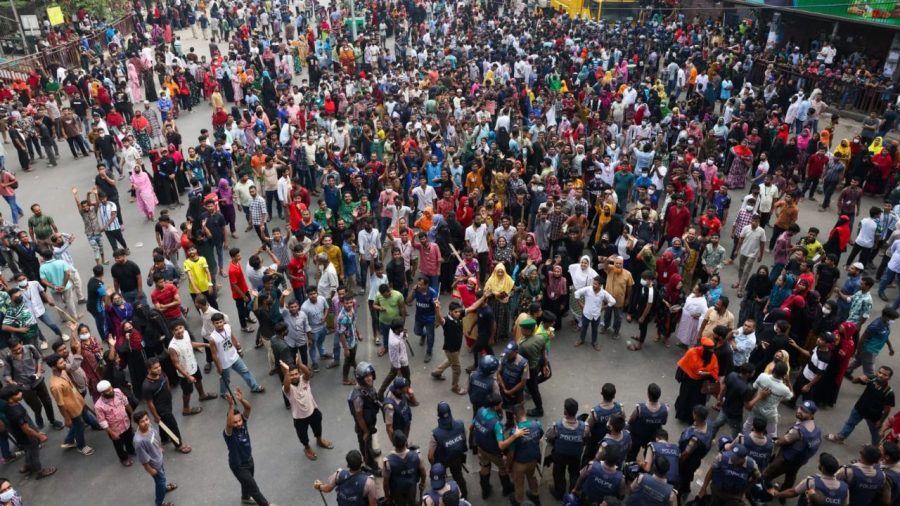



Production remained halted at 148 garment factories in Savar, Ashulia and Gazipur on Sunday as workers continued protesting ahead of the employers’ submission of their minimum wage proposal on Monday, with labour leaders warning of renewed unrest if the offer fell short of workers’ expectations.
Employers are set to submit their proposal at the Minimum Wage Board’s third meeting. Although the amount has yet to be finalised, sources said it could range from Tk14,000 to Tk15,000, less than half the Tk32,000 minimum demanded by the workers’ representative.
Labour leaders warned that an inadequate offer could fuel further unrest, urged employers not to use factory closures to pressure workers during negotiations, calling for a settlement through dialogue.
Employers acknowledged the need to raise wages in line with living costs and market prices but stressed the importance of considering the industry’s financial capacity, international competitiveness and export order situation.
Bangladesh Knitwear Manufacturers and Exporters Association (BKMEA) President Mohammad Hatem told TIMES, “Although workers’ demand for wages ranging from Tk32,000 to Tk48,000 has raised expectations, most factories in the country cannot afford to pay such amounts. There are even questions about the ability of many factories to pay wages exceeding Tk15,000.”
Hatem said employers would finalise their proposal through internal discussions before submitting it on Monday.
He argued that wage decisions must reflect the financial and production capacity of most factories rather than the performance of better-equipped establishments alone.
A Wage Board delegation that visited factories in Narayanganj found workers earning Tk8,000–9,000, indicating that even the existing Tk12,500 minimum wage was not being implemented everywhere.

Hatem said earnings varied according to workers’ skills, productivity and job types.
“Some piece-rate workers earned Tk40,000–50,000 a month, while output was comparatively lower under fixed-wage arrangements.”
He proposed annual wage adjustments linked to inflation to ensure regular income increases and reduce recurring disputes over minimum wage revisions.
Garment Workers’ Trade Union Centre President Montu Ghosh welcomed the proposal.
“There is considerable scope to consider this. Wages are determined in this way in many countries, including Japan,” he told TIMES.


Housing costs and worker benefits
Hatem urged government intervention to control housing rents in industrial areas, warning that landlords could absorb much of any wage increase.
He said he had raised the issue at a meeting chaired by the Labour Minister and expressed employers’ willingness to build dormitories for workers if the government allocated khas land.
He also proposed expanding rationing and Open Market Sale (OMS) facilities, building hospitals and providing worker accommodation where necessary.
Factory closures persist despite easing protests
Although Savar and Ashulia were largely calm on Sunday, production remained disrupted across the industrial belt.
In Gazipur’s Mouchak area of Kaliakair, law enforcement personnel arrived after workers staged a sit-in outside a factory. The workers dispersed after about half an hour.
Isolated incidents of unrest were also reported in Konabari and Jarun.
According to Bangladesh Garment Manufacturers and Exporters Association (BGMEA) data, 56 factories remained closed on Sunday, while workers at another 92 left without working, leaving 148 factories without production.
Section 13(1) of the Bangladesh Labour Act permits factory closures on a “no work, no pay” basis, denying workers wages for the days covered by the provision.
On Saturday, production was disrupted at 147 factories, including 55 closed under Section 13(1) and another 92 where operations were suspended.
IndustriALL Bangladesh Council (IBC) President Mir Abul Kalam Azad urged cooperation among workers, employers and the government.

“Workers want a fair wage, if they do not get it, the anger that has been building for so long could intensify further,” he told TIMES.
IBC General Secretary Salauddin Swapan remarked, “Workers will not back down from their legitimate demands. Many are trying to exert pressure during the negotiations but they (workers) will not retreat from their legitimate demands.”
Echoes of the 2023 wage protests
The latest tensions recall the unrest surrounding the previous minimum wage revision in 2023.
The Labour Ministry formed the Wage Board in the second week of April that year.
At its fourth meeting on 22 October, workers proposed Tk20,393, while employers offered Tk10,400.
Protests erupted the following day and spread across Mirpur, Narayanganj, Savar, Ashulia and Gazipur.
On 30 October, garment worker Russell Hawlader died after being injured during clashes and chases involving police and protesters in Gazipur. A factory was subsequently set on fire, and employers attempted to contain the unrest by closing 200 factories.
Three other workers — Imran, Jalal Uddin and Anjuara Khatun — also died during the three weeks of protests.
As unrest escalated, employers revised their offer on 7 November, raising it by Tk2,100 to Tk12,500.
The revised amount was adopted as the minimum wage and took effect on 1 December.


