Security has been tightened at key installations across the country amid fears of a possible militant attack, with intelligence operations stepped up nationwide, law enforcement officials say.
Authorities say banned groups are attempting to recruit members under pseudonyms on both online and offline platforms. They are also believed to be taking advantage of easier communication links with Pakistan and Afghanistan, seeking opportunities to signal their presence.
The alert follows confidential reports from multiple agencies, prompting Police Headquarters to issue a warning to all units.
Investigators say several instances of covert activity by outlawed organisations have recently come to the attention of the Dhaka Metropolitan Police (DMP) Counter Terrorism and Transnational Crime (CTTC) unit.
According to police, two suspected militants operating under the aliases Hasan and Rana are based in Sylhet and Dhamrai, on the outskirts of Dhaka.
In a letter dated 23 April, the Deputy Inspector General at Police Headquarters warned that members of a banned extremist group could target important installations, including the parliament building. Units were instructed to take effective preventive measures.
Following the directive, police and intelligence agencies have intensified surveillance and security arrangements.
DMP Motijheel Division Deputy Commissioner Harun-or-Rashid said the Protection Division is responsible for the routine security of key installations.
While the internal alert did not name any specific group, it referred to the recent arrest of a suspected member of Jama’atul Mujahideen Bangladesh (JMB), identified as Ishtiaq Ahmed Sami, also known as Abu Bakkar and Abu Mohammad.
Police said the suspect had maintained regular contact with two dismissed members of the armed forces.

Speaking on Saturday, DMP CTTC Joint Commissioner Munshi Shahabuddin said there was a risk of a militant attack in the country, although no specific organisation had yet been identified.
Militants have regained strength
Militant groups are showing signs of renewed activity, with security analysts warning that previously contained networks may be regrouping.
Several individuals held on suspicion of militancy were released on bail during the interim government period, officials say. Some are believed to have used public gatherings to rebuild networks and regain strength.
At the time, senior officials, including the interim government’s home affairs adviser and top police officers, maintained that there was no militant presence in the country. Former DMP Commissioner Sheikh Md Sajjat Ali drew criticism after publicly stating that “there are no militants in the country”.
Security experts now say such assessments may have underestimated the threat.
Major General (Retd) ANM Muniruzzaman, president of the Bangladesh Institute of Peace and Security Studies, said militant activity had not been fully eradicated.
“The problem did not disappear. It remained subdued over the past two to four years,” he said. “The capacity we had built to counter militancy weakened after 5 August 2024. Trained personnel are no longer in place, and monitoring has declined.”




He added that there were indications militants were reorganising and resuming activities, stressing the need to rebuild counter-terrorism capacity and strengthen surveillance.
“Reports of militant activity in India also raise concerns for Bangladesh, as such groups often maintain regional links and cooperation,” he said.
Law enforcement officials say tracking suspects is complex and time-consuming.
DMP CTTC Investigation Division Deputy Commissioner Ilias Kabir said it can take months to apprehend a single suspect.
“One arrest often leads to another through linked networks. They are highly cautious and operate in secrecy,” he said, adding that investigations into several individuals are ongoing.
CTTC officials said that on 2 April, acting on intelligence, a team detained a 16-year-old suspect, Ishtiaq Ahmed Sami, also known as Abu Bakar, in Habiganj Sadar.
Police said he had links with several individuals named in an anti-terrorism case filed at Sher-e-Bangla Nagar police station, including Ahsan Zahir Khan, Daniel Islam Hasan, and Russell, also known as Palash and Abu Baser Al Faruqi.
A suspected member of a banned militant group was arrested earlier this year as part of a broader counter-terrorism drive, police said.
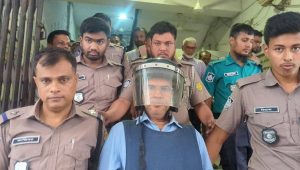
On the evening of 31 January, DMP CTTC officers detained Ahsan Zahir Khan, 50, from the south-western side of Zia Udyan lake in Dhaka.
CTTC officials said he was affiliated with the outlawed JMB. He is also accused in a case filed under the Anti-Terrorism Act at Phulbaria police station in Mymensingh.
Following his arrest, he was produced before a court in connection with a separate anti-terrorism case lodged at Sher-e-Bangla Nagar police station.
CTTC chief Md Masud Karim said the detained teenager (Sami) had been questioned and later sent to a juvenile correction centre through a court order.
He said the suspect was arrested for maintaining contact with previously detained militant members and for being active on online platforms.
Officials say banned groups, including JMB, continue to use encrypted and social media platforms such as Facebook, Messenger, WhatsApp and Telegram to communicate under pseudonyms.
A senior CTTC officer said members use these channels to promote extremist ideology and coordinate activities.
Investigators allege the detained teenager shared content online supporting the Islamic State (IS) group, attempted to recruit members, and circulated PDF manuals on making explosives.
The suspect is also accused of encouraging and planning attacks on Shia mosques, police checkpoints and ISKCON temples through close associates, the officer said.
Cross-border links
Indian police recently claimed that they have arrested a suspected member of Lashkar-e-Taiba (LeT) near the outskirts of New Delhi, in a case they say points to wider regional connections.
The Delhi Police Special Cell said the suspect, identified as Shabbir Ahmed, also known as Raja and “Kashmiri”, was detained in Ghazipur on 29 March with support from central intelligence agencies.
Indian officials allege he had travelled from Bangladesh and was planning a major act of sabotage in India under the direction of Pakistan’s intelligence agency, the Inter-Services Intelligence (ISI).
Investigators say the case is linked to a cross-border financing network spanning Pakistan, Bangladesh and Nepal.
Recent incidents raise security concerns
In January, a bomb was discovered inside a school bag on Alipur Bridge in Faridpur. The device, wrapped in tape and fitted with a remote-control mechanism, was defused by a team from the police Anti-Terrorism Unit.
In a separate incident on 21 February, a police officer was stabbed during a checkpoint search in the Kutubkhali area of Jatrabari in Dhaka. Officers became suspicious of a group of four young men carrying a bag. When they attempted to search it, one of the men attacked Constable Md Shah Alam, 33, before the group fled. A bomb was later recovered from the bag left behind. The case is under investigation by the CTTC unit.
On 15 February, two people, Jihad Ali and Al Amin, were killed in an explosion in Chapainawabganj’s Charbagdanga area while allegedly preparing explosives. Three others were seriously injured, and police arrested five suspects in connection with the incident.
Earlier, on 8 January, an explosion in a residential house in Bhedarganj upazila of Shariatpur destroyed part of the structure, killing one man, Sohan Bepari, 32, and injuring two others.
A major blast was reported on 26 December 2025 at Ummul Qura International Madrasa in South Keraniganj, injuring four people, including women and children. Investigators said materials used to make explosives, including improvised devices and chemicals, were recovered from the site. The madrasa’s director, Sheikh Al Amin, remains at large, while another suspect, identified as Mufti Harun, is also being sought. One individual, Ahsan Ullah, has been arrested.
Just days later, on 29 December 2025, another explosion occurred near the residence of Mufti Jasim Uddin Rahmani in Mohammadpur, Dhaka. Rahmani had been released from prison after 5 August 2024, having previously been detained over allegations of militant involvement.
In Jashore, a joint security operation on 31 January recovered a cache of weapons from a house in Bagharpara. Authorities said the haul included foreign-made pistols, magazines, ammunition, grenade-like devices, sharp weapons, communication equipment and surveillance devices.