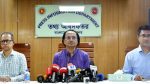
Health and Family Welfare Minister Sardar Md Sakhawat Hussain has urged World Health Organization (WHO) and Alliance for Transformative Action on Climate and Health (ATACH) to move beyond discussions and begin immediate field-level operations to protect global public health from climate disasters.
Addressing a high-level strategic meeting in Paris on Thursday, he said, “There have been many plans and discussions; now is not the time for just ideas or words. We must show work now to save people”.
The day-long meeting, titled “Recommendations for the Alliance for Transformative Action on Climate and Health (ATACH) and Commitments to Accelerating Progress on Climate-Resilient and Low-Carbon Health Systems,” was jointly organised by French Ministry of Health, WHO, and ATACH.
During his address, the minister expressed deep condolences to the families of those who lost their lives in the ongoing severe heatwave in France and to those affected by the recent earthquake in Venezuela.

Highlighting the crisis in Bangladesh, he pointed out the acute shortage of drinking water in coastal regions, stretching from Cox’s Bazar across the southern belt.
Sakhawat noted that water has become saline and polluted, making it unfit for drinking, bathing, or daily use. Groundwater levels have dropped so significantly that water cannot be extracted even with deep tube wells, a situation he urged global organisations to monitor and resolve.



He called for the urgent establishment of a “Climate Finance for Health” fund to protect low and middle-income countries, which are suffering the most from the spread of infectious and non-communicable diseases due to climate change.
Emphasising the need for eco-friendly technology to reduce air pollution and carbon emissions, he mentioned that many countries, including Bangladesh, still use traditional coal-fired brick kilns. He stressed that transitioning to modern concrete block technology requires global technical and financial assistance.
The minister also urged WHO to take a proactive role in fostering multi-sectoral collaboration between the health, environment, energy, and water sectors. He suggested developing practical guidelines to measure greenhouse gas emissions from health systems and sending teams to the field for public awareness and training.
Expressing hope that WHO would transform into a fully effective body rather than remaining idle, he shared Bangladesh’s progress in building a climate-resilient health system. He noted that the country has conducted health risk assessments and formulated “National Adaptation Plan for Health 2026-30,” which provides a complete action plan for low-carbon healthcare.
This plan prioritises issues such as dengue, vector-borne and waterborne diseases, and illnesses related to heat and air pollution, such as stroke and COPD. It also addresses malnutrition, food security, maternal and neonatal health, and mental trauma caused by climate disasters.
The meeting was attended by Anita van den Ende, secretary general of Ministry of Health, Welfare and Sport of the Netherlands, and Dr Gloria J Balboa, undersecretary of Department of Health of the Philippines, among other international representatives.
The minister travelled to Copenhagen on 21 June at the invitation of UNICEF and arrived in Paris on 24 June. He is scheduled to return to Bangladesh on Saturday, 27 June.