Home Minister Salahuddin Ahmed on Friday said the government has begun implementing measures to make Bangladesh free of drugs and gambling in line with the BNP’s election manifesto.
He made the remarks while addressing a discussion and award-giving ceremony organised by the Department of Narcotics Control (DNC) at the Osmani Memorial Auditorium in Dhaka to mark the International Day against Drug Abuse and Illicit Trafficking 2026.
The programme, chaired by DNC Director General Md Hasan Maruf, was also attended by Senior Home Secretary Monjur Morshed Chowdhury as a special guest.
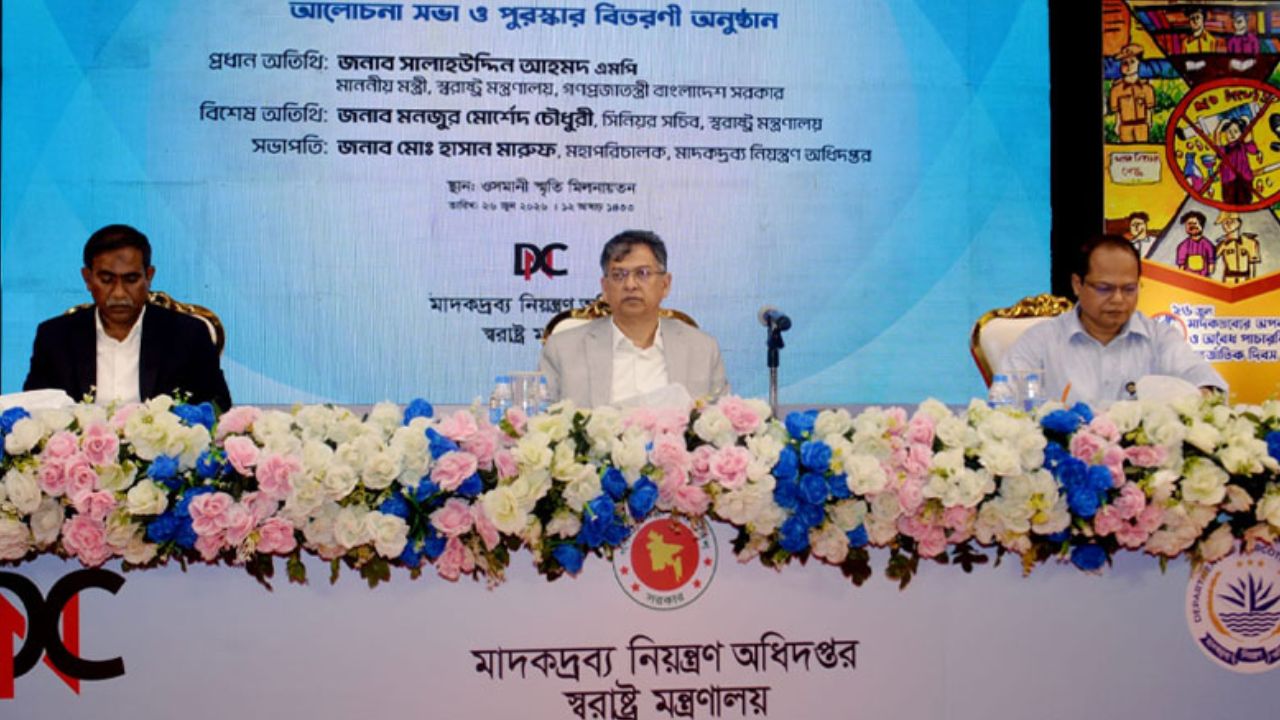
The minister said Bangladesh is currently experiencing a demographic dividend, with a large working-age youth population, and protecting them from drugs and gambling remains a government priority.
“Our election manifesto pledged to protect the youth from the clutches of drugs and gambling, and we are working accordingly,” he said, adding that the government is pursuing a zero-tolerance policy against narcotics.

Salahuddin said the government would place the Narcotics Control (Amendment) Bill before Parliament within the next two days to strengthen the DNC’s operational capacity.

The proposed amendment will grant the department greater autonomy and allow its officers to carry modern firearms, including 9mm pistols, after receiving specialised training. The minister said the move is intended to enable DNC personnel to confront armed drug traffickers more effectively.
He also expressed concern over the growing backlog of drug-related cases, noting that around 80,000 such cases remain pending in Dhaka alone.




To speed up trials, the amended law will include provisions for establishing special tribunals where necessary. The government also plans to introduce trained sniffer dogs for narcotics detection, establish detention facilities for DNC officials in compliance with the Code of Criminal Procedure, and set up advanced chemical testing laboratories in every district.
The minister said drug trafficking and gambling have increasingly shifted to digital platforms, with criminal networks targeting young people through social media, encrypted communications and online betting.
He said the Public Gambling Act of 1867 is no longer adequate to address cyber-based gambling and financial crimes. On the advice of the National Telecommunication Monitoring Centre (NTMC), the government is strengthening the legal framework to trace money laundering conducted through mobile financial services, anonymous SIM cards, one-time passwords (OTPs) and WhatsApp.
Salahuddin said the government’s focus has shifted from arresting street-level drug dealers to dismantling the financiers and organisers of the narcotics trade.
The proposed amendment includes provisions to confiscate assets acquired through illegal drug proceeds under the Narcotics Control Act, 2018 and the Money Laundering Prevention Act, 2012. He said the DNC has so far filed nine money laundering cases and is investigating another 23 major cases.
Referring to the recent discovery of a ketamine manufacturing laboratory in Uttara, the minister said the emergence of New Psychoactive Substances (NPS) has created fresh challenges for law enforcement.
He stressed, however, that the government considers drug addicts as patients rather than criminals. To support their rehabilitation, it plans to establish 200-bed government treatment centres in every division, increase financial assistance for private rehabilitation centres and provide advanced training for addiction treatment professionals to strengthen psychosocial counselling services.
Concluding his speech, the minister said the fight against drugs cannot be won by the government alone and called for a coordinated social movement involving educational institutions, parents, teachers, religious leaders, civil society and non-governmental organisations.
Earlier, he visited an anti-drug exhibition stall, unveiled the Annual Drug Report and a commemorative publication, and distributed prizes and certificates to winners of anti-drug awareness competitions.
This year’s observance of the International Day against Drug Abuse and Illicit Trafficking was held under the theme: “World Drug Problem: Persisting Issues, New Challenges, Innovative Responses.”