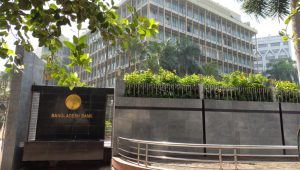
Fresh concern has emerged over S Alam Group – once a dominant and controversial conglomerate in the banking sector – and its chairman Mohammed Saiful Alam, who has been living abroad since the fall of the Awami League government in August 2024.
Despite investigations into alleged looting and money laundering, loss of ownership, and legal restrictions, a show of strength by around 1,000 people in front of Islami Bank on Sunday has intensified speculation — is an attempt to regain influence from behind the scenes now taking shape?
Protesters demanded that control of the banks be returned to S Alam and that officials appointed by the group be reinstated.
Shortly afterwards, another group staged a counter-protest at the same location, calling for the immediate arrest of S Alam and the seizure of his assets.
The uninterrupted show of strength by a group widely labelled as “bank looters” has sharpened concerns — is the banking sector, now undergoing reforms, again facing old risks?
From early morning, a large number of dismissed officials gathered in front of Islami Bank’s head office at Dilkusha in Motijheel.
They began a human chain at 9am, although the announced time was 10am amid deployment of heavy police personnel across the area.

On the ground, more than 1,000 people were seen continuing the programme until around 12pm. Many said they had travelled from Chattogram and Patiya — the hometown of S Alam — to join the gathering.
The protesters demanded dissolution of the current boards of Islami Bank, First Security Islami Bank, Social Islami Bank, Union Bank, and Global Islami Bank—all once controlled by S Alam Group along with restoration of previous ownership.
They also called for the reinstatement of officials dismissed after the political transition.
According to them, they had served the banks for years but were removed without clear reasons during the tenure of interim government, headed by Professor Muhammad Yunus. They described the decision as “unjust and illegal”.
However, many bank officials dismissed their claims.



A bank official, speaking to TIMES of Bangladesh on condition of anonymity, said a large portion of the protesters had been recruited through opaque processes during the regime of ousted prime minister Sheikh Hasina, with many appointed without formal recruitment notices.
Around 11,000 persons were recruited in the five banks. Of which, around 10,000, including 5500 from Islami Bank alone were removed.
Although written examinations were later introduced by the interim government to verify appointments, most did not participate and got fired. Those who did take part have retained their positions.
A different scene unfolded in the afternoon.
As the sacked officials ended their programme, another group under the banner of “Grahok [Customer] Forum”, backed by a large Islamic party staged a human chain and protest at the same spot.
They described S Alam as a “bank looter” and demanded his arrest, asset seizure, and the recovery of billions allegedly laundered abroad.
The Forum also demanded that the banks were previously taken over by force and should be returned to their rightful owners.
They warned that the dismissed group must not be allowed to re-enter the banking system under any circumstances.
Behind these opposing positions lies a broader reality — the scale of allegations of financial irregularities linked to S Alam Group.
The Criminal Investigation Department is probing allegations of Tk1.13 lakh crore in money laundering.
At the same time, regulatory assessments suggest that by 2024, around Tk2.25 lakh crore had been siphoned off from the banking sector in the name of loans by the politically linked conglomerate.
The group’s influence is also reflected in loan default data.
According to information presented in Parliament, 11 of the country’s top 20 defaulting entities are linked to S Alam Group.
Analysts say this indicates that the group’s financial exposure and risks are deeply embedded across a large segment of the banking sector.
Against this backdrop, controversy has intensified following the inclusion of a new Section 18A in the Bank Resolution Act.
Questions are being raised over whether the provision creates a legal pathway for the return of previously controversial owners, including S Alam.
Responding to a question from journalists on Saturday, Prime Minister’s Finance Adviser Rashed Al Mahmud Titumir said, “The law provides equal opportunity for all.”
“If it conflicts with the Constitution or any other law, the Supreme Court will interpret it,” he said.
Many interpret his remarks as suggesting that the possibility of ownership restoration within the legal framework is not being entirely ruled out.