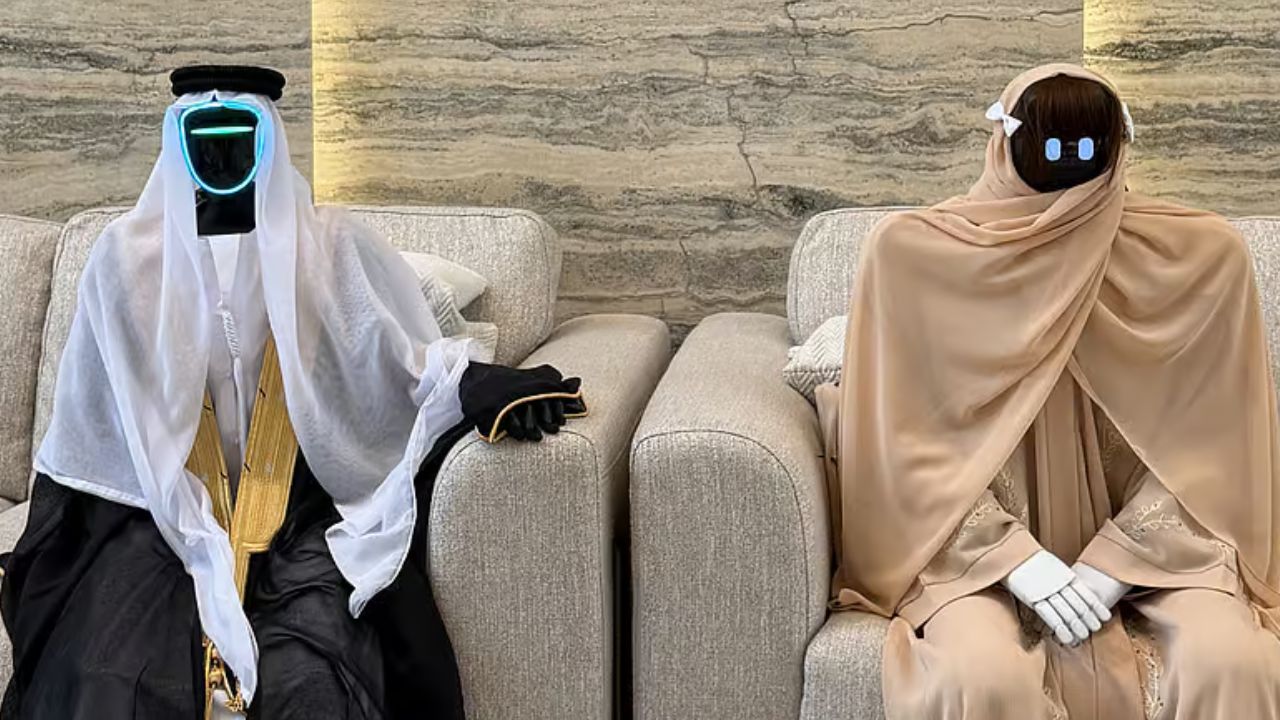



In an unusual celebration bringing traditional Emirati customs into the age of humanoid robots, a couple has tied the knot in a ceremony designed to make advanced technology feel familiar and approachable to the public.
The stars of the celebration were the groom, Bu Sunaidah, and the bride, Moza, two humanoid robots whose names were carefully chosen to reflect local Emirati identity.
While the groom does not eat and the bride never tires, their dream honeymoon would keep them entirely within the United Arab Emirates.
The mastermind behind the event is Yousif Lootah, an Emirati entrepreneur and technology advocate, who clarified that the celebration was not a mere social media stunt. “It was not simply a funny event,” Lootah told Khaleej Times.
“We wanted to show that robots are no longer something distant or complicated. They are becoming part of our lives and our future”.

According to Lootah, an entertaining idea can provide the first step towards education. “When people smile and engage with an idea, they begin asking questions about robots and artificial intelligence,” he said, adding that this was the real objective.
Lootah and his team treated the event much like a genuine wedding, paying close attention to the programme, settings, and cultural elements to create a memorable experience.
The celebration combined authentic Emirati elements with a forward-looking spirit to prove that technological progress and national identity can progress together. “Technology does not erase our identity or culture,” Lootah said, explaining that an Emirati robot can reflect societal values.



The groom, Bu Sunaidah, was developed as a sociable Emirati character who interacts with the public, while the bride, Moza, represents an intelligent Emirati female robot who encourages learning and creativity.
Lootah hopes the newlyweds will eventually be joined by other locally inspired robotic personalities to establish a family of Emirati characters that can inspire future generations.
While Lootah did not disclose the total cost of the wedding, including the venue and dinner, he emphasised that the value of its impact far outweighed the price.
The primary objective was to communicate that technology can be close to society, serving educational and inspirational purposes.
Although food was served, the robotic couple could not join their guests at the dinner table. “The guests enjoyed food and atmosphere,” Lootah said with a smile, noting that the happiness surrounding the couple was the best gift they could receive.
The event was particularly popular among children and families. Lootah noted that rather than the number of guests, the true success was the scale of engagement. “If we encouraged one child to dream of becoming a robotics engineer, then I believe our message succeeded,” he said.
Online, social media users reacted with a mixture of jokes, questions, and speculation about the future. One comment that particularly amused Lootah read, “Today, robots are getting married.
Tomorrow, they will be our colleagues at work”. Addressing concerns about automation, Lootah clarified that robots will not replace human workers but will instead work alongside them to improve the quality of life.
Looking to the future, Lootah suggested visits to the Museum of Future and other national attractions for the couple’s tour, followed by an educational initiative to teach children how to design and programme robots.
His broader vision is for the UAE to become a global capital for robotics and artificial intelligence, attracting innovators, universities, and businesses worldwide.
Lootah dreams of school and university programmes where every Emirati student learns to design, programme, and develop robots, urging the youth to become creators, not just consumers, of technology. “Do not limit yourself to using artificial intelligence,” Lootah said. “Learn how to develop it, innovate through it and use it to serve your country and humanity”.
“My dream is to see robots developed by Emirati hands in every school, university and institution,” he concluded, expressing his belief that UAE can become the best place in the world to lead the robotics and artificial-intelligence revolution.