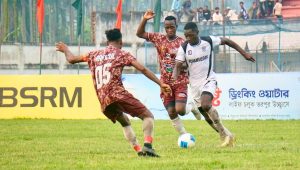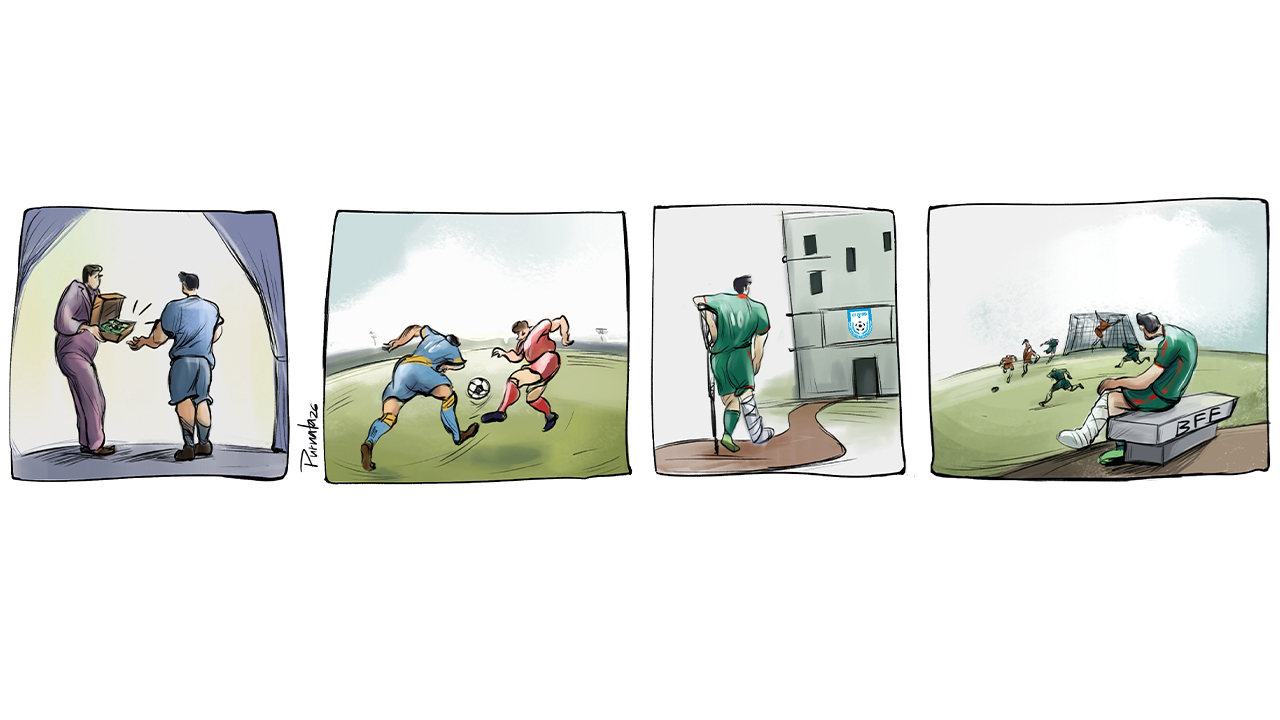



Whether out of social obligation, or simply for money, Bangladesh national team footballers regularly turn out for local-level tournaments. In common parlance, this is known as “khep khela” — playing for hire. What makes it controversial is that these same players receive a monthly sports allowance from the government and are under professional contracts with their clubs. Even so, the practice persists, raising uncomfortable questions about why it continues at all.
Players turning out for such unauthorised matches is nothing new. But the issue resurfaced recently after videos of several footballers — including Shekh Morsalin, Foysal Ahmed, and Mehedi Hasan — playing in local fixtures went viral. State Minister for Youth and Sports Aminul Haque was visibly unimpressed after spotting current national team players at local tournaments in Tangail and Jhenaidah.
“I went to two tournaments, one in Tangail and one in Jhenaidah. In both places, I saw our current national team players taking part,” Aminul told to media. “The government gives footballers one lakh taka every month. Even then, why must they play these matches? That question has come to my mind.”
The timing only sharpens the concern. Bangladesh will host the SAFF Championship in Dhaka from 4 to 17 November, with the team aiming for a stronger FIFA ranking and a path toward wider Asian competition.

Former national team captain Zahid Hasan Emely believes national players, in particular, should steer clear of such matches, given their relative financial security compared to lower-tier professionals.
“Those who are not in the national team or camps can play; I see no harm in that. But national team players should not. They have financial stability,” Emely told TIMES of Bangladesh.
That financial security, however, isn’t always guaranteed by the clubs. TIMES spoke to one of the footballers seen in the viral clips, who agreed to talk only on condition of anonymity.




“I know it is not right to play such matches as a professional footballer. We do not play these matches when the league or national-team camp is going on. We play them during the off season or break, although I know it is not right. Sometimes people we know, or people from our area, invite us and at times it is difficult to refuse the request. Sometimes district administrations organise tournaments too, and again it becomes difficult to say no.”
He pointed to inconsistent club payments as another driving factor.
“Clubs are not in a financially sound position right now. In almost every season most of the players do not receive their salaries as per agreement,” he added.
The player said he tries to play cautiously in these matches to avoid injury, aware of the risks involved.
Those risks are far from theoretical. National team regular Atiqur Rahman Fahad tore his ACL playing a local match in Chattogram in 2019 and was sidelined for over a year. Jafar Iqbal suffered a serious knee injury around the same period, while Motin Mia dealt with repeated hamstring and ankle problems in Sylhet between 2019 and 2021.
Sad Uddin and Mahbubur Rahman Sufil picked up muscle strains on a waterlogged pitch in Sylhet, and Nabib Newaj Jibon was warned by both Abahani and the BFF after reportedly playing during an injury lay-off in 2021.
Poor playing surfaces and rough tackling can quickly turn a paid exhibition match into a career setback. Emely noted that there’s little regulatory protection in these games.
“There are no fixed rules for these matches. Defenders tackle however they can,” he said.
The BFF does not directly contract national team players, Emely explained, but the federation and the ministry could act jointly to address the issue. Aminul says he plans to raise the matter with BFF president Tabith Awal, starting with warnings to players before considering action against repeat offenders.