The persistence of custodial deaths remains a grim constant in Bangladesh’s political history, with human rights advocates revealing yesterday that no administration over the last 25 years has been free of such fatalities.
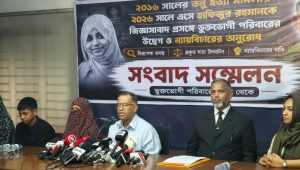
At a discussion held at the National Press Club to mark the International Day in Support of Victims of Torture, participants called for an immediate overhaul of the legal framework to eliminate torture in state custody.
Data presented by Md Sazzad Hussain, director of Programmes at the human rights organisation Odhikar, highlighted that 486 individuals died due to custodial torture between 2001 and 22 June 2026.
The statistics illustrate that the practice spanned across various political and transitional regimes.
According to Odhikar’s study, the BNP government (2001–2006) recorded 184 custodial deaths, representing 38 per cent of the total. This was followed by six deaths during a brief caretaker administration and 42 deaths under the military-backed caretaker government between 2007 and 2009.

The highest volume of fatalities occurred under the Awami League administration from 2009 to June 2024, which saw 213 deaths, or approximately 44 per cent of the total, excluding those killed during the July Uprising.
Following the subsequent political transition, 29 deaths were recorded under the interim government (August 2024–February 2026), while two deaths have been documented under the current BNP administration as of 22 June 2026.


Taskin Fahmina, Odhikar’s director of Training and Advocacy, further noted that 4,289 extrajudicial killings were documented during the same 25-year period.
Survivors of state violence shared harrowing testimonies of their ordeals.
Imtiaz Hossain Rocky described his 12-year legal battle following the death of his brother, Ishtiaque Hossain Jonny. In February 2014, a police team led by then Sub-Inspector Jahidur Rahman Khan detained the brothers from Pallabi.
Jonny died after being tortured for over two hours at the police station. Rocky noted that despite a decade of litigation under the Torture and Custodial Death (Prevention) Act, 2013, the case has only moved through two judicial tiers.
Azizul Haque Islamabadi, central organising secretary of Hefazat-e-Islam, recounted being held in a cramped 8-by-8-foot cell with 22 others during a 35-day remand. He described being deprived of water for three days and forced to stand for nine hours at a time.
The long-term impact of state violence was also highlighted by MA Muhaimen Pulak, who lost sight in his left eye due to a pellet injury during the July Uprising.
He spoke of his ongoing struggle with post-traumatic stress disorder. Similarly, Momtaz Begum shared the story of her 18-year-old son, Sheikh Shahriar Bin Matin, who was shot and killed by police during the same uprising.
Advocate Shishir Manir criticised the fundamental nature of the country’s legal processes, stating that the criminal justice system is “built on torture” from the point of arrest.
Speakers at the event demanded comprehensive reparations and compensation for victims to address the enduring physical and psychological trauma.
Other notable speakers included ICT Prosecutor Tanveer Zoha, Jatiya Mukti Council chief Faizul Hakim Lala, and UN Human Rights Officer Zahid Hossain.