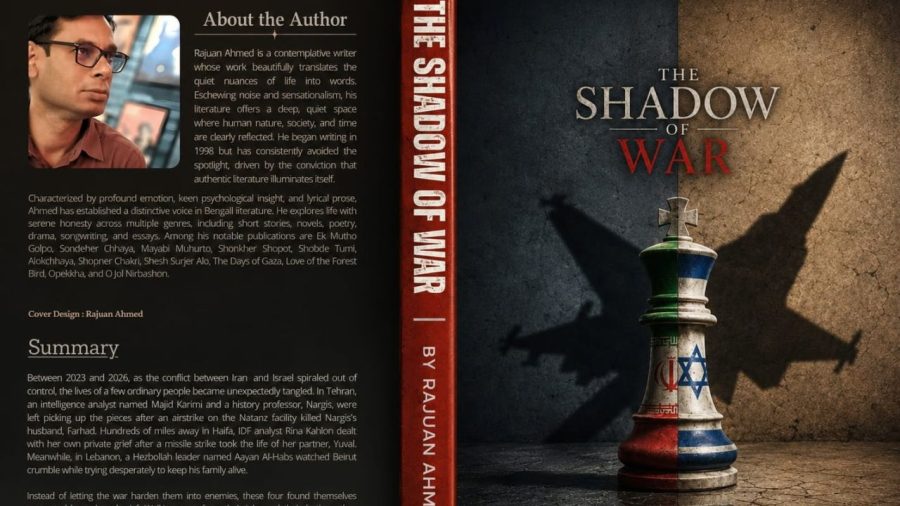



The New York Public Library has added The Shadow of War, a geopolitical novel by Bengali author Rajuan Ahmed, to its permanent collection. Published by Headroom Publishers, the book is now listed in the library’s main catalog and on OverDrive, the global digital lending platform. Scholars, students, and general readers anywhere can borrow it in electronic form. The novel explores the toll that war takes on people, both physically and psychologically, and it has sparked new conversations in literary circles abroad.
Beyond the Numbers
Most war coverage counts things: territory held, missiles fired, and people killed. Ahmed focuses instead on the people those numbers leave out: ordinary citizens who are trying to get through each day and to live with what they have seen. The story is set amid the Middle East tensions of 2023 to 2026, when the conflict between Iran and Israel escalated to a degree never seen before. Caught in that chaos, people from opposing political camps find their lives bound together.
Together, these characters form a cross-border group called “Bridges of Peace.” They carry no weapons. Instead, they document the physical and emotional damage that the war inflicts on women and children. The novel suggests that cycles of violence end through empathy and shared compassion, not through military strength.

Publication Details
Headroom Publishers released the book in August 2026. The e-book edition carries ISBN 9798235000339, and the paperback edition carries ISBN 9798224864218. Readers can borrow it through the New York Public Library’s OverDrive collection. Amazon Print-on-Demand sells it in more than eleven countries, and it is also available from Rakuten Kobo and Books-A-Million. It is categorized as international thrillers, geopolitical fiction, and humanitarian fiction.





The Author
Ahmed keeps a low public profile. He writes fiction and poetry, works as a lyricist and columnist, analyzes capital markets, and runs an industrial business. He avoids publicity and does not promote himself. In his view, good art finds its readers without a marketing campaign. He published his first short story, Abhagi, in 1991 while he was still in college. After completing his Master’s degree in 1999, he began a corporate career but never stopped writing. He has also earned praise for his screenwriting in film and television.
Much of his work deals with social realities, identity crises, and humanitarian disasters. His Bengali titles include Ek Mutho Golpo, Mayabi Muhurto, Shonkher Shopoth, Sada Aproner Adale, and Shopner Chakri, all of which look closely at everyday life. His books on international conflict, among them The Days of Gaza, In the Land of Mirages, and O-Jol Nirbashon, have been well received. His science fiction novel Quantum Wizards took readers in a new direction.
A Wider Door for World Literature
An English-language novel by a Bangladeshi author has now entered one of the world’s best-known libraries. That matters for international literary exchange. Writers from South Asia and the Global South have long struggled to gain entry to Western publishing and library networks. Tools like Amazon Print-on-Demand and OverDrive are changing that, and authors such as Ahmed can now reach readers across the world directly.
The Shadow of War is more than a story. It gives voice to people whose suffering rarely makes the news: those who have been driven from their homes by conflict. Headlines usually stop once the damage has been counted. Fiction can stay with the silence that follows and with the wish to start over. Thanks to the library’s digitization efforts, researchers and students of conflict and human relations now have this novel as a resource.
What It Stands For
War can redraw borders for a time, but it is the relationships between people that eventually heal a society. Ahmed makes that case to readers everywhere. For him, the book’s place in the New York Public Library is not just a personal milestone. It is a lasting effort to put a humane account of war on the world stage.