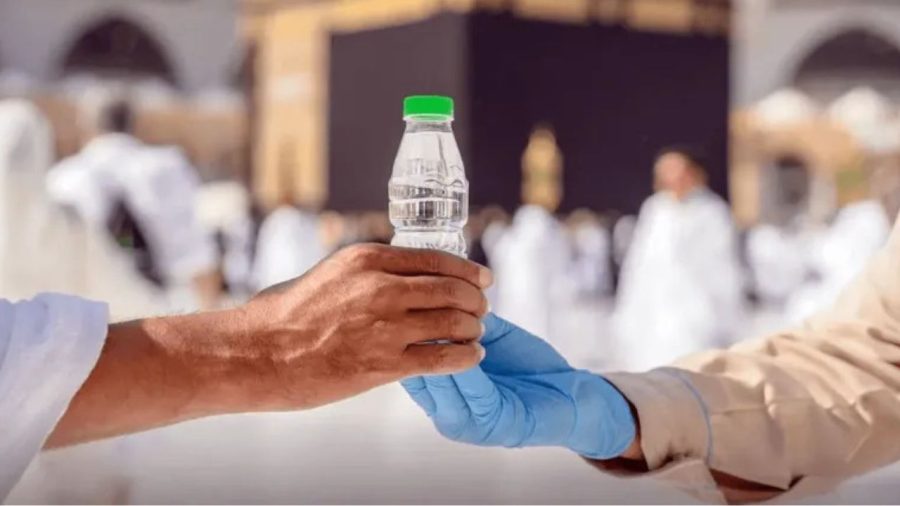



Consumers in Dhaka are paying up to Tk3,600 for five litres of water sold as Zamzam, despite sellers often being unable to provide reliable proof that it actually comes from the sacred well in Makkah.
The trade continues both online and offline despite a ban on open-market sales, while traders themselves have alleged that some sellers mix ordinary water with Zamzam before selling it.
Some vendors say they collect the water from Hajj pilgrims, while others say they obtain it through different agencies. But many could not show dependable evidence of where the water came from, how it was stored or whether the contents of the bottles were genuinely Zamzam water.
Some traders even acknowledged that they buy and sell the water largely on trust.
The Zamzam well, located 21 metres southeast of the Holy Kaaba in Saudi Arabia, carries special religious significance for Muslims performing Hajj and Umrah. Worshippers travelling from distant countries drink the water and use it for ablution and bathing, and also take it home for family members when they return.
A sealed five-litre bottle costs 10 riyals, or about Tk282, in Saudi Arabia. Smaller bottles and loose water are available free of charge.
Once the water reaches Dhaka, 250 millilitres is sold in some places for Tk300 to Tk350, while five-litre bottles fetch as much as Tk3,600.
During visits around the capital’s Baitul Mukarram National Mosque, Zamzam water was found being sold at shops dealing in Islamic goods.
However, the traders concerned were reluctant to provide detailed answers about how the water is collected, how supply is maintained throughout the year, how much it costs to buy, how it is stored or transported and whether ordinary water is mixed with it.

Several shopkeepers on the ground floor of Baitul Mukarram said demand for Zamzam water is high, but supply is irregular.
They said they obtain the water either from Hajj pilgrims, whom they pay an “honorarium”, or through various agencies. One trader, who declined to be named, claimed that at least 250 shops in the area sell Zamzam water, although none can maintain a regular supply.
Traders were reluctant to disclose how much they pay for the water or provide details about sourcing, storage and transport.
To understand the reality of pilgrims selling Zamzam water, this correspondent spoke to Mofizur Rahman, who recently returned from performing Umrah.
“We bring back whatever amount we are allowed to carry and distribute it among relatives and neighbours. It never occurred to me that it could be sold,” he said.



Some traders also alleged that ordinary water is mixed with Zamzam before sale.
Shahin Mia said a small number of businesses engage in the practice, adding that anyone with even a minimum understanding of Islam should not do so.
Shukkur Ali, a trader near Baitul Mukarram, alleged that some shopkeepers bring in a single five-litre bottle and continue selling from it throughout the year by mixing it with ordinary water.
He said they keep a Zamzam bottle on display to support the claim that the water is genuine, adding that disputes have broken out over the practice several times.
Retail buyers, he said, cannot tell which water is genuine Zamzam and which is adulterated.
Questions over the authenticity of water sold in Dhaka as Zamzam had already prompted regulatory action.
In 2023, the Directorate of National Consumers’ Right Protection found Zamzam water being sold commercially during a drive at Baitul Mukarram Mosque Market. At the time, 250-millilitre bottles were selling for Tk300 to Tk350 and five-litre bottles for more than Tk2,500.
Enamul Haque Khan Dolon, general secretary of the Baitul Mukarram Market Business Owners’ Association, had said he was unaware of the sales and questioned whether Hajj pilgrims would sell Zamzam water. He also said action would be taken against traders violating the law.
On 30 January 2024, the directorate ordered a halt to open-market sales, warning that shops could be sealed for breaching the directive. It also said action would be taken against people selling Zamzam water through Facebook pages.
The directorate said, “Business that capitalises on religious sentiment must certainly be stopped.”
The restriction was imposed after consultations with Islamic experts, amid the absence of information showing that Saudi Arabia commercially sells water from the Zamzam well.
Despite the directive, the trade has not disappeared. While open-market sales appear to have declined, advertisements have re-emerged on social media and online platforms.
Some sellers offer “original Zamzam water” at fixed prices, while others advertise Tk990 packages of ruqyah paper and Ajwa dates with “free Zamzam water”. Courier and cash-on-delivery services are also promoted.
Facebook pages including “Taharat Zone” and “Manar” carry direct sales advertisements, alongside many similar sites. However, the source and authenticity of the water being sold online could not be independently verified.
‘Sale is permissible’, but conditions apply
Islamic jurisprudence does not directly prohibit the sale of Zamzam water once it has been collected and taken into private possession.
A fatwa published by IslamQA, citing Ibn Qudamah’s Al-Mughni and Saudi scholar Sheikh Abdul Aziz ibn Baz, says Zamzam water may be sold after it has been collected in a container and may also be taken from Makkah to other countries.
Hanafi scholars have expressed a similar view. Darul Ifta Birmingham says bottled Zamzam water becomes the property of the person possessing it and may therefore be bought and sold.
A fatwa approved by scholars at Darul Ifta Mahmudiyyah in Lusaka also says that profit from the sale of Zamzam water is permissible, citing Hanafi jurisprudential sources.
In Bangladesh, Islamic Foundation mufti Maulana Mohammad Abdullah also said such sales are permissible, but only under certain conditions.
“Zamzam water may be brought in on a limited scale and sold in return for the costs of packaging and other expenses,” he told TIMES.
He said sellers must ensure that the water comes from a lawful source, is genuinely Zamzam and is not sold through deception.
Md Masum Arefin, director, Complaints and Investigation Department Office of the Directorate of National Consumers’ Right Protection, told TIMES that no fresh drive or investigation had been conducted after 2024 as no specific complaints had been received.
He said that if consumers submit written complaints, the matter can be examined and necessary action can be taken.