


The government is formulating long-term, area-specific agricultural production plans based on geographical advantages to ensure a stable supply and prices of essential commodities throughout the year, Commerce Minister Khandakar Abdul Muktadir has said.
He said strategic planning to determine which crops should be produced in which regions and during which seasons could significantly reduce seasonal shortages and abnormal price increases in the market.
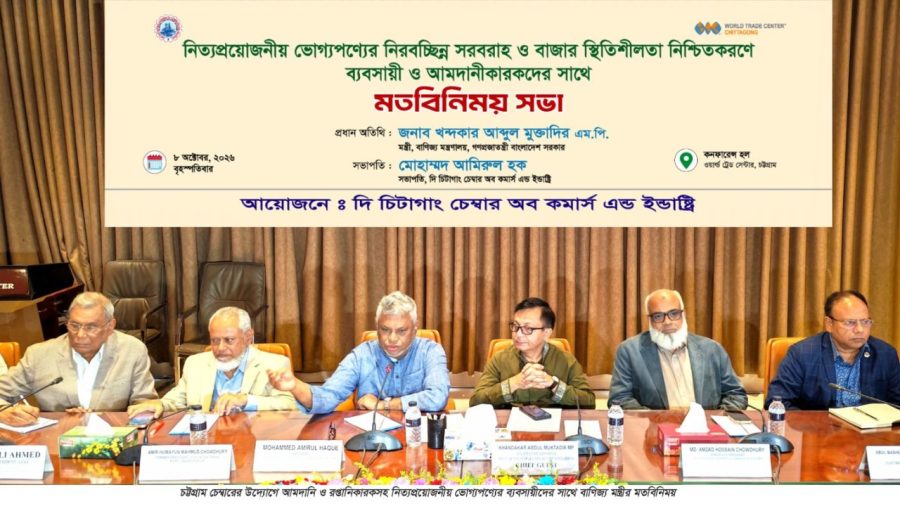
The minister made the remarks on Thursday at a meeting with importers and traders of essential consumer goods at the conference hall of the Chattogram World Trade Centre. The meeting was organised by the Chattogram Chamber of Commerce and Industry to discuss uninterrupted supplies of essential commodities and market stability.
The minister said the country currently has adequate stocks of essential commodities, including sugar, chickpeas, dates, onions and edible oil, ahead of the upcoming Ramadan.
“There is no shortage of essential commodities at present. In addition, consignments of imported goods are in the pipeline,” he said.
He warned that the government would take strict action against traders who deliberately or collectively attempt to increase commodity prices during Ramadan or at any other time.
Business services to go online
The Commerce Minister said the government was taking steps to improve the ease of doing business, adding that traders would no longer need to visit government offices to obtain trade licences, registration with the Registrar of Joint Stock Companies and Firms (RJSC), Import Registration Certificates (IRC), Export Registration Certificates (ERC) and import permits for agricultural products.

“These services will be made available online so that traders can obtain them from home with a single click,” he said.
Regarding complications faced by traders in importing bitumen and sodium sulphate, the minister said arrangements would be made to allow clearance of the two products based solely on Pre-Shipment Inspection (PSI) reports.
Market to be monitored every 15 days during Ramadan
Chattogram Chamber President Mohammed Amirul Haque said the business community would work in coordination with the government to ensure stable supplies and prices of essential commodities during Ramadan.
He said the import and supply situation of key commodities, including lentils, rice, chickpeas, wheat, soybean oil, palm oil and sugar, would be monitored regularly.




“Market conditions will be monitored through coordination meetings between the government and the business community every 15 days,” he said.
Highlighting longstanding problems in Chattogram’s logistics system, Mohammed Amirul Haque said the 13-tonne weight restriction on transporting goods from Chattogram via the Dhaka-Chattogram Highway was increasing transportation costs for businesses and ultimately pushing up commodity prices.
He called for the restriction to be lifted quickly to reduce the cost of transporting essential goods.
He also said complications surrounding the scheduling of lighter vessels and minimum freight rates were increasing import costs and putting additional pressure on the supply chain.
He urged the authorities to remove the minimum freight rate requirement and the mandatory scheduling system to address the problem.
Call to remove transport disparities
Former Chattogram Chamber President and Port Users Forum Chairman Amir Humayun Mahmud Chowdhury said businesses were being affected by disparities in transporting goods from Chattogram to other parts of the country.
He called for the issue to be resolved quickly and sought the Commerce Minister’s support for the rapid implementation of a Cargo Village at Shah Amanat International Airport in Chattogram, similar to facilities in Dhaka and Sylhet.
Former Chamber president Engineer Ali Ahmed stressed the need to strengthen the skills and expertise of Bangladesh’s negotiators involved in regional and bilateral trade agreements.
He said greater attention should be given to developing their capacity to protect Bangladesh’s interests in international and regional trade negotiations.
Chattogram Chamber Senior Vice-President Md Amjad Hossain Chowdhury sought the minister’s intervention to relax various banking conditions faced by the shipbreaking sector in importing scrap vessels.
Other speakers called for regular market monitoring to ensure uninterrupted supplies of essential commodities, stricter measures to prevent adulterated products and an end to unnecessary harassment of businesses by government agencies.
They also urged government agencies to make their services more business-friendly.
Directors of the Chattogram Chamber, importers, representatives of various business organisations and senior officials of government agencies were also present.