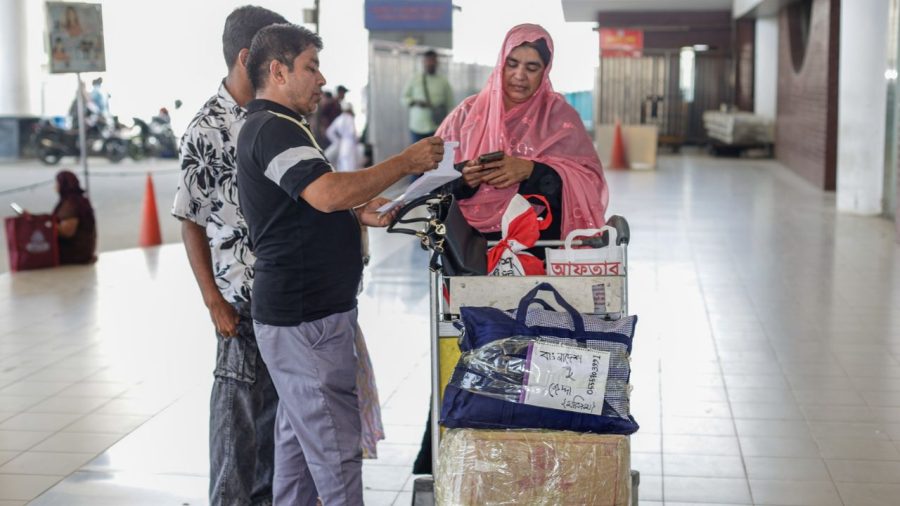



The escalating confrontation between Saudi Arabia and Yemen’s Iran-aligned Houthi rebels has disrupted 51 flights linking Bangladesh with Saudi Arabia and other international destinations, affecting around 5,500 passengers scheduled to travel from Dhaka.
The disruption comes as Saudi Arabia reported a fresh barrage of incoming fire on Monday, while Riyadh’s international airport remained closed following deadly attacks over the weekend.
Two Bangladeshis were among those killed in Saturday’s attack on King Khalid International Airport in Riyadh, while four others were critically injured, according to Bangladeshi officials.
The flight suspensions have created uncertainty for thousands of travellers, including those heading to Saudi Arabia for work, family, and religious purposes, as well as passengers hoping to use transit services.
In a statement issued on Monday afternoon, the Civil Aviation Authority of Bangladesh (CAAB) said 51 flights had been cancelled or suspended between Saturday night and Monday afternoon because of restrictions affecting operations at Saudi airports.
Of the affected flights, 12 were direct services to Saudi Arabia and 39 were international transit flights.
The direct flights included four operated by Biman Bangladesh Airlines, two by US-Bangla Airlines, three by Saudia and three by Riyadh Air.
Among the affected transit services, 16 were operated by IndiGo, nine by Emirates, five by Qatar Airways, five by Flydubai, three by SalamAir and one by EgyptAir.

Authorities said the disruption was no longer confined to direct flights between Bangladesh and Saudi Arabia, as restrictions on Saudi airspace and airport operations were also affecting international transit routes.
The cancellations and postponements have complicated travel arrangements for thousands of passengers, with no certainty over when normal operations will resume.
Bangladeshi travellers heading to Saudi Arabia have been left anxious as the disruptions threaten their employment plans and return journeys.
Shahadat Hossain, from Noakhali, was scheduled to fly to Saudi Arabia on Monday to take up his first overseas job. However, the disruption has forced him to postpone his journey.
“I left home with the dream of going to Dammam and starting my job this week. But now I am not sure when I will be able to travel, or whether I will be able to go at all, as my visa expires on 29 October,” he told TIMES.




If he cannot travel before his visa expires, he will have to renew it, potentially adding to the cost and uncertainty surrounding the new job.
Jasim Uddin, from Kaliakoir, has been living and working in Saudi Arabia for the past six years. He had returned to Bangladesh on holiday and was scheduled to fly back on Monday.
However, he found out that his flight had been cancelled only after arriving at the airport. He must now return home and await confirmation of when he can travel back to his workplace.
The Saudi-led coalition supporting government forces in Yemen reported incoming drones and missiles on Monday although there was no immediate confirmation of whether they had been intercepted.
The Houthis have intensified attacks on Saudi airports and oil facilities since last week as the confrontation spreads amid the wider regional conflict involving the United States and Iran.
The attacks have prompted restrictions on parts of Saudi airspace and disrupted operations at Riyadh airport, leaving the skies over the capital largely empty even as the city hosts a major energy conference.
Saudi Arabia faces a difficult security challenge as it seeks to counter Houthi advances around the strategically important Bab el-Mandeb Strait, a vital maritime passage connecting the Red Sea with the Gulf of Aden.
Yemeni military sources said forces backed by Riyadh had made some gains around the strait but remained under pressure on other fronts. They warned that efforts to weaken the Houthis could take time.
Iran, Saudi Arabia’s long-time regional rival and a backer of the Houthis, has offered to mediate between the group and the kingdom.
“We have repeatedly expressed our readiness to help facilitate dialogue between the parties,” Iranian Foreign Ministry spokesperson Esmaeil Baghaei said on Monday.
The offer came as Saudi Arabia intensified airstrikes against the Houthis. Yemeni television reported strikes in Al Jawf province on Monday.
Meanwhile, the Houthis have continued threatening Saudi airports, airspace and oil installations, central to the kingdom’s economy and ambitious development plans.
The United Arab Emirates called for renewed joint Gulf action on security and defence in response to the attacks.
Anwar Gargash, an adviser to the UAE president, said targeting Saudi Arabia undermined the security of all Gulf states. He argued that neglecting collective Gulf security had “emboldened others” to overreach against countries in the region.
Saudi Arabia and the UAE had worked together in Yemen for years but supported different factions within the coalition backing the Yemeni government, leading to tensions between the two countries.
US President Donald Trump said on Saturday that Washington was considering joining Saudi Arabia in strikes against the Houthis. No US military action had been confirmed as of Monday.
The attacks have caused one of the most significant disruptions to Saudi aviation in years, adding pressure to an industry already affected by regional conflict and rising jet fuel costs.
According to aviation analytics firm Cirium, 82% of scheduled flights at Riyadh airport had been cancelled by noon GMT on Monday, with the final proportion potentially higher. Cancellations across all Saudi airports had reached 46.4%, the firm said.
Flight-tracking data from Flightradar24 showed aircraft avoiding Riyadh, although planes continued crossing Saudi airspace and landing at Jeddah, the kingdom’s major aviation hub on the Red Sea coast.
For Bangladesh, the immediate concerns remain the safety of its nationals and the thousands of passengers whose travel plans have been disrupted.
With Saudi airport operations uncertain and attacks continuing, further cancellations and delays remain possible.