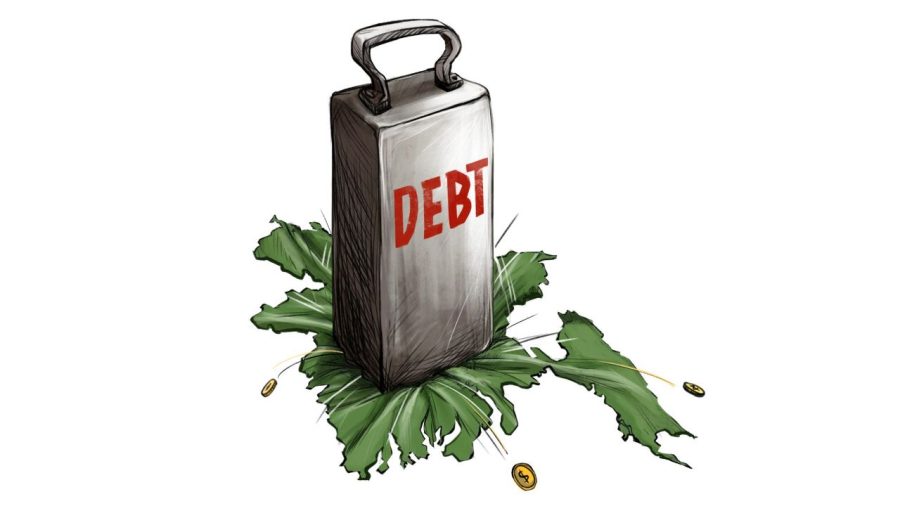



Bangladesh is borrowing more to pay its bills, repeatedly missing revenue targets and spending heavily to service past loans, raising fears that mounting debt could squeeze essential public spending and push the country towards a debt trap.
For the first time in four decades, the government borrowed to cover routine operating expenses in FY2024-25, a trend that worsened the following year. Borrowing, traditionally used to finance development, is increasingly covering day-to-day spending.
The strain is deepening as foreign debt repayments climb, new financing commitments shrink and reliance on domestic banks grows, even as private sector credit growth languishes below 5 per cent.
Economists disagreed on whether Bangladesh was approaching a debt trap but shared concerns over weak revenue collection, rising interest payments and persistent spending pressures.
A debt trap occurs when mounting repayment obligations force a country to borrow repeatedly to service existing loans, eroding fiscal flexibility and economic autonomy.
Former World Bank Dhaka Office Lead Economist Zahid Hussain told TIMES that Bangladesh was moving towards that position.
Centre for Policy Dialogue Distinguished Fellow Fahmida Khatun and Policy Exchange Bangladesh Chairman M Masrur Reaz acknowledged the risks but did not consider the country already heading towards a debt trap.
The warning signs are visible in the budget.
The government has targeted Tk695,000 crore in revenue against expenditure of Tk938,000 crore for FY27, with a deficit of Tk236,850 crore, equivalent to 3.5 per cent of gross domestic product (GDP).
The deficit is 21.5 per cent above the previous year’s revised Tk195,000 crore.
The National Board of Revenue collected Tk415,473 crore in FY2025-26 against a revised target of Tk503,000 crore, falling short by Tk87,527 crore.

Although collection rose 12.03 per cent from Tk370,875 crore a year earlier, the NBR must achieve over 45 per cent growth this fiscal year, compared to previous year’s actual collection, to meet its new target.
Persistent shortfalls are increasing borrowing requirements.
Interest payments alone are budgeted at Tk127,500 crore, including Tk105,000 crore on domestic debt and Tk22,500 crore on foreign loans, leaving less for education, healthcare, infrastructure and productive investment.
Zahid Hussain warned that existing revenue could not adequately cover expanding government commitments, particularly if new spending obligations arose.
The new government pay scale would add at least Tk106,000 crore to operating expenditure in coming fiscal years, following partial implementation this year. Costs could rise further if state-owned enterprise employees and teachers covered by monthly payment orders are included.
“Debt could grow faster than the economy if borrowing costs exceeded economic growth while substantial fiscal deficits persisted,” Zahid Hussain warned.
International Monetary Fund (IMF) data show Bangladesh’s general government gross debt rising to 41.8 per cent of GDP in 2026 from 27.7 per cent a decade earlier, with the ratio projected to reach 48.8 per cent by 2031.
The current ratio remains below Pakistan’s roughly 70 per cent, India’s 83.4 per cent and the levels exceeding 100 per cent in the United States and China, but above the approximately 27–30 per cent recorded in Cambodia and Vietnam.



Yet the headroom for more debt does not determine repayment capacity. It depends on government revenue, borrowing costs, repayment schedules and foreign currency availability.
Masrur Reaz argued that the central problem was not an exceptionally high debt ratio but limited repayment capacity, with foreign loan obligations competing for dollars needed to import fuel, industrial raw materials and intermediate goods.
Bangladesh Bank reported government foreign debt at $95.1 billion at the end of June 2026, up from $93.74 billion a year earlier.
Provisional Economic Relations Division figures show external debt servicing rose nearly 10 per cent to $4.49 billion in FY2025-26 from $4.09 billion the previous year.
Meanwhile, new foreign assistance commitments plunged 37 per cent to $5.24 billion, their lowest level in 12 years, while disbursements fell to $8.07 billion from $8.57 billion.
Net foreign assistance inflows after repayments consequently narrowed about 20 per cent to $3.58 billion from $4.48 billion.
Masrur Reaz estimated annual external debt servicing had approached $5 billion, with total government interest payments close to $10 billion.
He blamed the deterioration partly on nearly two decades of unfinished revenue reforms, weak expenditure management, corruption and waste.
“Between FY15 and FY24, successive governments undertook numerous development projects, some necessary but others premature, unnecessary or inflated,” he said.
Heavy borrowing financed many without consistently generating sufficient economic benefits, leaving mounting liabilities without adequate revenue.
“Infrastructure borrowing could support growth if projects generated returns justifying their costs,” Masrur Reaz said.
That concern matters as Bangladesh now seeks $6.47 billion in foreign financing for 13 proposed projects, including six-laning the Dhaka-Chattogram highway, MRT Line-2 and purchasing 300 electric buses.
The projects have a combined estimated cost of Tk1,06,439 crore, including Tk79,583 crore in proposed foreign financing. Their fiscal impact will depend on borrowing terms, implementation efficiency and economic returns.
Domestic borrowing is also mounting. Government net borrowing from banks surged to Tk1,65,538 crore in FY26, exceeding the revised Tk118,000 crore target by Tk47,538 crore, according to Bangladesh Bank.
Government credit grew 30 per cent during the fiscal year, against private sector credit growth of just 4.47 per cent.
For FY27, the government has targeted Tk1,12,000 crore in net bank borrowing, a limit dependent on revenue performance, spending controls and external financing.
Foreign borrowing is also becoming costlier and more complicated. The government last week approved $3.3 billion in non-concessional external loans, including $3.1 billion for fuel oil and liquefied natural gas imports and $200 million for electricity distribution improvements.
The fuel financing, arranged through the International Islamic Trade Finance Corporation, carries a six-month tenure and interest linked to the six-month Term Secured Overnight Financing Rate (SOFR) plus 1.70 percentage points.
Such loans can secure essential energy supplies, but short maturities increase repayment and refinancing pressures.
Reaz argued that Bangladesh could not simply stop borrowing.
He recommended restricting new foreign loans over the next two to three years to projects delivering substantial economic or human-capital returns, expanding productive capacity or preventing significant losses if delayed.
He favoured concessional loans with lower interest rates and longer repayment periods, alongside a comprehensive review of public finances and a three-to-five-year debt-management strategy focused on revenue reforms, efficient spending and rigorous project selection.
Fahmida Khatun maintained that Bangladesh had not yet entered a debt trap but warned that rising interest obligations threatened essential public services.
She recommended broadening the tax base, improving compliance, cutting low-priority spending and targeting subsidies more effectively.
“Delaying reforms may weaken investor confidence and complicate financing access,” she cautioned.
According to the economists, every additional taka spent servicing debt leaves less for schools, hospitals, energy infrastructure and growth-supporting investment.
Slower growth, in turn, makes existing obligations harder to manage.
The economists argued that Bangladesh’s challenge was not simply how much it owed but whether its economy and revenue system could sustain those obligations.
The country still has room to borrow, but that flexibility is narrowing as repayments rise, revenue targets are missed and borrowing increasingly finances existing commitments rather than productive investment.
Avoiding a debt trap will require stronger revenue collection, tighter spending discipline and borrowing that delivers measurable economic returns.
Without those reforms, the government risks spending an ever-greater share of its resources paying for yesterday’s borrowing rather than financing tomorrow’s growth.