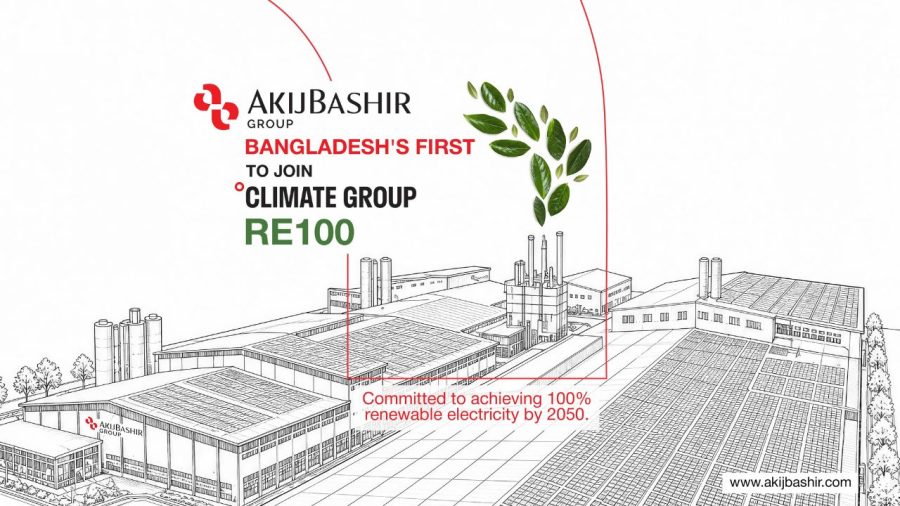



AkijBashir Group has become the first Bangladeshi company to join RE100, taking its growing investments in solar power, battery storage and waste-heat recovery into a global corporate framework for 100 per cent renewable electricity.
The conglomerate has already developed around 90 MW of solar generation capacity across the group’s particle board, ceramics, glass and other manufacturing facilities, giving it one of the most visible industrial renewable-energy footprints in Bangladesh, AkijBashir said on Thursday.
RE100, led by international non-profit Climate Group, brings together more than 400 businesses committed to using 100 per cent renewable electricity by 2050 at the latest.
Members report progress annually and their renewable-electricity claims are assessed against the initiative’s technical criteria.
For AkijBashir, joining RE100 turns a series of factory-level energy projects into a more structured long-term transition.
The membership gives the group a framework to measure renewable-electricity sourcing, benchmark progress against international practice and strengthen accountability to customers, partners and other stakeholders.

It also provides access to peer learning, technical expertise, policy engagement and international best practice.
The company’s renewable-energy push is already spread across several of its major industrial operations.
At Akij Ceramics in Trishal, a 24.39-megawatt-peak rooftop solar project is expected to generate about 28,050 megawatt-hours of electricity annually and cut carbon dioxide emissions by around 22,440 tonnes a year.
Of the total capacity, 10 MW has been connected to the national grid through net metering, allowing electricity generated at the factory to support both its own operations and the wider power system.




AkijBashir Glass in Habiganj has installed an 18.2 MW rooftop solar system supported by battery storage, enabling the factory to use solar-generated electricity beyond daylight hours and reduce exposure to load-shedding.
The plant also uses waste-heat recovery. Heat generated by the glass-melting process is recovered to produce steam and electricity, improving efficiency in one of the group’s more energy-intensive operations.
AkijBashir says renewable sources now account for 71 per cent of the glass facility’s energy.
At Janata Jute Mills, rooftop solar meets the mill’s full electricity demand, supported by battery storage that extends renewable-energy use beyond daytime generation.
Akij Particle Board Mills has installed an 8.1-megawatt-peak rooftop solar photovoltaic system expected to generate around 9.3 million kilowatt-hours of clean electricity annually and avoid about 7,452 tonnes of carbon dioxide emissions a year.
The group has also worked with Infrastructure Development Company Limited on renewable-energy and energy-efficiency projects, while its factories are expanding measures including waste-heat recovery, water reuse, net metering and more efficient production technologies.
The investments serve two purposes for the industrial group: cutting emissions and improving energy security.
Battery storage allows factories to use more solar power outside generation hours, while waste-heat recovery captures energy that would otherwise be lost.
Net metering offers another route for large industrial solar installations to interact with the national grid.
AkijBashir Managing Director Sk Bashir Uddin said the RE100 membership was intended to go beyond a reporting commitment.
“Joining RE100 is more than a renewable energy commitment for AkijBashir Group. It is a step towards transforming how we power our business and build sustainable growth,” he said.
He said becoming Bangladesh’s first RE100 member reflected the group’s aim to move towards 100 per cent renewable electricity while contributing to a cleaner and more resilient energy future for the country.
AkijBashir also hopes the move will encourage other businesses and industries to accelerate their shift towards renewable energy.
The group operates across ceramics, glass, jute, tableware, bathware, cables, biax films, doors, steel buildings and board industries.
For a diversified manufacturer with energy-intensive businesses, the RE100 commitment now puts a global benchmark around investments that had until now largely been developing plant by plant.
AkijBashir said it would continue expanding renewable energy, efficiency and resource-conservation initiatives as part of its broader “Beyond Tomorrow” approach to industrial growth.