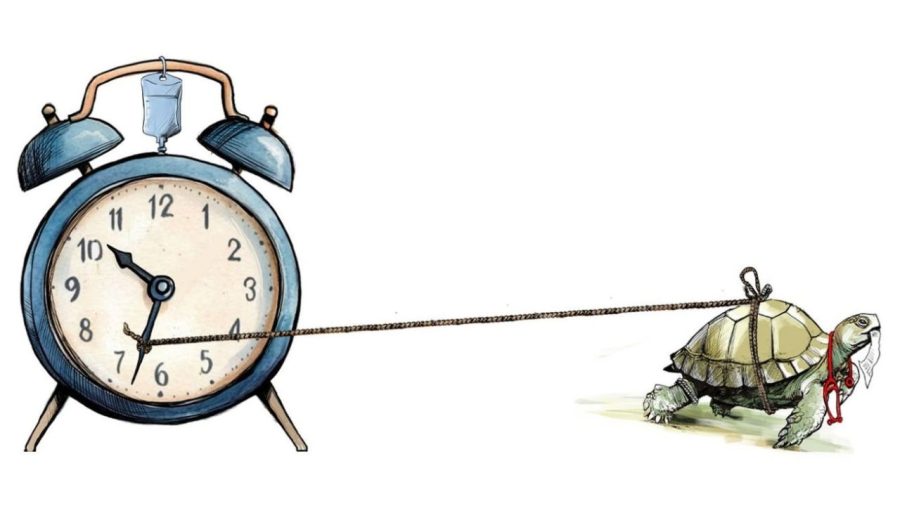



Dhaka Medical College Hospital has two CT scan machines. One has been out of service for four months, reportedly, after rats chewed through a cable.
The cable costs around Tk20,000, but the hospital cannot replace it on its own — a small repair caught in a much larger bureaucratic rigmarole.
The radiology department wrote to the hospital’s then director, Asaduzzaman, who forwarded the matter to the Directorate General of Health Services. From there, it went to the ministry. No one knows how much longer the process will take.
Mohammad Nazrul Islam, head of the radiology department, said the hospital has no direct contract with the supplier and, therefore, cannot deal with the company itself.
Sometimes, he said, machines remain out of service for two to four years, eventually deteriorating beyond repair.
The Power and Participation Research Centre (PPRC) said in a report on 29 July that 52 per cent of diagnostic equipment at government hospitals surveyed had not been used in the previous year.
The finding was based on a survey of 22 government health facilities, including district hospitals, upazila hospitals and medical college hospitals.
The breakdowns also put pressure on machines that remain operational.
Mahfuza Mahmud, a teacher in the radiology department, said, “A machine has the capacity to conduct 25 tests a day. But since we have to test many more patients, the functioning machines, facing overuse, become inoperative.”
Nazrul told TIMES, “Since the companies do not receive money directly from the hospital, they do not come here. If the hospital repairs the machine, the warranty becomes void. If a bigger problem occurs later, the company will no longer repair it, so no one wants to take that risk.”

Asked why companies do not respond, he said, “There isn’t a specific person in a government institution with the authority to give a direct command. As a result, companies do not take anyone’s instructions seriously. But in a private institution, if the owner informs them, they are compelled to provide service.”
The process becomes even longer and convoluted at district hospitals, where more offices are involved. At the upazila level, another one or two layers can be added.
Consequently, patients are forced to seek care at private facilities.
Public health expert Mohammad Mushtaq Hossain linked the “repair bureaucracy” to complex administrative structures inherited from the colonial period.
He told TIMES, “Many of the administrative rules still followed in the country are connected to structures dating from the British period. As the British distrusted Indians and often regarded them as ‘thieves’, there was a tendency within the colonial administration to monopolise authority.”
As a continuation of that mindset, many decisions are still delayed, lamented the expert.
Mushtaq said hospitals should be given greater autonomy to make decisions as per their needs and purchase or repair necessary equipment.


PPRC Executive Chairman Hossain Zillur Rahman also said the problem went beyond budget shortages. He recommended creating a professional health management structure for hospitals and further decentralising financial authority.
There are examples showing that local initiatives can expedite repairs.
When a biochemistry analyser used for diabetes testing at Rangamati Upazila Health Complex broke down, a letter was sent to the Directorate General of Health Services.
After no response came for four months, an official arranged for the machine to be sent to NEMEMW in Dhaka, where it was repaired within two days.
Nurul Islam, a director of hospitals at the Directorate General of Health Services, told TIMES, “To obtain warranty benefits for repairs of broken equipment, the relevant supplier has to be contacted by letter. These machines are supposed to be repaired from their own funds.”
He contends service disruptions caused by breakdowns would be difficult to overcome unless Bangladesh develops the capacity to manufacture heavy medical equipment domestically.
Grim picture at major Dhaka hospitals
The same pattern is evident across major public hospitals in Dhaka, where diagnostic equipment is insufficient with a significant number of available machines inoperative.
At Dhaka Medical, four out of 10 X-ray machines, one of two MRI machines and three of 10 ultrasonography machines are out of order.
Its Cath lab has also been out of service for three months, halting coronary angiograms, angioplasty and stent placement.
At Shaheed Suhrawardy Medical College Hospital, the MRI machine has been broken for four years, vitamin D testing kits have run out and two of five X-ray machines are out of order.
Of the 168 types of tests at the hospital, 55 are not performed, even as the 950-bed facility accommodates between 2,400 and 2,700 admitted patients a day.
At the National Centre for Control of Rheumatic Fever and Heart Diseases, four out of 45 types of tests are unavailable: urine RME, urine culture and sensitivity, throat swab culture and sensitivity, and ECG.
The National Institute of Kidney Diseases and Urology lacks a displayed list of available tests; a help-desk employee said it was taken down and will be restored later but could not say when.
At Dhaka Medical’s chest diseases department, space and equipment shortages add to the pressure.
The department has 25 beds, but the number of critically ill patients often exceeds capacity, forcing doctors to prioritise admissions.
Inadequate ventilation worsens breathing problems during hot weather, while the sleep lab has been out of service for six months.
Patients have to bear higher costs
When diagnostic equipment at government hospitals remains broken, brokers for private diagnostic centres become active, taking patients to clinics with offers of discounts.
Saiful Islam, the doctor in charge of the chest diseases department at Dhaka Medical, said equipment shortages often force doctors to send patients outside for tests.
A CT scan costs Tk1,000 to Tk2,000 at a government hospital, compared with Tk5,500 to Tk11,000 at a private facility.
An MRI costs Tk2,000 at Suhrawardy Hospital but Tk7,000 to Tk9,000 at nearby private centres.
The government fee for a vitamin D test is Tk2,000. Due to unavailability of kits, patients have to pay Tk4,000 outside.
An angiogram, including medicines, costs Tk5,000 to Tk6,000 at a government hospital, compared with Tk18,000 to Tk25,000 at a private facility.
An inoperative government machine means loss of service, resulting in soaring treatment costs for patients.
The problem is compounded by a shortage of skilled staff.
Of the 6,406 approved medical technologist posts under the Ministry of Health and Family Welfare, 3,892 are filled, leaving around 40 per cent vacant.
Vacancies stand at 27 per cent at upazila health complexes, 12 per cent at district hospitals and 36 per cent at medical colleges and specialised hospitals.
Consequently, some hospitals have modern equipment which cannot be operated due to lack of skilled workers.