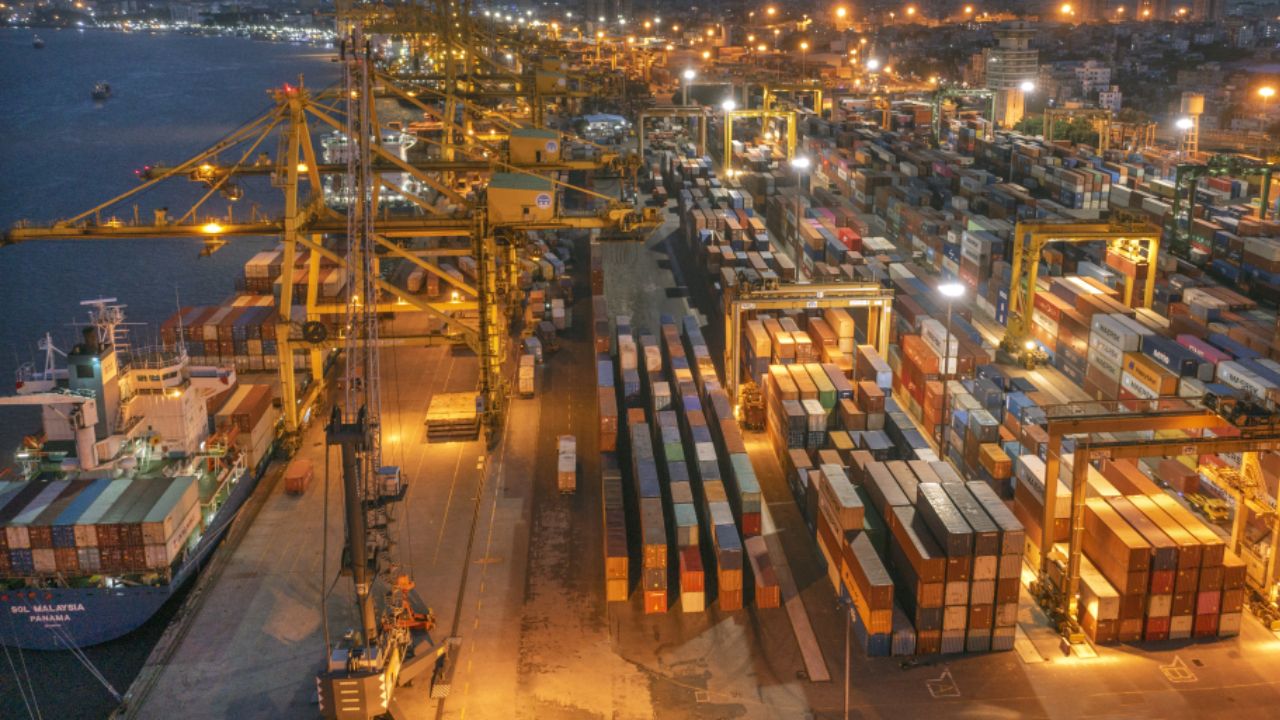

The Chattogram Port Authority (CPA) has renewed its call for empty shipping containers to be stored in non-bonded areas without customs bond licences, saying existing rules are worsening yard congestion and slowing operations.
The CPA sought approval from the National Board of Revenue (NBR) in a letter on 26 July but has received no decision. With the issue unresolved, the Chittagong Chamber of Commerce and Industry (CCCI) has asked Finance and Planning Minister Amir Khosru Mahmud Chowdhury to intervene.
In a 30 July letter, CCCI President Mohammed Amirul Haque urged the minister to direct the NBR and other relevant authorities to act immediately, saying the growing volume of empty containers was undermining the operational efficiency of the country’s principal seaport.
Shipping agents and main line operators (MLOs) have also separately urged the NBR to amend the existing system.
According to a letter signed by CPA Secretary Syed Refayet Hamim, all imported less-than-container-load (LCL) cargo is destuffed inside the port, while nearly 70 per cent of full-container-load (FCL) cargo is opened, inspected and delivered within the port premises. This leaves thousands of empty containers accumulating in the yard every day.

The containers often remain at the port for long periods while awaiting export or transfer to private inland container depots (ICDs). As they are not removed as quickly as they are generated, they occupy valuable yard space, reduce operational capacity and slow cargo handling. Private ICDs face a similar situation, the letter said.
CPA calls restriction outdated
Under existing customs rules, empty containers cannot be stored outside bonded facilities. The CPA says the restriction is outdated, noting that shipping lines in many countries, including neighbouring India, may store empty containers in designated non-bonded areas under their own management.
It believes a similar system in Bangladesh would reduce pressure on the port, improve yard use and accelerate container handling. The CPA made a similar proposal to the NBR on 13 October last year, but no policy decision followed.



Recent figures reflect the growing congestion. As of 30 July, Chattogram’s 21 private ICDs were holding around 55,940 TEUs of empty containers. At Chattogram Port, the number rose from 2,170 TEUs on 28 July to 2,670 TEUs on 29 July, adding pressure on already limited yard space.
Low charges discourage removal
Industry stakeholders say low storage costs are compounding the problem. Chattogram Port charges $6.90 to store a 20-foot empty container for seven days and $13.80 for a 40-foot container. Private off-docks charge Tk100 a day for a 20-foot container and Tk200 for a 40-foot container.
Sector insiders say the comparatively low charges give foreign shipping lines little financial incentive to remove empty containers promptly. As a result, Bangladesh is increasingly being used as a long-term storage location for surplus containers.
In its letter to the finance minister, the Chamber warned that although nearly 90 per cent of Bangladesh’s international trade passes through Chattogram Port, pressure from empty containers is limiting its productivity.
It cited several structural causes, including the long-standing imbalance between imports and exports, stronger demand for 40-foot containers than 20-foot units, and disruptions caused by natural disasters, heavy rainfall and labour unrest.
The Chamber also said there had been no indication of what action, if any, the NBR had taken despite repeated requests from the port authority and shipping agents.
Import-export gap widens backlog
Mohammed Amirul Haque told TIMES of Bangladesh that India and Vietnam already allow empty containers to be stored in non-bonded areas, giving their ports greater operational flexibility.
“Bangladesh wants to compete with countries like Vietnam and Singapore in international trade, but our shipping sector is not being given the same operational facilities,” he said.
Data from main line operators show that Bangladesh receives between 105,000 and 170,000 import containers each month, while only 60,000 to 70,000 export containers leave during the same period.
The imbalance leaves tens of thousands of containers empty and awaiting repositioning. CPA Secretary Syed Refayet Hamim said the authority had yet to receive an official response from the NBR on its latest proposal. Attempts to contact Acting NBR Chairman Ahsan Habib for comment were unsuccessful.