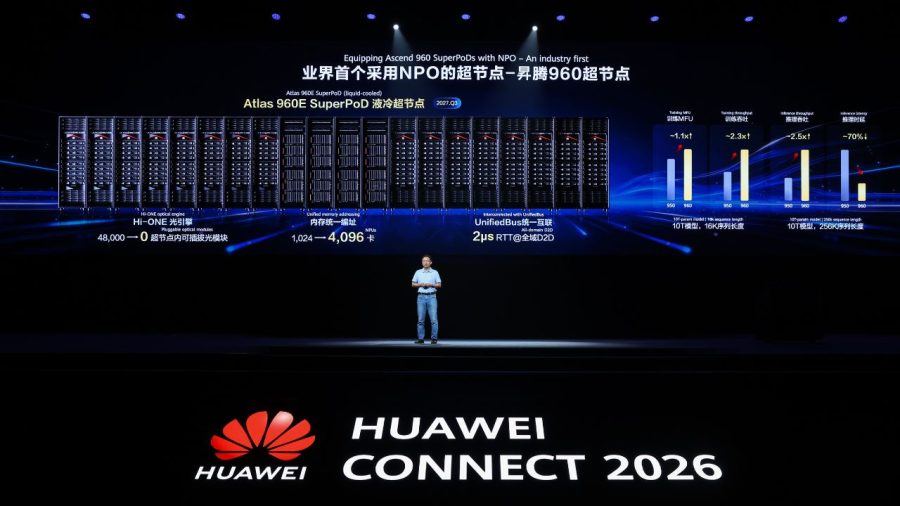

Huawei has recently launched Atlas 960E SuperPoD, an AI computing solution designed to support the growing demand for large-scale artificial intelligence applications.
The solution was unveiled at HUAWEI CONNECT 2026 in Shanghai by David Wang, Deputy Chairman of the Board and Rotating Chairman of Huawei, during his keynote address on advancing the intelligent world, said a press release on Tuesday.
The event was held under the theme “Advancing the Agentic World” and brought together industry leaders, customers, partners and technology experts to discuss the role of AI, digital connectivity and collaboration in creating a more intelligent and productive future.

Huawei said the Atlas 960E SuperPoD is designed to support the development and operation of advanced AI models. It offers strong computing performance, improved energy efficiency and reliable system operations, helping organisations build and manage AI infrastructure more effectively.
Alongside it, Huawei launched the Atlas 950 SuperPoD. The SuperPoD-based SuperClusters are the first-generation products built on Huawei’s Peerium Computing Architecture, designed to enable one million processors to work together as a single computer.




The lineup also includes the upgraded TaiShan 950 SuperPoD for general computing and OceanStor M900, a storage solution designed to support AI-related data needs. Huawei said these solutions aim to help industries manage increasing data demands and accelerate the practical adoption of AI.
Huawei also announced that its CANN platform is now open source, enabling developers, partners and the wider technology community to contribute to and benefit from AI innovation.
“At Huawei, we are committed to building powerful AI infrastructure and promoting open-source and open systems to strengthen the computing ecosystem,” Wang said. “We will continue to work with partners to support AI innovation and advance the intelligent world.”
Huawei said it continues to work with customers and partners across industries, including telecommunications, finance, manufacturing, energy, transportation, public services and education, to support digital transformation and build a more connected and intelligent future.